

Blog Preview
The Scope of Laboratory Careers in India careers in India is expanding fast as diagnostic testing becomes a routine part of healthcare. Here is what that growth actually means for job-seekers.
Key Takeaways
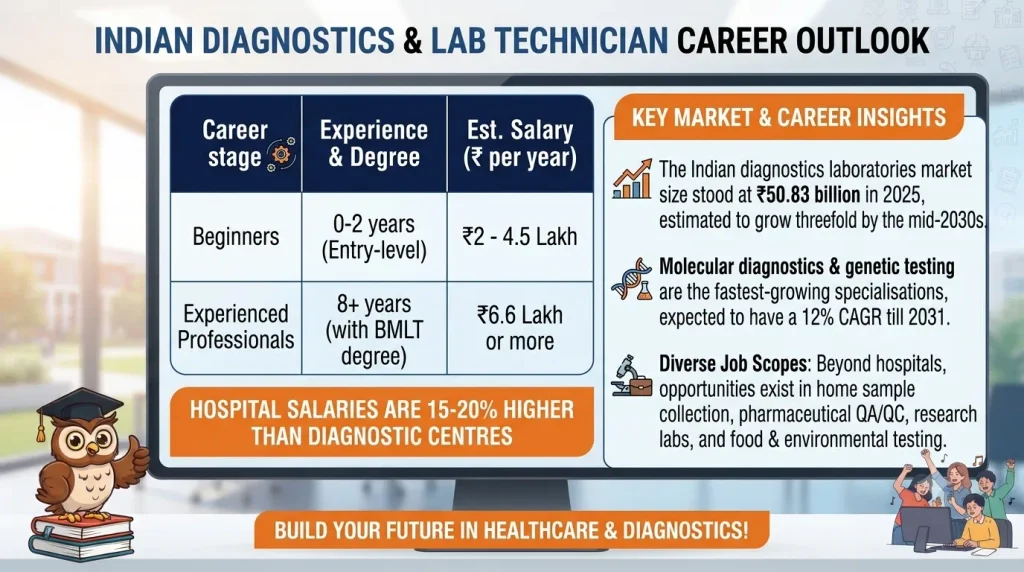
- The Indian diagnostics laboratories market size stood at ₹50.83 billion (USD) in 2025 and is estimated to grow threefold by the mid-2030s.
- Beginners in the lab technician career can earn ₹2-4.5 lakh per year, while professionals with 8 or more years of experience and holding a BMLT degree can earn ₹6.6 lakh.
- Lab technician salaries in hospitals are 15-20% higher compared to the diagnostics centres.
- Molecular diagnostics & genetic testing are the fastest-growing specialisations and are expected to have a 12% CAGR till 2031.
- Apart from hospitals, there are plenty of other job scopes, including home collection of samples, pharmaceutical QA/QC, research labs, and food environment testing.
Short Summary
Laboratory careers for students studied in best colleges for medical laboratory science in Tamil Nadu, India, have become increasingly lucrative due to the growing diagnostics industry, which, according to industry experts, is worth about USD 50 billion in 2025 and would be increasing at a compound annual growth rate of more than 11% throughout the decade.
Entry-level lab technicians earn around ₹2-4.5 lakh annually and earn significantly higher salaries with BMLT degrees, hospital experience, and specialisation in molecular or genetic diagnostics.
The factors responsible for the increased demand include increasing diagnostic chains, preventive health screenings, and the prevalence of chronic diseases.
Understanding the Growing Scope of Laboratory Careers in India
Each of the millions of blood tests, biopsy reports, and swab tests conducted during the pandemic era had one thing in common: they all went through the hands of a lab professional. but the profession of lab technicians is not as much in the limelight as that of doctors and researchers.
There have been huge changes in the field of laboratory careers in India, with the diagnostic tests moving from being a necessity into preventive health care, with the industry reports estimating the Indian diagnostics laboratory market at around USD 50.83 billion in 2025, growing almost three times till the mid-2030s.
Science graduates have an increasing number of career opportunities in the laboratory sector, with demand in this profession driven more by practical skills than theoretical studies over years, which makes lab technician jobs recession-proof.
This blog will discuss what drives this demand, pay for different jobs in the laboratory domain and how you can make a successful career in this field.
Why the Scope of Laboratory Careers in India Is Expanding
The primary factor responsible for this surge is simply the expansion of diagnostic infrastructure itself. Big diagnostic groups like Dr Lal PathLabs, SRL Diagnostics, and Metropolis Healthcare keep establishing new laboratories in Tier 2 & Tier 3 cities, along with corporate hospitals upgrading their pathology facilities.
Both these things mean that more technicians and analysts are hired. But besides this, there is also a change in the behaviour of patients due to an increased awareness about health, where people have started going for regular blood tests, screening packages, and other checkups, as opposed to only when they develop symptoms.
The trends in diseases are further strengthening this scenario. Non-communicable diseases form 60% of total deaths in the country according to the data provided by the Ministry of Health and Family Welfare. It needs regular surveillance, screening, and testing, which cannot be done in a one-off manner but requires regular monitoring, tasks that keep the labs working on a large scale.
The technology in the industry is also becoming modernised with increasing adoption of AI-enabled image analysis, automation of pathology workflow, and LIS in India’s diagnostic laboratories, while molecular diagnostics is growing at the highest pace of 12% CAGR until 2031 compared to other segments of the in vitro diagnostics market.
The adoption of technology does not mean that the laboratories will replace the staff; instead, it will increase their requirement due to the increasing requirement of skilled technicians.
What Does a Laboratory Career in India Actually Pay?
The salaries of laboratory technicians differ based on the source and nature of employment and their qualifications; therefore, it would be better to understand the trend rather than just focus on the numbers.
Starting with the initial level of employment, where technicians with experience ranging from one year up to three years get paid approximately ₹4-4.5 lakhs annually.
The salary range for freshers differs between ₹2 and ₹5 lakhs according to the company and city. On the other hand, technicians having more than eight years of experience earn a salary of ₹6.6 lakhs or above.
Formal education increases the salaries of technicians considerably; the ones holding a bachelor’s degree in medical laboratory technology (BMLT) earn more than those with a diploma in medical laboratory technology (DMLT).
The place where one is working also holds more importance than what many students think. Lab technicians working for hospitals get 15-20% more pay as compared to those employed by diagnostic centres, mainly due to complicated tests and shifts that are performed in a hospital setup.
Whereas diagnostic chains and bigger companies pay better performance bonuses as compared to smaller and independent laboratories.
On the other hand, jobs at government hospitals have lower pay, but the advantage of a fixed scale of pay and job stability can be taken into consideration based on personal preferences.
These figures are not exact but give a fair idea about what pay one can expect from a laboratory technician’s job.
Which Sectors Are Hiring Laboratory Professionals?
For the moment, hospitals continue to be the biggest and most consistent employers of laboratory professionals in India.
The country has huge chains of hospitals like Apollo Hospitals and Fortis Healthcare, which operate laboratories in all the hospitals that they have in operation.
A relatively recent but actually emerging category has been the one of home sample collection, as e-diagnostic firms have created an entirely new field for laboratory professionals.
In addition to conducting tests on patients, laboratory technicians are employed by pharmaceutical and biotech firms to conduct quality control and quality assurance tests to ensure that the drugs manufactured are safe for consumption prior to their release into the market.
Laboratory technicians can also get employment in research laboratories, especially if their interest is in research-orientated careers, whereas other places of employment include food testing laboratories and environmental laboratories.
Career Roles Within the Laboratory Sciences
A laboratory career consists of several related jobs that vary in skills required. Lab technicians deal with the everyday work of sample testing and analysis and serve as an entry point for many graduates.
Medical laboratory technologists usually hold a BMLT degree and perform more advanced tests, control the quality of results and sometimes manage lab technicians’ work.
R&D lab technicians assist scientists in conducting research in pharma, biotech or university labs in experiments not connected to everyday testing.
The career path within this area is relatively straightforward and skills-based; a lab tech who develops his or her expertise in molecular diagnostics, genetic testing or automated LIS systems, the fastest-growing and most cutting-edge components of the industry, is likely to advance quicker and receive more pay raises than a technician who sticks to routine testing.
Preparing Laboratory Professionals for a Growing Industry at Takshashila University
The scope of laboratory at Takshashila University is founded upon exactly the same demand dynamics within this sector, an ever-growing diagnostics industry that is increasingly modernising in terms of technology and is increasingly valuing qualified and professionally trained personnel more than those who were not formally trained.
The curriculum of such programmes consists of fundamental concepts of laboratory science together with practical experience of working with modern diagnostic methods, tools and quality standards.
Through organised laboratory training and practical experience, as well as placement assistance linked with hospitals and diagnostics companies, laboratory science programmes at Takshashila University can help students enter a field where the demand for professionally trained specialists continues to grow faster than their supply.
To wrap up
The scope of laboratory is based on real growth in the form of an increasing diagnostics industry, the increasing burden of chronic diseases, and the move to preventive healthcare, which isn’t likely to go away any time soon.
This means that for science graduates, there is a stable, skill-based career path available to them, with clear ways to increase their earning potential through qualification, specialisation, and choice of employer. get you have any idaea about the Scope of Anaesthesia and Operation Theatre Technology in India read this blog
Ready to Get Your Start in Laboratory Careers?
Laboratory careers in India have scope that is most rapidly expanding for those with recognised qualifications and practical training experience. Looking for admissions news, fest alerts, and academic highlights? Follow our official page @takshila university so you never miss an update
Takshashila University offers a diverse range of healthcare and allied health science programmes designed to prepare students for various careers in the healthcare sector. Students can explore undergraduate programmes such as Bachelor of Cardiovascular Technology, Bachelor of Medical Laboratory Science, Bachelor of Emergency Medical Technologist, Bachelor of Anaesthesia and OT Technology, and Bachelor of Nutrition and Dietetics.
The university also offers specialised programmes such as Bachelor of Optometry, Bachelor of Applied Psychology and Behavioral Health, Bachelor of Medical and Psychiatric Social Work, Bachelor of Medical Radiology and Imaging Technology, and Bachelor of Physician Associates. Other options include Bachelor of Dialysis Therapy Technology, Bachelor of Respiratory Technology, B.Sc. Health Information Management, and Bachelor of Cardiac Perfusion Technology. For students looking to pursue advanced studies, the university also provides the Master of Physician Associates programme. These programmes offer students opportunities to explore different healthcare specialisations and develop the knowledge and skills required for careers in the medical and allied health sectors.
Frequently Asked Questions for Scope of Laboratory
Q1. What is the scope of laboratory careers in India currently?
The scope of laboratory careers in India is currently expanding gradually due to the increasing number of diagnostics laboratories worth approximately USD 50 billion in 2025, with an annual growth rate of above 11%.
Q2. What is the salary of a lab technician in India?
An experienced lab technician who has been working for more than 8 years is paid more than ₹6.6 lakh annually.
Q3. Is it true that BMLT pays better than a DMLT?
Yes, it is true that BMLT pays better because the average annual salary is considerably high compared to DMLT.
Q4. What are the best employers when it comes to pay for lab technicians?
Laboratory technicians working in hospitals earn around 15-20% more than those who work in standalone diagnostics labs, whereas private diagnostic chains have more performance-orientated growth opportunities compared to independent labs.
Q5. Is a laboratory a safe career?
Yes, healthcare diagnostics is definitely a recession-proof industry, and increasing numbers of patients with chronic diseases and preventive care trends will ensure steady job opportunities for trained laboratory technicians.
Q6. What qualifications are required for having a career in the laboratory?
Skilfulness in performing the tests, knowledge of laboratory information systems, strict adherence to safety and infection control practices, and knowledge of automated or artificial intelligence diagnosis techniques.
Q7. Is there any chance of working outside hospital/clinical laboratories for laboratory scientists?
Yes, because laboratory scientists have a chance to become quality controllers in pharmaceutical and biotechnological firms, researchers in research organisations, and testers in food and environmental laboratories.
Q8. Which specialisation in laboratories is most promising for the future?
The fastest-growing sectors of the diagnostics industry are molecular diagnostics and genetic testing, and such technicians usually enjoy higher salaries and career progression rates.
Q9. Is working on home sample collection a viable career choice?
Yes, the advent of e-diagnostics firms providing blood sample collection at home has created a new field in laboratory jobs.
Q10. What is the preparation of Takshashila University for laboratory professionals?
It provides a laboratory science programme that includes fundamentals of science and diagnosis.