The demand for artificial intelligence professionals is altering India’s jobs market at a pace that is more rapid than what any degree cycle is able to adapt to. Here’s why it has big implications for engineers of the future.
Short Summary
There has been a huge demand for artificial intelligence professionals in India.
The market of analytics in India is forecasted to reach USD 16 billion by 2027, while the requirement of students studying in artificial intelligence colleges and data science in Tamil Nadu is forecasted to exceed one million in the industry.
Why the Demand for Artificial Intelligence Is Reshaping India’s Job Market
Ten years ago, artificial intelligence would have seemed like an offshoot of science fiction films. Today, AI picks the product you get through your shopping application, routes your food delivery, and approves your loan applications in less than a minute.
Such is the rise in the demand for artificial intelligence professionals that colleges, employers, and even government policy have been trying to cope with it.
For a student who is at the fork of deciding between the streams of engineering, such statistics do not only indicate a fact; they are more of a signal. It is not about the college students of computer sciences anymore; the employers are looking out for individuals who know all about data, machine learning, and applied AI.
India currently ranks 1st globally in AI skill penetration, according to NASSCOM, and its AI/data science workforce is projected to grow to 1.25 million professionals by 2027.
This blog addresses why there is such a demand, what the figures look like, and how a student can make a career out of it.
It pays to know where this demand actually comes from, rather than thinking about AI jobs as one single concept. According to the jobs Report 2025, AI and big data analysts, together with FinTech engineers and machine learning specialists, represent the fastest-growing professional segments globally.
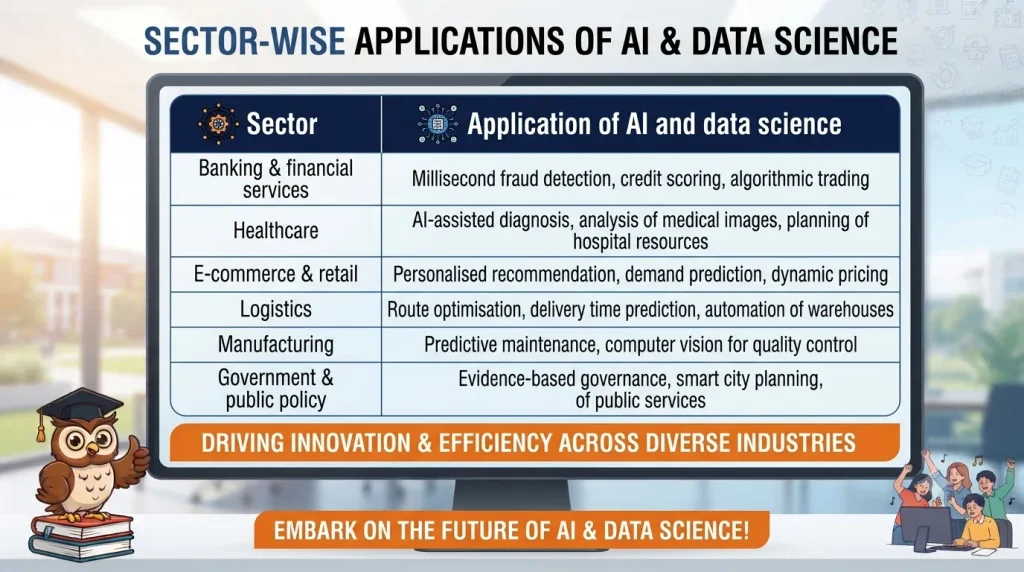
| Sector | Application of AI and data science |
| Banking & financial services | Millisecond fraud detection, credit scoring, algorithm trading |
| Healthcare | AI-assisted diagnosis, analysis of medical images, planning of hospital resources |
| E-commerce & retail | Personalised recommendation, demand predication, dynamic pricing |
| Logistics | Route optimisation, delivery time prediction, automation of warehouses |
| Manufacturing | Predicative maintenance, computer vision for quality control |
| Government & public policy | Evidence-based governance, smart city planning, delivery of public services |
Even Indian applications that we use on a daily basis depend on these technologies greatly. Ride-hailing applications utilise predictive analytics for calculating estimated time of arrival; money transfer applications based on the Unified Payment Interface utilise machine learning for detecting any suspicious payments in real time.
WEF report foresees 170 million additional job creations by 2030, 92 million of which would be offset by displacement, resulting in a net gain of 78 million jobs. And behind all of this there is a data scientist, machine learning engineer or AI specialist.
Why Employers Cannot Find Enough Talent
Does NASSCOM still cite a six-figure shortage? Most computer science graduates may have an academic background in AI. There are some recurring reasons cited by industry reports in general:
- Mismatches in skills:
Most computer science graduates may have an academic background in AI, but they lack practical skills, such as working with datasets, deploying models, and building production-ready pipelines.
- Pace of technological progress
Generative AI, large language models, and AI agents have seen rapid development since moving out of research labs and into companies much faster than academic programmes can be updated.
- Specialisation over versatility
Businesses now seek employees who combine their domain-specific knowledge (finance, healthcare, and retail) with in-depth knowledge of AI.
- Fewer entry-level spots, more expectations
The competition for entry-level jobs has increased significantly, with recruiters preferring candidates who have done internships or have certificates in AI.
And this is exactly when the choice of an engineering programme becomes important. An educational system based on outdated syllabi results in graduates understanding AI theory while lacking practical skills required by recruiters.
What Roles Are Actually in Demand?
Under the AI and Data Science title, there are a few different roles, and understanding the difference between them will allow students to choose the specialisation correctly.
- A data scientist works with data, builds predictive models and provides actionable business insights.
- Machine learning engineer works on designing, building and deploying machine learning models into the production system.
- An AI engineer creates and implements AI-enabled applications, often with a focus on large language models.
- It is the duty of the data analyst to make sense out of the data trends, create reports, and create dashboards for making decisions.
- A data engineer is engaged in building and sustaining data infrastructure.
- The annual salary of freshers in India will range from ₹6 to 14 lakh. The salary for mid-level employees (with 3-5 years of experience) can be substantially higher, especially when niche skills like generative AI, ML platforms, and NLP are involved. Certifications on cloud-based ML platforms are also associated with a salary premium.
How Students Can Prepare for This Demand
The interpretation of statistics is one thing, and their application is quite another. Some key points to remember as far as advice from employers and industries go:
- Develop a solid basis in math and statistics; linear algebra, probability, and statistics will be at the core of any AI solution.
- Gain practical experience with actual data sets rather than focusing on academic exercises in textbooks.
- Mastering one particular area of AI for healthcare, finance, or retail is more attractive to employers than generic AI.
- Create deployable applications, not just notebook exercises that stay on your computer.
- Be up-to-date with the developments in generative AI and LLM technologies, since this area is developing at the lightning pace monitored by hiring specialists.
What matters is an education that combines strong fundamentals with real industry connection, not the outdated syllabus of a decade-old computer science programme.
Building Tomorrow’s AI Talent at Takshashila University
Takshashila University takes precisely this approach when it comes to engineering education. The Artificial Intelligence and Data Science tracks at the institution have been carefully constructed in such a way that students are provided with an adequate grounding in core computer science along with relevant practical experience in machine learning, data engineering, and AI systems, which are also the domains highlighted by companies as being underserved.
Instead of adding artificial intelligence as another academic subject, it has been incorporated in projects, practical lab sessions, and industry problem statements at Takshashila University.
The purpose of this approach is clear: to ensure there’s no disconnect between what students are taught in their curriculum and what the industry needs.
It will help bridge the gap between theoretical knowledge and practical abilities, which can make the difference between a good degree and a career in the fast-changing domain of AI and data science.
To wrap up
It is no fad that AI and data science engineers are highly sought after; it is a fundamental shift in how various industries operate, including banking, healthcare, logistics, and others.
As the number of jobs for such engineers is rising above a million in India, where there is a known shortage of specialists, the potential for graduates is at its peak.
What differentiates a hired candidate from an overlooked one has become clear recently: it comes down to the kind of education provided by an institution that treats AI and data science as a skill-based discipline rather than just another subject. Big events, bigger memories! Catch all the live action and updates over on our Instagram @takshila university Also check out this blog After Studying Artificial Intelligence and Data Science, What to Study Next?
Takshashila University offers a wide range of undergraduate and postgraduate engineering programmes to help students explore different technology fields and build industry-relevant skills. Students can choose from core programmes such as B.Tech in Computer Science and Engineering, B.Tech in Information Technology, B.Tech in Artificial Intelligence and Data Science, B.Tech CSE in AI and Machine Learning, and M.Tech in Computer Science and Engineering.
For students interested in specialised technology domains, the university also offers programmes such as B.Tech CSE in Cyber Security with IBM, B.Tech in AI and Data Science with IBM, B.Tech CSE in AI and ML with Xebia, B.Tech CSE in Generative AI with Xebia, B.Tech CSE in AI and Data Engineering with TransOrg, and B.Tech CSE in Blockchain and FinTech with Chainlearn.
Other industry-integrated specialisations include B.Tech CSE in Full Stack Development with HCL GUVI, B.Tech CSE in Computer Systems and Business Systems with TCS, B.Tech CSE in Cloud Computing and DevOps with AWS, B.Tech CSE in Robotics and Intelligent Systems with Bosch, B.Tech CSE in Cyber Physical Systems and IoT with Enbott, and B.Tech CSE in AR and VR with Novac Technologies.
Students can also explore emerging technology specialisations such as B.Tech CSE in Data Science with NxtWave Disruptive Technologies, B.Tech CSE in AI Engineering with NVIDIA, and B.Tech CSE in iOS Development with Apple. These diverse programmes give students opportunities to choose a learning path aligned with their interests and evolving technology careers.
Frequently Asked Questions for Demand for Artificial Intelligence
Q1. Why is there an increased demand for artificial intelligence in India?
BFSI, healthcare, retail and logistics firms in India have begun to implement AI at scale rather than using it just in pilot projects. As a result, demand has shifted from technology firms to almost all industries that rely on data analytics.
Q2. How many professionals does India require for data science?
India faces a shortage of over 230,000 data scientists in addition to an estimated shortage of over one million AI/ML professionals overall.
Q3. What is the difference between a data scientist and an AI engineer?
Data scientists analyse data and create predictive models, while an AI engineer creates applications based on AI. They often work with large language models and production systems.
Q4. What would be the starting salary for a fresher in AI or data science roles in India?
The annual salary of a fresher will vary from ₹6 to 14 lakh, depending on their role and exposure to machine learning or generative AI technology.
Q5. Which industries employ the greatest number of professionals in this field?
Some of the industries that hire the largest number of professionals in the AI and data science field are the banking sector, the healthcare industry, the e-commerce field, logistics, and manufacturing.
Q6. Does one require knowledge of programming to join the profession?
A working knowledge of programming (most often, Python), as well as mathematics and statistics, is the base of most AI and data science professions.
Q7. Do employers demand more than education when recruiting?
The increasing requirement from employers is hands-on experience in projects, dealing with real-life datasets, and working with the current technological tools like generative AI.
Q8. Is it harder to get an entry-level job in AI in 2026?
Getting an entry-level position became more challenging due to the requirements of the recruiters for hands-on experience or certification.
Q9. What methods does the university use to prepare students for jobs in AI?
Takshashila University’s AI and Data Science courses include foundational computer science principles coupled with practical learning experiences and exposure to machine learning and the application of AI.
Q10. What does the future hold in store for AI and data science careers?
From world reports such as the WEF Future of Jobs Report 2025, it can be inferred that AI jobs will continue to be one of the fastest-growing career options till 2030.