Blog Preview:
Not every student is fortunate enough to have his/her admission to an engineering institute secured with the help of a JEE rank card. In this blog, you will find information regarding all the legitimate routes which lead to B.Tech Admission Without JEE, including state counselling, management quota, lateral entry admissions, and Tamil Nadu’s 12th marks criterion. Students exploring the Best Computational Engineering College in Tamil Nadu can also consider universities that offer industry-relevant engineering programmes and alternative admission pathways.
Short Summary
Every year, many thousands of students believe that they cannot pursue their B.Tech admission without JEE entrance test.
Such belief deprives capable students from admission to engineering colleges even if they are eligible to join them. It is important to note that the best private universities in Tamil Nadu do not admit students based on the JEE score at all, but through state counselling boards, management quotas, and lateral entry via diploma programmes.
As a counselling institute, Takshashila University interacts with a number of such students every year who did not clear their JEE exams but successfully secured a good career in engineering through these alternative routes.
Key Takeaways
- The majority of B.Tech seats are taken without JEE by means of state counselling, lateral entry, or management quota arrangements.
- The TNEA system in Tamil Nadu takes admissions solely based on the results of the 12th-grade examination and does not require an entrance exam.
- AICTE has introduced a supernumerary lateral entry quota (of about 10-20%) for students with diplomas who want to enrol in B.Tech programmes in their second year.
- The management quota exists as an approved method of admission at the private and deemed universities.
- Ensure that you check AICTE/UGC recognition status and minimum marks needed before submitting an application through any alternative procedure.
Introduction: Why B.Tech Admission Without JEE Is More Common Than You Think
JEE Main is just one way to get into NITs, IIITs, and other centrally funded institutions; it is not the only way to study engineering in India.
India has many thousand AICTE-approved private and state universities, and the vast majority of them take in students on channels that have nothing to do with JEE.
The hard truth is this: while there are some 15+ lakh B.Tech admissions that are offered each year across India, only a small percentage of those are taken up through the counselling process of JEE Main and Advanced (JoSAA).
Not sure which of these routes fits your marks and goals? Talk to a Takshashila University admissions counsellor and find out whether you can take admission to BTech or where you stand before you assume the JEE-only path is your only option.
Main Routes for Direct Admission Engineering (Without JEE)
- State Counselling Based on Class 12 Marks
There are many states which conduct their own state-level counselling where PCM marks in Class 12 itself determine your merit rank without an entrance test.
Tamil Nadu is the most common example among a few other states that have a merit-based counselling process that relies on marks scored by candidates in boards for certain types of colleges.
- Engineering Admissions Under Management Quota
Private & deemed engineering universities set aside certain percentages of seats known as the Management Quota Seats, wherein you can take admissions directly based on your Class 12 PCM marks without JEE or CET scores.
This is an entirely legitimate admission route approved by AICTE/UGC, and it is one of the easiest and quickest ways of securing a seat in your desired branch and campus.
- Lateral Entry B.Tech (Direct Second Year)
In case you have done your 3-year engineering diploma, you need not necessarily begin with B.Tech. Year 1. As per AICTE guidelines, all AICTE-recognised engineering colleges need to keep aside a supernumerary quota of around 10% to 20% of their sanctioned capacity for lateral entry candidates, who will join the third semester of their four-year bachelor’s degree course.
This pathway is relatively low on entrance examinations in most states, although some specific states conduct lateral entry tests for B.Tech.
- Private/Deemed University Direct Admission
Private and deemed universities generally admit candidates based solely on their Class 12 marks and/or merit ranking of that university in addition to the JEE but keep a small portion for those opting out of the JEE.
Tamil Nadu’s Unique Pathway: TNEA (No Entrance Exam At All)
Tamil Nadu has one of the most unique engineering admissions process systems in the entire nation, and that too makes it quite interesting because there is no entrance exam at all.
Process of Admission
B.Tech admission without JEE in all government and private engineering colleges in the state of Tamil Nadu happens through the TNEA (Tamil Nadu Engineering Admissions) process under the supervision of the Directorate of Technical Education (DoTE).
There is no separate entrance exam here. The entrance test is not conducted anymore, and admission is done only based on normalised scores of Class 12 in physics, chemistry, and mathematics.
Eligibility
Students must have a minimum of 45% aggregate marks in Class 12 (general category) and 40% for reserved categories.
There are 1.34+ lakh seats available through the TNEA counselling procedure at 455+ participating institutions through four counselling stages, including choice filling, seat allotment, confirmation and reporting, and fee payment.
The below are some key aspects of nativity as well as lateral entry norms that apply in the Tamil Nadu state.
Candidates who have pursued education from Class 8 to Class 12 in Tamil Nadu do not require a separate nativity certificate.
On the other hand, residents of Tamil Nadu who completed their studies from other states must provide a nativity certificate while applying. Students from other Indian states can also avail of the opportunity under certain eligibility conditions and counselling norms.
Lateral entry to B.Tech in Tamil Nadu: Students possessing a diploma degree can take admission into the second year of B.Tech through the TNEA lateral entry stream, which, like other parts of India, also works on an AICTE supernumerary quota basis.
JEE Admission vs Non-JEE Admission: A Practical Comparison
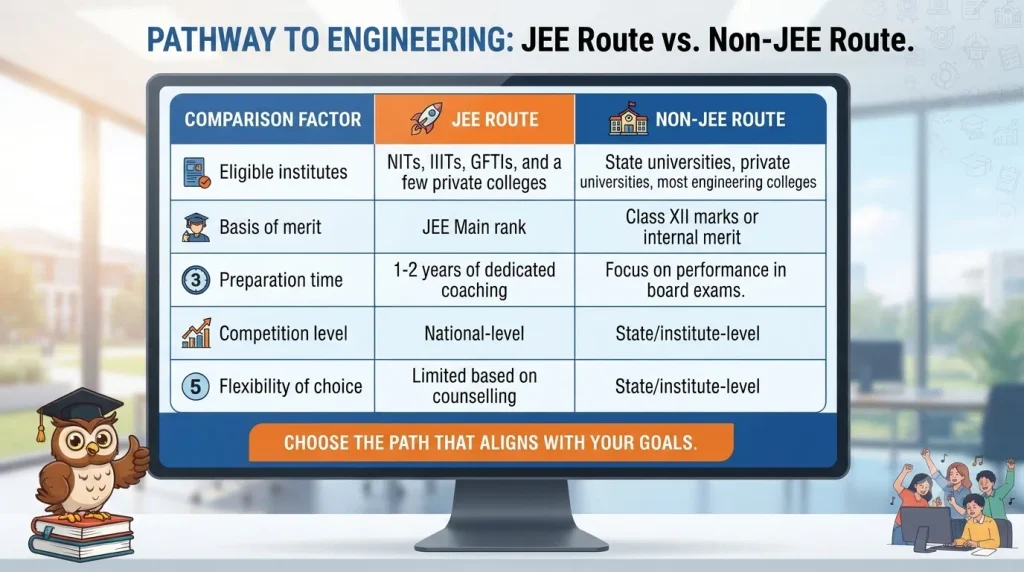
| Factor | JEE Route | Non-JEE Route |
| Eligible institutes | NITs, IIITs, GFTIs, and a few private colleges | State universities, private universities, most engineering colleges |
| Basis of merit | JEE Main rank | Class XII marks or internal merit |
| Preparation time | 1-2 years of dedicated coaching | Focus on performance in board exams. |
| Competition level | National-level | State/institute-level |
| Flexibility of choice | Limited based on counselling | State/institute-level |
Both options have their own pros and cons and thus are suitable for students with different objectives.
A student who wishes to enrol in an NIT should prepare for JEE, while a student who aims at a strong private or state university, a specialised subject like AI, or does not want a second high-stakes exam after board exams can opt for the non-JEE pathways.
Eligibility Criteria You Should Actually Check
Before proceeding any further, check whether you are eligible for direct entry into your selected university by confirming these details:
- Minimum score in Class 12
More often than not, the minimum score needed is around 45% for general candidates and 40% for reserved classes, although this may change from one institution to another.
- Subject requirements
In general, there are requirements of physics and mathematics as compulsory subjects. Requirements for that branch will vary with respect to chemistry, biology, and computer science.
- Diploma score
Most universities set a minimum aggregate that a candidate requires to have to his/her credit before granting admission, which is usually around 45%, which is also lower for reserved category students.
- Domicile/nationality
Some of the seats under the state quota will be reserved for state-domiciled candidates, while seats under the management quota as well as those of private universities will be filled with applicants from different states.
- AICTE/UGC approval rating
Make sure that the university or programme you are applying to has proper accreditation.
Why This Matters: Takshashila University’s Perspective
At Takshashila University, we think that entrance to a degree in engineering should not be limited to one test.
Our B.Tech enrolment procedure is built from transparent, fair, and effective guidelines — measuring the performance in Class 12, experience, and future plans instead of looking for admission by means of JEE examination results.
In addition, we have effective admission ways for those having the diploma and willing to get their B.Tech admission without JEE with compliance to AICTE regulations. Our admission experts help the students and their families in determining the actual branch, computer science, AI & data science, or others, based not only on seats available but also on the interests of students and possible outcomes later on.
If you enter the university based on only Class 12 grading, a management quota, or lateral admission after obtaining a diploma, the admission procedure is clear, fair, and orientated at the results.
Expert advice: Select the university according to its curriculum, professors, and the results of placement and not according to the way you entered the college, says the academic counsellor of Takshashila University.
To wrap up
A JEE rank can lead you to a career in engineering, but that is not your only option. With state counselling like Tamil Nadu’s TNEA, management quotas in private or deemed universities and lateral entry for diploma holders, many deserving students make their B.Tech admission without JEE.
It is important to check to see if you meet the eligibility criteria, check if the university is accredited and choose the best university and stream according to your future career aspirations. Takshashila University can help you pick the best option with ease without complexity.
You can also get a B.Tech seat without taking JEE; the road could be through state counselling, management quota or lateral entry. Don’t miss a moment! Check out our IG @takshila university for the latest news, events, and campus vibes Hence it is Rising Demand for Artificial Intelligence and Data Science Professionals know more about it
Students looking for engineering admission options can explore a range of programmes at Takshashila University, including B.Tech in Computer Science and Engineering (CSE), B.Tech in Information Technology (IT), B.Tech in Artificial Intelligence and Data Science (AI and DS), and B.Tech in Computer Science and Engineering with AI and Machine Learning. These programmes provide students with different pathways to pursue their engineering interests.
Frequently Asked Question for B.Tech admission without JEE
Q.1 Is it possible for someone to get B.Tech admission without JEE?
Indeed, most private institutions, recognised universities, and certain state counselling systems allow direct admission of students on the basis of their 12th-grade performance without requiring them to take the Joint Entrance Test.
Q. 2. Is there any similarity between TNEA and JEE Main?
No, TNEA is a procedure which is conducted exclusively in the state of Tamil Nadu according to the aggregate score obtained in physics, chemistry, and mathematics without conducting a separate entrance examination.
Q. 3. What is management quota?
‘Management quota’ refers to the system in private universities or deemed universities which allows the students to get admission through management. Good students can get admission in this category without participating in the entrance exams.
Q. 4. What do you mean by lateral entry BTech?
Lateral entry is a scheme wherein diploma holders (or BSc graduates in mathematics) can enter the second year of a BTech course without undergoing the course in the first year.
Q. 5. Will I have to take an entrance exam for an old lateral entry?
This will differ according to the state. Some states have their own special entrance tests for lateral entry courses, such as TNEA-LEE or LEET. But many private colleges rely just on diploma marks for picking students.
Q. 6. What are the minimum marks needed for non-JEE B.Tech admission?
It varies from one area to another, but most of the time one needs a minimum of 45% in Class 12 (40% for reserved classes).
Q. 7. Are the out-of-state applicants eligible to apply for TNEA?
Yes, if the out-of-state applicant is eligible and qualifies as per the qualifying criteria and rules prescribed for that year.
Q. 8. Is a B.Tech. degree that does not come through JEE as valid?
Yes. A degree is a degree, but there is no difference in the meaning if it is obtained through the JEE or without. An institution and a programme must be accredited for the degrees to be considered by the AICTE.
Q. 9. What is the difference between management and state quota?
Seats under the state quota are allocated based on merit and domicile factors through centralised counselling, while in a management quota the university itself makes the selection process without being bound by the above-mentioned conditions.
Q. 10. Which courses can be obtained through non-JEE routes?
Most of the popular courses, including computer science, AI, data science, mechanical engineering, civil engineering, and electronics and communication, can be pursued through management, state or lateral entry processes subject to seat availability.