
Short Summary:
The decision about whether one should go for a job or a business venture is one of the most difficult decisions to make among students at present, and the correct choice of the job or business dilemma can only be determined based on personal objectives and risk-taking capacity.
In this blog, the two options have been compared using a proper table of comparison along with facts regarding student entrepreneurship in India from the one of the best MBA colleges in Tamil Nadu.

Introduction: Charting Your Path: The Real Question Behind Job or Business
For decades, the choice of going for a secure career path versus an independent enterprise was an easy task to do, but today’s students have to contend with a more complicated situation. The job or business challenge has become one of the most discussed issues among graduating students, and this is so since both avenues present equal chances of success and failure.
While India has become one of the most dynamic economies in terms of startups and entrepreneurship, its corporate sector provides opportunities for structured growth, financial stability, and skill development to many young professionals.
The following blog discusses both sides of this dilemma as well as the factors that graduating students need to consider when choosing the right avenue. Still weighing your options? Get personalised career guidance at Takshashila University.
The Changing Landscape of Job or Business Decisions in India
India now stands as one of the biggest startup ecosystems around the world, comprising of over 130 startups called unicorns as of 2026, with continued growth expected through the rest of the decade as fintech, e-commerce, and AI ventures scale up.
This trend has undoubtedly impacted the attitude of students. The 2023 GUESSS India survey reveals that a sizeable share of around a third of the Indian students were working on building their ventures even before leaving college, which was relatively higher than the global average.
However, the survey also indicated that very few under 5%; had reached the revenue-generating stage.
On the other hand, while around seventy per cent of the surveyed students claimed to take a job right after finishing their education, this number would drop significantly in the next five years as many graduates opted for entrepreneurship.
The Case for Choosing a Job
- Financial Stability and Predictable Growth
Job provides a regular salary and regular appraisals and growth opportunities and other perks. For a student with responsibilities towards his/her family or loans for education, having such job security is a huge advantage in the initial stages of a career.
- Acquisition of Skills through Structured Environment
Working in an established company means getting exposed to processes and mentoring and best practices of an industry; a foundation Takshashila’s placement-focused degree programmes are designed to build early, which would take many years for a student to get through independently.
There are many entrepreneurs who acknowledge that the learning gained while working in a corporate environment taught them the discipline required for launching their businesses in the future.
- Lesser Risks
The statistics available on entrepreneurship across the world reveal that very few new ventures succeed, and there is a low success rate of first-timers compared to someone who has launched a venture once.
For those students who have never been involved in any venture earlier, a job offers fewer risks and more time to save and accumulate experience.
The Case for Choosing a Business
- Independence and Long-term Upside Potential
There is some level of autonomy and upside in building a startup, something that isn’t very easy to find in an employee position.
A successful founder could create outsize value not only for themselves but also for the greater economy in industries like fintech, e-commerce, and enterprise technology, which are likely to produce the next wave of unicorns in India.
- Elevated Ecosystem
Currently, the barriers for joining entrepreneurship have become lower for students compared to those that existed a decade ago.
With the help of university incubators, government programmes, and mentoring programmes, it has never been simpler to begin a business venture.
Currently, there are many companies that are set up by Indian students which receive funding from their universities.
- Addressing Needs and Generating Employment
Increasingly, entrepreneurship is seen as an opportunity to generate opportunities as opposed to seeking them.
Many Indian startups founded by young entrepreneurs from cities that are not Tier I solve problems faced at a regional or national level in logistics, agritech and health care, among others, contributing to job creation in their respective locations.
Job vs Business: A Quick Comparison
To understand the impact of personal considerations on either choice, it is important to consider how both the career tracks stack up on issues that matter most to students.
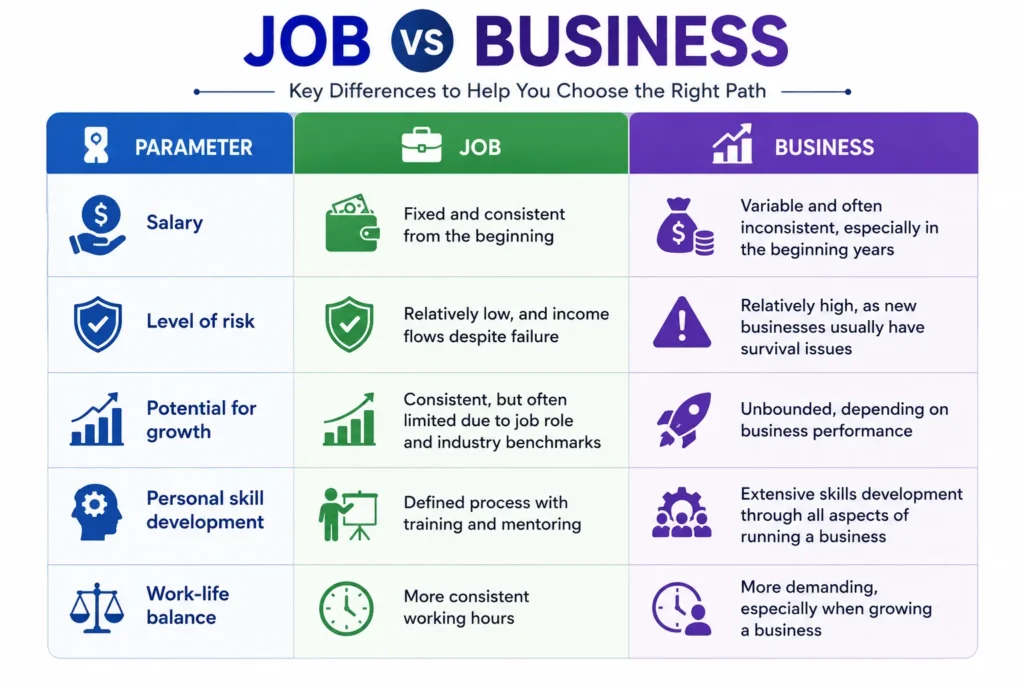
| Parameter | Job | Business |
| Salary | Fixed and consistent from the beginning | Variable and often inconsistent, especially in the beginning years |
| Level of risk | Relatively low, and income flows despite failure | Relatively high, as new businesses usually have survival issues |
| Potential for growth | Consistent, but often limited due to job role and industry benchmarks | Unbounded, depending on business performance |
| Personal skill development | Defined process with training and mentoring | Extensive skills development through all aspects of running a business |
| Work-life balance | More consistent working hours | More demanding, especially when growing a business |
This is not to say that one approach is better than the other, but rather to make it clear that either employment or business truly hinges on which value a student holds dear – whether it’s security, freedom, quick rewards or long-term ownership.
Supporting Every Path: The Takshashila University Perspective on Career Choice
The university understands that it is a personal decision to choose whether a person wants to go with a job or a business, and hence, the Takshashila university is the top engineering college that prepares students for whichever route they choose.
While the university ensures placements and industrial ties for those interested in structured careers, there is an emphasis on entrepreneurship as well through innovation cells and mentoring by industry experts.
This is because the university treats jobs and businesses as two equally important avenues that may be pursued by someone as a result of their sound engineering education at Takshashila.
Contact our admissions team or follow us on @takshashilauniv for campus updates and student stories.
To wrap up: Making a Confident, Informed Choice Between Job or Business
There is no universal answer to either the career or the entrepreneurship question, as the choice should be based on the unique situation, aspirations, and risk appetite of each person.
The most important thing is for the students to make their decision clearly without pressure from any external factors, including their classmates, relatives, and prevailing myths about one being better than the other.
In case they think carefully before choosing their future, and in case their choice is informed and supported by the necessary education and guidance, they will most likely end up happy and successful in their choice, unlike those who follow the trends because of their apparent popularity. also have a knowage about Higher Studies or Job After Graduation
Frequently Asked Questions About Job or Business
Q1. Should one take up a job or business immediately after graduating?
This will be entirely subjective and would depend on factors such as finance, the risk-taking capacity of an individual and career preferences. A job may be a safe bet, while a venture means taking independent decisions and learning through the experience.
Q2. What proportion of students in India are entrepreneurial-minded?
According to recent studies conducted, about a third of students from India are thinking of launching a start-up even while studying. Only a small fraction of these are running actual ventures.
Q3. Is it possible to set up an enterprise while studying in India?
Yes, this is because of the presence of incubation centres in colleges and governmental support that helps students set up enterprises. Modern-day universities have made it possible for students to engage in enterprises.
Q4. What are the major dangers of being an entrepreneur as compared to employment?
The initial years of any new venture will be very risky for its survival. There will be issues of unstable income and uncertainty initially. Newbies always have a lower success rate than the experienced ones.
Q5. Is it possible for students to do both a job and a business in different phases of life?
Yes, there are several individuals who start off as employees and then move towards becoming entrepreneurs in order to create savings, gain skills, and make connections. Some start off by creating enterprises when they are students and then formalise them later.
Q6. Is prior experience in a job useful for budding entrepreneurs?
Yes, working in an organised setting gives one knowledge about the procedures and also develops connections in the professional circle. Most founders attribute their success to previous experience in jobs.
Q7. Which are the industries that have the highest number of student entrepreneurs in India?
FinTech, e-commerce, Agri-Tech, and enterprise technology are some of the fastest-growing industries when it comes to student entrepreneurship. The aforementioned sectors are very compatible with the growth of the digital economy in India.
Q8. How should students determine whether they are ready for entrepreneurship?
Determining readiness to venture into entrepreneurship is very important. This includes self-assessment of the financial buffer one has, risk-taking ability, access to mentorship, and understanding of the problem that needs solving. Entrepreneurship requires emotional fortitude through tough times as well.
Q9. Is any sort of institutional support given to student entrepreneurs by universities?
Yes, currently, there are many universities that provide incubation and mentorship services as well as access to financing options for student ventures. The institution provides significant leverage to the student’s success in executing an idea.
Q10. How does Takshashila University facilitate students who are deciding between a job or a business?
Students get robust placement services along with proper entrepreneurship mentorship and innovation cells at Takshashila University. Students get appropriate mentorship depending on the career path that suits them.