
Short Summary
Compare higher studies Vs job after graduation to see what will meet your career objectives best.
In addition, you will understand why you should continue to pursue postsecondary education and early employment by making good decisions that will provide you with long-term career success, along with assistance from Takshashila University
Introduction: Understanding the Key Differences Between Postgraduate Education and Entering the Workforce

Choosing between higher studies Vs job after graduation is one of the most crucial decisions that students need to make that they will learn in MBA colleges in Tamil Nadu one of the best colleges is us
Deciding whether to pursue higher studies after graduation or take up a job after graduation requires deep consideration. Higher education builds academic depth, while working early builds practical experience.
If you are also confused about this, then you should not worry because within this blog we will be discussing the comparison between these two.
As it is found that by 2026, India is expected to contribute significantly to the global talent pool, with two avenues offering distinct advantages.
Higher Studies vs Job After Graduation
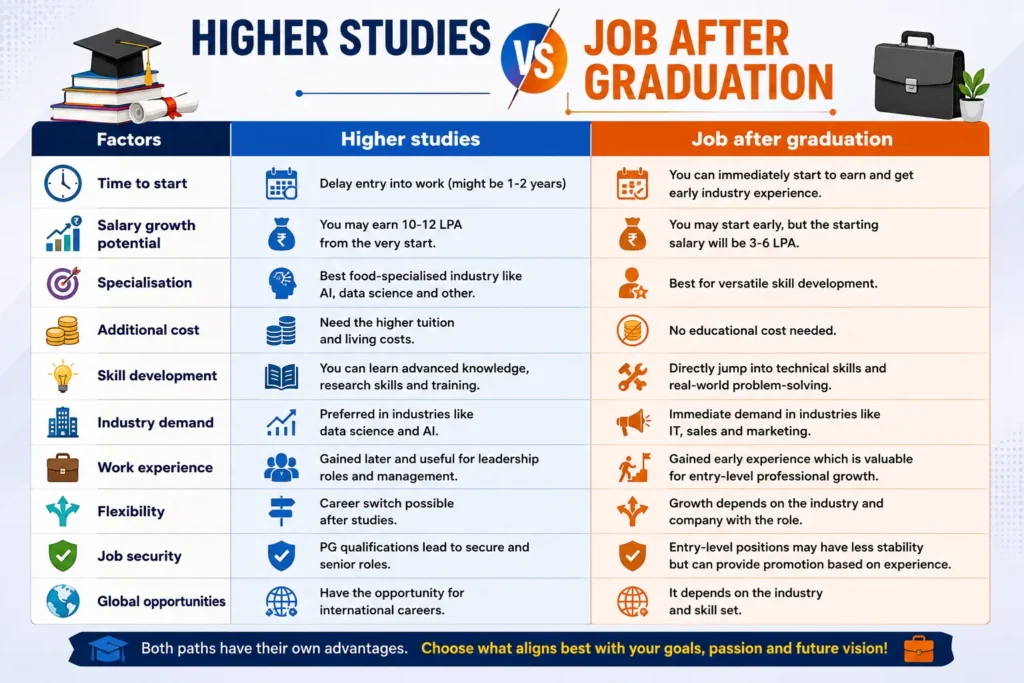
| Factors | Higher studies | Job after graduation |
| Time to start | Delay entry into work (might be 1-2 years) | You can immediately start to earn and get early industry experience. |
| Salary growth potential | You may earn 10-12 LPA from the very start. | You may start early, but the starting salary will be 3-6 LPA. |
| Specialisation | Best food-specialised industry like AI, data science and other. | Best for versatile skill development. |
| Additional cost | Need the higher tuition and living costs. | No educational cost needed. |
| Skill development | You can learn advanced knowledge, research skills and training. | Directly jump into technical skills and real-world problem-solving. |
| Industry demand | Preferred in industries like data science and AI. | Immediate demand in industries like IT, sales and marketing. |
| Work experience | Gained later and useful for leadership roles and management. | Gained early experience which is valuable for entry-level professional growth. |
| Flexibility | Career switch possible after studies. | Growth depends on the industry and company with the role. |
| Job security | PG qualifications lead to secure and senior roles. | Entry-level positions may have less stability but can provide promotion based on experience. |
| Global opportunities | Have the opportunity for international careers. | It depends on the industry and skill set. |
Benefits of Choosing Higher Studies After Graduation
Higher education spurs advanced career growth, helping grads specialise in fields that are in hot demand.
- Increased Salary Potential
MBAs in India can earn up to 77% more than bachelor’s-only degree holders, according to GMAC’s Corporate Recruiters Survey, with average MBA salaries ranging ₹6–23 LPA depending on the business school (NIRF). Plus, those who do postgrads in data science or tech degrees can see their salaries jump by about 25%.
- Access to Specialised Industries
Secondly, extra schooling gives entry into ultra-specialised industries. Let’s take data science – the sector is set to boom by 40% a year in India, but guess what? You mostly need a master’s in analytics, AI, or machine learning for top spots.
- Research and Innovation Opportunities
Lastly, advanced degrees offer chances to dabble in research and cool projects. India’s R&D spending currently stands at about 0.64% of GDP, and NITI Aayog has called for raising it to 2% within the next four to five years.
- Role of Leaders and Managers:
Higher degrees are generally required for executive-level positions. Laders in India have received postgraduate degrees, giving them an advantage in their ability to lead a corporation.
Advantages Of Selecting A Job After Graduation
As soon as you graduate from school, you’ll likely have the opportunity to begin working in the real world right away. Several benefits that you will feel are:
- Independent financial future
The ability to get your first paycheque as soon after graduation can mean that early on you’ve begun earning money to help you pay bills, put some money aside for savings and save any costs associated with additional training or classes.
- Practical industry experiences
In addition to receiving your first pay cheque as soon after graduation as possible, you’ll also have practical experience related to how your industry works; value practical experience gained through an employer’s work history more so than a higher education diploma or degree, especially true in the IT, sales and marketing sectors.
- Rapid Skill Development
In fields like IT, digital marketing, and entrepreneurship, hands-on experience can really boost how quickly you pick up skills.
- Professional Networking
Building a professional network early on helps a lot too. This means connecting with everyone from co-workers to clients to big shots in the industry.
Factors to Consider Before Making Final Decision
When making a decision for higher studies Vs job after graduation, what should you choose then? You must evaluate both. Their needs and the circumstances that are affecting them before they make any decisions related to their life choices.
- Career Goals
If you would like to be a leader or an expert in an area such as AI, data science or biotech, pursuing additional education is going to help you along your way.
- Financial Readiness
Higher education can be expensive, as if it could range anywhere from 5 lakh to 25 lakh rupees. Hence, you must determine how much funding you can access before committing to an educational programme.
- Industry Trends
The level of demand for certain credentials varies from one industry to another; therefore, students should pay attention to how many degrees or certifications are expected in their target industries.
How Takshashila University Helps Students Make the Right Choice
When getting confused about whether to choose higher studies vs. a job after graduation, Takshashila University is the right place for you. We will help you in making an informed decision by looking into every key consideration based on your abilities.
We have a variety of resources available for students wanting assistance navigating their post-collegiate plans, from career guidance to admissions support, whether they’re seeking to continue their education or enter the workforce immediately following graduation.
Follow us on @Takshashila for regular updates on placements, events, and campus life.
Conclusion: Making the Right Decision for Long-Term Career Success
Choosing whether to pursue additional education or begin working directly following graduation is an individual decision based on one’s career goals, financial circumstances, and current opportunities in the local job market.
Additional education may lead to higher-paying positions in the future, while entering the workforce early may improve one’s financial independence and career-related networking opportunities.
Placing appropriate emphasis on your career objectives, financial situation, and the current job market you wish to enter will allow you to make a good choice that supports your long-term career success. The student should also know about Top Career Options After Graduation in India
Frequently Asked Questions About Higher Studies Vs Job After Graduation
Q1. Which should I choose between higher studies vs job after graduation?
It depends on your career goals; higher studies suit those targeting specialised, leadership, or research-driven roles, while an early job suits those who want faster financial independence and hands-on industry experience.
Q2. What types of companies normally hire graduates with a postgraduate degree?
Companies that tend to hire graduates with postgraduate qualifications tend to be focused on data analysis, technology, healthcare and finance.
Q3. Why do some individuals choose to work instead of attending school?
The key reasons individuals choose to work instead of study include wanting to achieve financial independence and wanting to develop practical skills quickly.
Q4. Will getting a degree always earn you a higher salary than if you do not have one?
Job seekers with MBAs earn an average of 77% more than those with only a bachelor’s degree; however, this is not true in all instances.
Q5. What are the financial issues related to attending a higher education institution?
Postgraduate study has significant expenses ranging between ₹5 lakh and ₹25 lakh depending on the type of programme.
Q6. In what way would having an actual job enable someone to grow in his/her career?
Getting actual work experience will help you enhance your technology capabilities, gain more confidence in yourself as a professional, and create a directory of contacts for future promotions.
Q7. What are the 3 most important skills that employers are looking for?
You need to be a tech person and have strong communication skills. You also need to demonstrate some level of leadership ability, as well as being flexible and adaptable in all things you do.
Q8. Why are internships important before making career decisions?
Internships are helpful because they help you better understand the industry and can help you determine whether or not a specific career is right for you.
Q9. Can I continue my education after I have been employed?
Yes – many people go back to school for their MBA, MTech or another graduate degree after completing two or three years of work experience.
Q10. How does Takshashila University help students to make career choices?
Through providing students with career counselling, youth development training, internship opportunities, and graduate degree programmes in order to help them to select their proper career path.