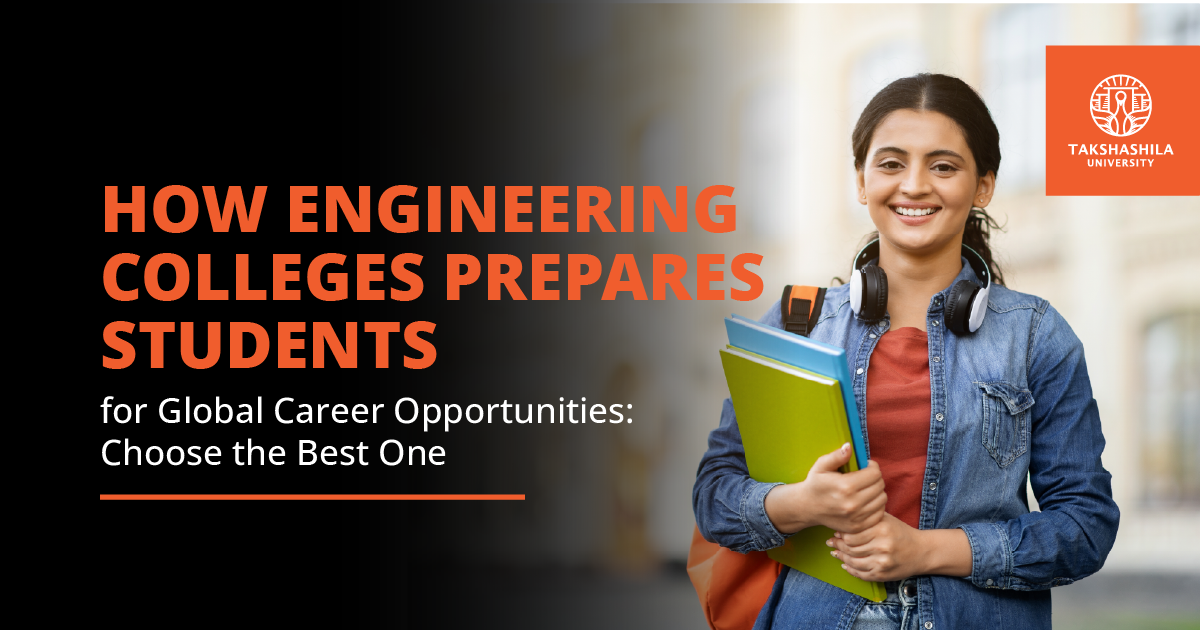
Current engineering education is not merely confined to mastery of technical concepts but also encompasses the full preparation for global career opportunities in technology, innovation, and research. The leading engineering colleges are placing significant emphasis on aligning their curricula with industry requirements, establishing international collaborations, providing research exposure, and developing soft skills, thereby empowering students to be globally competitive. At Takshashila University, we assess colleges using research-based metrics, student experiences, and industry trends to help learners make well-informed decisions about a rewarding engineering career. Also, check out our last blog about After artificial intelligence engineering, which course is better? Now let us see in this blogs How Engineering Colleges Prepare Students for Global Career Opportunities
Introduction
Selecting the appropriate engineering college is a key decision that could influence a student’s career path, international employability, and personal development. Even though India is home to some of the best engineering schools in the world, students are increasingly attending colleges that offer not only technical education but also international exposure, industry readiness, and opportunities for interdisciplinary learning.
Today’s engineering colleges are redesigning their curricula to be at par with global standards by adding, besides others, high-tech learning, practical experience, internships, and training in soft skills to their programmes. At Takshashila University, we combine data research, student feedback, and industry insights to determine how premier engineering colleges are preparing students for careers not only in India but also around the globe.
Key Factors That Enable Global Career Readiness
The key factors through which global career readiness is measured include a curriculum aligned with industry needs, internships, research experience, international collaboration, soft skills training, and placement support. The latter guarantees the competitiveness and global employability of engineering graduates.
Industry-Aligned Curriculum
Engineering colleges that adapt their curriculum to current industry demands help students gain skills that are immediately applicable in the workforce:
- Updated Syllabus: Incorporates emerging technologies like AI, IoT, blockchain, and cloud computing.
- Interdisciplinary research: optimising equally interacting engineering, management, design, and analytics.
- Practical Application: Hands-on projects, lab work, and simulations mirror real-world challenges.
Insight: A curriculum aligned with industry needs ensures students graduate with relevant skills, making them globally competitive.
Internship and Work Experience Programs
Internships and live projects are crucial in linking theoretical learning in the classroom to practical application in the world. By working together with multinationals, providing students with structured internships, and giving them R&D exposure, students acquire not only practical skills but also problem-solving capabilities and awareness of the global work culture. Institutions like VIT, SRMIST, and Amrita University are successfully incorporating such industrial experiences into their curricula.
Research and Innovation Exposure
The leading technical colleges are going out of their way to encourage students to involve themselves in research, patents, and innovation labs:
- Dedicated research centres and labs foster innovation and technical expertise.
- Students participate in international conferences, publish, and collaborate on research projects.
- Innovation hubs and incubation centres allow students to develop startups or patentable technologies.
Insight: Research opportunities enhance critical thinking and problem-solving skills necessary for international technical positions.
International Collaborations and Exchange Programs
The professional avenues for students are greatly widened through global exposure, as it allows students to see their academic and professional future in a much broader way. The partnership with universities in the USA, the UK, Germany, and Singapore, as well as double-degree and international certification courses, enables students to earn qualifications recognised worldwide.
Moreover, being in the company of students from different cultures helps one acquire the ability to adapt, communicate, and understand other cultures. In short, universities that are highly globalised and have broad international contacts provide their students with a definite edge in the international labour market.
Placement Support and Industry Linkages
Engineering colleges focus on structured placement support and corporate tie-ups to ensure employability:
- Strong recruitment networks with Infosys, TCS, Microsoft, Amazon, and Cognizant.
- On-campus placement drives and career mentorship programmes.
- Integration of industry projects and internships directly into the curriculum enhances job readiness.
Observation: Colleges with global industry connections increase the likelihood of international placements and high-paying roles.
Soft Skills and Leadership Development
Technical expertise alone is insufficient for global careers; colleges also emphasise soft skills:
- Communication, teamwork, leadership, and project management training.
- The confidence and socialisation are improved with the help of workshops, seminars, and other leisure-time activities.
- Engagement in international competitions or global hackathons fosters enhanced problem-solving through teamwork.
How Takshashila University Evaluates Engineering Colleges
Takshashila University is a place where we have no reservations in giving the aspiring engineers genuine, scientifically based information that can assist them in their decision-making regarding the college. The selection procedure investigates the elements that are significant for the students’ future success. The focus of our assessment is on:
- Curriculum Relevance: Corresponds to new technologies and international academic benchmarks.
- Employability Index: Job placement ratios, types of recruiters, and successful former students’ stories.
- Research & Innovation: Patents, publications, and entry to the innovation laboratories are indicators of presence.
- International Exposure: Student exchange, dual degrees, and global certifications are the means of international exposure.
- Skill Development: Soft skills development remains one of the major issues as well as the main focus. Leadership training and entrepreneurial ventures are essential.
This structured intervention allows students to make informed decisions that prepare them for global job incorporation and career wholeness.
Conclusion
The present engineering education system is not merely about textbooks and examinations, but rather it is a mentor for the pupils to global technology, research, and innovation opportunities. The schools that put the emphasis on the industry-oriented curriculum, global exposure, and research opportunities, along with soft skills and placements, provide their students with a competitive advantage in the global job market.
Using its research-based approach, Takshashila University leads students and families to select the most suitable engineering schools that match their career goals, skill development needs, and eventual global employability. Those who choose institutions equipped with the latest amenities, have global partnerships, and possess strong links to industry will be in a position to earn high salaries in India and abroad. Dreaming of a global engineering career? See how @TakshashilaCollege prepares students for international opportunities
FAQ About How Engineering Colleges Prepare Students for Global Career Opportunities
Q1: How do engineering colleges prepare students for global careers?
Through industry-aligned curriculum, international collaborations, research opportunities, internships, and soft skills development.
Q2: Are international internships essential for global employability?
Of course, besides that, they also give the chance to have a cross-cultural experience, to be familiar with the global work standards, and to create a network of contacts.
Q3: Do top engineering colleges offer research opportunities?
For sure. Higher education establishments such as Amrita, VIT, and SRMIST possess research centres, innovation hubs, and patent programs that are fully committed to research.
Q4: How important is industry linkage in engineering education?
The establishment of strong business collaborations facilitates the sourcing of interns, live projects, placements, and hands-on learning opportunities, thus contributing to the students’ career prospects.
Q5: How does Takshashila University guide students in college selection?We offer insights that are supported by research, industry analysis, alumni feedback, and placement metrics to assist students in selecting colleges that are in line with the global career opportunities.