
Short Summary
After Studying Artificial Intelligence and Data Science, students usually opt for pursuing either an M.Tech course (£6-20 LPA), MS overseas, MBA, industry certification, joining the workforce directly, or pursuing a Ph.D. The salary of an AI Engineer in India is around ₹12.2 lakh per year, while AI will provide over 20 million jobs by 2027. There are thousands of AI job openings available at present, so all the possible directions lead towards the labour market with an acute shortage of skilled professionals. Students can also pursue an MBA from leading MBA colleges in Tamil Nadu to develop their management and business skills alongside their technical expertise.
Introduction: The Question Every AI & Data Science Graduate Eventually Asks Themselves

Getting my degree in artificial intelligence and data science was the end of the race until I figured out that it was more like a turning point into another direction. After studying artificial intelligence and data science, I rarely wonder about my employability; instead, the first thing that comes to my mind is ‘What should I do to achieve career success?’
Since artificial intelligence and machine learning have been ranked as top specialisations when it comes to the salary level of engineering graduates, my decision right after graduation will play an important role in my salary level within the coming years.
After Studying Artificial Intelligence and Data Science: Why This Decision Matters More Than It Used To
Ten years ago, what next was about opting either for a job or for an MBA.
Today, what next options are truly varied for AI and data science students: further studies in a specialised postgraduate programme, international programmes, professional certifications, a straight path to well-paid technical jobs, or an academic-orientated career leading to a PhD?
This choice is now more critical than it ever used to be since the area develops so quickly that your chosen specialisation may just lose its relevance within a couple of years.
Your Options at a Glance
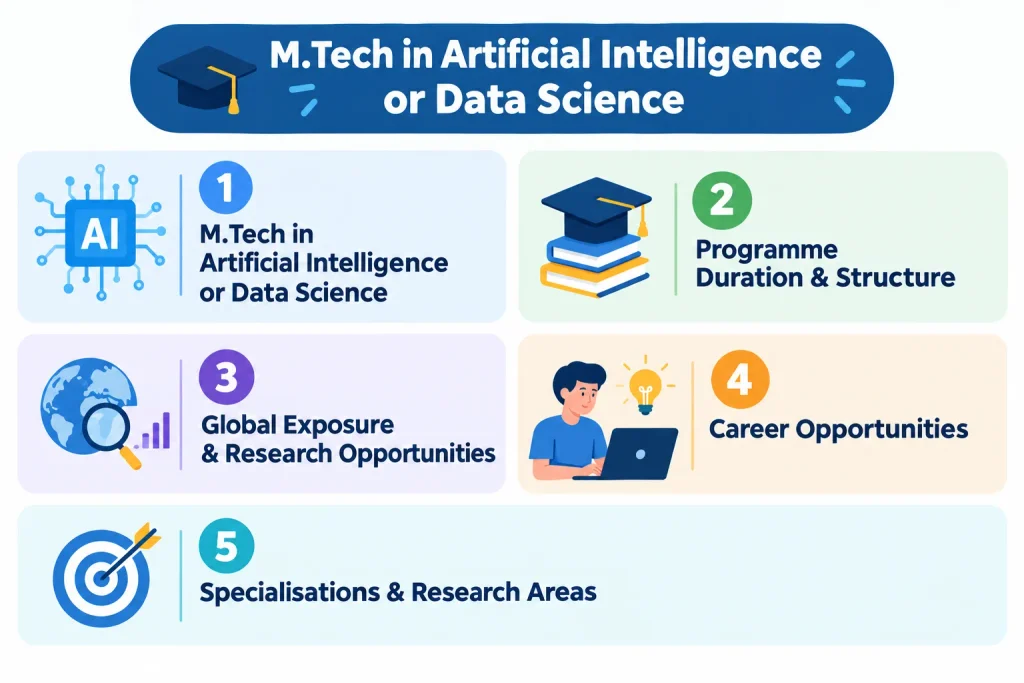
You can pursue an M.Tech in AI / Data Science for 2 years. That will give you ₹6 LPA – ₹20 LPA, frequently 40%+ more than a B.Tech fresher package. It is for those students interested in pursuing a technical specialisation further and PSU/research eligibility.
Go with MS Abroad (AI/ML/Data Science) for 1.5-2 years. You will get substantially higher international salaries, multiple times greater than the Indian average. It is suitable for students who emphasise gaining international exposure and career opportunities.
There is also an MBA (Tech/Analytics) for 2 years, which gives you high variability and emphasises a management career track. Graduates who wish to pursue a career in product management or other strategic roles.
Industry certifications (AWS, GCP, and TensorFlow) for 3-12 months; this will add value to salary, apart from increasing market worth. Graduates looking to begin their careers instantly while gaining specialisations.
Straight job as AI engineer / data scientist, you will get an instant ₹6.8 LPA – ₹20.4 LPA average, with ₹30+ LPA possible for senior positions. Graduates with strong practical knowledge who wish to earn money and gain experience.
- M.Tech in Artificial Intelligence or Data Science
For students looking for an intensive course on the technical aspects of AI, the M.Tech program still stands out. Indian CS and AI M.Tech degree holders earn from ₹6 LPA to ₹20 LPA, which is one of the highest brackets of pay scale compared to other streams for M.Tech graduates.
An M.Tech graduate also gets a chance to secure a job in the government sector via the GATE programme.
- An MS Abroad in AI, Machine Learning or Data Science
In terms of students seeking international exposure, getting an MS degree from foreign universities is still one of the surest ways to enter international AI jobs.
Such education will take 18 months or 2 years, and students will end up earning higher starting salaries compared to those of similar positions in India because of the high demand for AI professionals in the international labour market.
Again, such a choice comes with cost implications, but considering the objective, it could be the best.
- MBA in Technology or Analytics
It is not the case that all students want to stay within the realm of technical education, and there are those who are inclined towards pursuing strategy and leadership, and that is where an MBA in technology or analytics could come in handy.
This route is more about complementing the existing skills than substituting them.
- Industry Certifications Alongside a Job
All graduates don’t need to pursue another full-time programme. Certificates in AWS, Google Cloud Platform, Python, and TensorFlow have become truly important credentials that help gain extra market value both for novice graduates and seasoned professionals.
In this way, graduates will be able to begin earning from the first days of starting work and develop specialisation via shorter programmes. It is a good way to find a compromise between studying more and finding a job.
- Joining the Workforce Straight Away
Since the salaries in the fields of AI and data science are highly competitive even for fresh graduates, many choose not to go for further studies and enter the workforce.
The annual salary for an AI engineer in India averages ₹12.2 lakhs, and the usual range lies between ₹6.8 lakhs and ₹20.4 lakhs, while experienced specialists can earn even ₹30 lakhs a year.
The best specialists with proficient skills in Python and good internships may earn more than ₹100,000 per month.
- The Research and PhD Route
For a more select few who are passionate about original research, obtaining a PhD is still the route to becoming involved in the latest AI developments in both the academic, governmental and private sectors.
However, the payoff comes later in the form of an extended runway, normally four or five years, and reduced pay during education but leaves graduates with one of the most intellectually fulfilling and long-term rewarding career paths in the field.
Why Is This Decision Being Made Against a Background of Real Demand?
When you are wondering after studying artificial intelligence and data science, no matter which route is chosen, the economic reality is uniquely favourable.
It has been estimated that AI will create 20 million job openings in India by 2027, while only replacing a relatively smaller number of jobs through automation, leaving the demand for AI and data science professionals undeniably high.
Industry reports have pointed out thousands of job openings for AI and data science specialists in India, which have not been filled due to the lack of appropriately qualified candidates, thus creating an extremely favourable labour market environment for any new graduate.
Choosing the Right Next Step, With Support From Takshashila University
Guidance post-graduation at Takshashila University is as important as the degree itself. Mentorship from the faculty and career counselling ensure that the graduates in artificial intelligence and data science can make a clear choice about their path.
Whether it be for GATE and M.Tech admissions, creating a certificate programme, or studying abroad.
The university understands that the decision of what to do after the degree depends on the individual and thus tries to tailor it accordingly to their strengths.
To Wrap up: Your Next Step Starts With Knowing Your Own Goals
There is no definitive answer as to what to do after studying artificial intelligence and data science; the answer would differ depending on the individual and on the objective he/she seeks to pursue.
Technical expertise, international experience, leadership roles, income, or research, among other options. What is clear is that all of them lead today to a market that is hungry for specialised skills and ready to pay for them.
The important thing is that your decision aligns well with your own objectives, not necessarily those of your fellow graduates.Also check out Future of Engineering in 2035
Frequently Asked Questions About After Studying Artificial Intelligence and Data Science
- What can I study after obtaining a bachelor’s degree in artificial intelligence and data science?
Some options could be an M.Tech in AI or data science, an MS from foreign countries, an MBA in technology or analytics, various certification courses or even going for direct employment or a PhD.
- Is M.Tech a better choice after B.Tech in AI and Data Science?
The answer is yes, because M.Tech passouts of AI, which is a specialisation in CSE, earn a salary between ₹6 LPA and ₹20 LPA, which is about 40% or more than a regular B.Tech passout.
- Shall I pursue my studies outside India after AI and data science?
MS from foreign countries can be an excellent option for people who want international exposure and global success in their career, but at the same time, the cost of study will be quite high compared to studying in India.
- Shall I prefer joining industry over pursuing further studies?
Many candidates prefer joining the industry right after the completion of a B.Tech course, and an AI engineer can earn an average of ₹12.2 LPA in India.
- Which certificates are good for AI and data science aspirants?
AWS, GCP, Python, TensorFlow and similar certifications are considered very valuable and are great assets to the CV of AI or data science aspirants.
- Is doing an MBA after studying artificial intelligence and data science a good idea?
Yes, for those who wish to pursue a career in product management, strategy, or leadership, an MBA would be a great combination with their technical knowledge.
- Is the AI and data science profession popular in India?
Yes, there will be more than 20 million jobs created due to the growth of AI in India by 2027, and most of the AI and data science vacancies are not filled due to the lack of suitable professionals.
- Is it good to go for a PhD after AI and data science?
Yes, a PhD is the ideal choice for those graduates who want to make novel contributions in research and are planning to build their careers in academia.
- What is the salary earned by AI engineers and data scientists in India?
Salary varies from ₹6.8 lakh to ₹20.4 lakh per annum, while experienced engineers can get more than ₹30 lakh per annum.
- How does Takshashila University guide the students in deciding the next field of studies?
Takshashila University provides career counselling and guidance from mentors to select the field according to one’s strength.