Direct Short Answer
The field of pharmacy is experiencing fast changes because Artificial Intelligence is becoming more prevalent, yet this technology will not completely replace the profession. The implementation of Artificial Intelligence in pharmacy operations has automated standard processes, which include drug discovery and clinical trials,s and prescription management tasks. This shift enables pharmacists to dedicate their time to three main responsibilities, which include patient care, research work and strategic decision-making. The profession requires human practitioners to perform essential tasks, which include patient counselling, ethical decision-making and clinical judgement. Knowledge of whether Will Pharmacy Be Replaced by AI enhances career opportunities and employability, and institutions like Takshashila University offer programmes that integrate AI awareness with pharmaceutical expertise.

Introduction
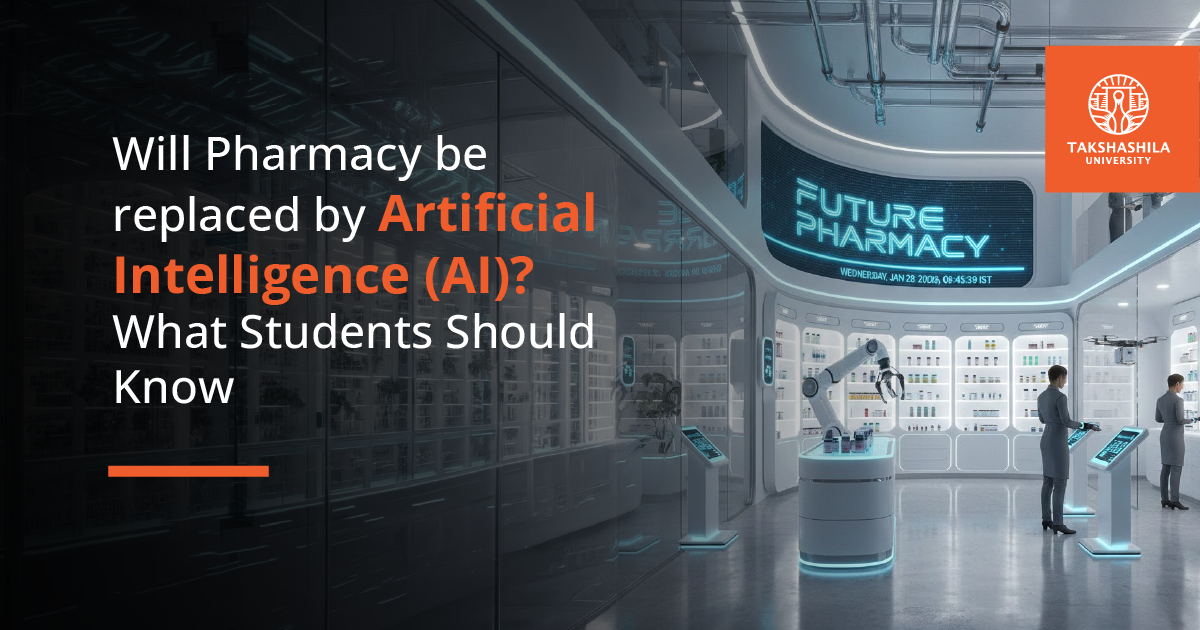
The rise of Artificial Intelligence (AI) has led to speculation: “Will pharmacy be replaced by AI?” As healthcare becomes more data-driven and technology-oriented, pharmacy students and professionals are concerned about job security and evolving skill requirements.
AI has made significant inroads in healthcare, from predictive analytics to automated drug development. However, pharmacy is not merely about dispensing medications; it involves patient interaction, ethical decisions, clinical judgment, and research. The relationship between Pharmacy and AI needs to be studied by students because it helps them acquire new skills, which will protect their professional development in the future.
The blog demonstrates how artificial intelligence impacts the pharmacy profession by showing which tasks artificial intelligence can perform and which duties need human proficiency while teaching students to thrive in today’s changing professional landscape. Also Check out this blogs What to Do After B Pharmacy
How AI Is Changing Pharmacy
AI makes a significant impact on the pharmaceutical industry because it enhances operational efficiency and accuracy while driving the creation of new products. Human experts continue to play vital roles in different operational activities of the industry.
1. Drug Discovery and Development
AI algorithms can analyse chemical structures, predict drug efficacy, and identify potential side effects much faster than traditional methods.
Impact:
- Reduces the time and cost of developing new drugs.
- Assists researchers in identifying high-potential compounds.
- Aid in the design of clinical trials and human oversight but does not supersede these processes.
2. Clinical Trials and Data Analysis
The artificial intelligence system processes extensive clinical trial data to recognise patterns, track side effects, and forecast results. The artificial intelligence system provides organisations with various advantages through its advanced capabilities.
Benefits:
- Improvement is observed in the efficiency and accuracy of a trial.
- Do predictive monitoring systems enhance patient safety?
- The process needs human assessment to determine ethical matters and to oversee research activities.
3. Prescription Management and Automation
Software powered by AI could be used for carrying out prescription checks and managing inventories, besides alerting users about drug interactions.
Advantages:
- The dispensing medication error level is reduced to nil.
- Presenting pharmacists’ time to counsel their patients and offer personalised care.
Key Point: AI systems handle repetitive tasks, but pharmacists need their professional expertise to establish patient safety requirements and ethical standards and execute clinical decisions.
Will Pharmacy Be Replaced by AI?
However, no, AI should not replace them but rather collaborate to empower pharmacy personnel.
Areas AI Cannot Replace.
- Patient Counselling: Empathy, communication, and understanding patient history require human interaction.
- Ethical and Clinical Decision-Making: The process of medical decision-making requires higher levels of circumstance-based judgement than machines can provide.
- Research Leadership: Designing novel experiments and interpreting nuanced results still require human insight.
- Pharmaceutical Entrepreneurship: Building healthcare solutions and startups requires creativity and high-end thinking.
Areas AI Will Transform
The application of AI in pharmacy is changing the landscape, automating the same normal things, counting inventory and checking and writing documents regarding prescriptions. The new system boosts work efficiency through its ability to manage standard work tasks while it decreases operational errors. Its data-driven capabilities provide research support for both pharmacovigilance and personalised medicine development, which enables pharmacists to make better choices. AI develops precision medicine through its ability to create treatments which match the unique genetic and medical histories of each patient, which enables healthcare professionals to focus on their clinical skills and patient care, resulting in improved health outcomes.
Pharmacy and AI – Skills Students Should Focus On
Students who understand pharmacy and AI will have a competitive edge. Key skills include:
- Data Analysis & AI Tools: Python and R are great for anything related to predictive modelling in biopharmaceuticals, such as TensorFlow-based applications.
- Clinical Knowledge: Pharmacology and therapeutics knowledge, together with clinical skills, must be maintained to provide proper patient care.
- Regulatory Awareness: Global regulatory standards for modelling and developing AI-driven therapy solutions will become the standards that set out the requirements to follow.
- Research & Critical Thinking: Our research largely involves designing experiments and interpreting the data together with AI insights.
- Communication & Ethics: Advising patients, explaining AI findings, and increasing compliance with regulations.
Takshashila University Institute provides degree programmes which teach students artificial intelligence, together with their studies in pharmacy, to equip them for upcoming employment prospects in the healthcare sector.
Takshashila University: Preparing Pharmacy Students for the AI-Driven Future
Through expert-led programmes which teach pharmaceutical skills and practical AI methods, Takshashila University prepares pharmacy students to succeed in the AI-driven healthcare industry. The institution provides students with industry partnerships, which enable them to participate in internships and live projects while they gain practical experience and receive career guidance and mentorship to support their development as leaders and experts in their fields. Takshashila University uses its research strengths, clinical expertise, and AI technology to teach students vital skills which help them succeed in the changing healthcare environment.
How AI Will Enhance Pharmacy Careers
AI adoption in pharmacy is set to create new opportunities rather than replace jobs. Roles such as AI-assisted pharmacists oversee AI tools to enhance patient care, AI research analysts optimise drug discovery and clinical outcomes, and healthcare data specialists manage AI-generated information for hospitals and pharma companies. Additionally, entrepreneurs in digital health can launch innovative AI-driven solutions. It is necessary to understand both the profession and AI, as they provide the individual utilising these automated, analytical data insights, guiding the strategic positioning involving human expertise and decision-making.
Conclusion
AI is reshaping pharmacy, but Will Pharmacy Be Replaced by AI Technology was a way of scaling and becoming more efficient, exact, and innovative.
The combination of technical skill, clinical expertise, and AI knowledge will help students succeed in newly emerging job positions that require R&D leadership and AI-based patient treatment and health entrepreneurship abilities. The training and mentorship programmes at Takshashila University Institute, together with its industry partnerships, enable students to succeed in today’s evolving professional environment. AI is transforming pharmacy, but skilled professionals will always be in demand Takshashila University
FAQ About Will Pharmacy Be Replaced by AI
Q1: Will AI replace pharmacists completely?
AI systems handle basic work functions, yet human pharmacists continue to provide necessary support for patient treatment and ethical decision-making and research monitoring.
Q2: How is AI used in pharmacy today?
The development of AI in drug discovery, clinical trial analysis, prescription management, and predictive analytics is a critical issue.
Q3: What skills should pharmacy students learn to work with AI?
The study examines how Data analysis, together with AI tools, clinical expertise, regulatory knowledge, research methods, communication skills and ethical decision-making abilities.
Q4: Can Takshashila University help students integrate AI knowledge with pharmacy expertise?
Yes. Takshashila University provides students with industry partnerships, artificial intelligence projects, and mentoring programmes, which prepare them for upcoming pharmacy profession changes.
Q5: Will AI create new pharmacy career opportunities?
Absolutely. Roles like AI-assisted pharmacists, healthcare data analysts, research specialists, and digital health entrepreneurs are emerging with AI integration.