

Blog Preview:
The scope of MBA in India is now way past banking and consulting and extends to analytics, healthcare, and technology. Here’s how the scope is manifesting for students in reality.
Short Summary
In 2026, the scope of MBA in India is still very good, with average starting salaries of MBAs usually falling in the range of INR 7-12 LPA and senior consulting/finance jobs paying more than INR 30 LPA. The demand for students studied in MBA colleges in Tamil Nadu is increasing in BFSI, consulting, technology, FMCG, and healthcare industries due to the rising requirement of strategic and data-savvy leaders in organisations.
If there is any question on whether an MBA course is still relevant or not for students, then it increasingly seems to come down to specialisation, quality, and relevance. Choosing the right MBA College in Tamil Nadu University and exploring reputed MBA colleges in Tamil Nadu can also play an important role in shaping students’ career opportunities.
Understanding the Real Scope of MBA in India Today
If you ask ten individuals if doing an MBA is still worth it today, you’ll probably get ten different opinions, some positive, some negative. Most of this is attributed to the old beliefs about what an MBA really means and where it will take you.
The scope of an MBA in India has expanded way beyond consulting companies and investment banks recruiting only from selected colleges.
Every function within every business has started requiring professionals who can marry strategic management skills with analytical ability, digital knowledge, and cross-functionality.
This blog explains what exactly the scope of MBA in India really is in 2026, the industries looking for people, the high-paying specialisations, realistic salaries, and how to put oneself in a good position.
MBA Salary in India: What the Numbers Actually Show
There is wide variation in terms of pay packages for MBAs depending on the institute, specialisation, and other factors, which makes it worthwhile to study salary ranges rather than rely on single pay numbers.
While the average figure for all institutions will normally fall within ₹4.5-6 LPA, salaries offered to professionals in the better specialisations or institutions would normally be ₹7-12 LPA, as per many salary surveys of the year 2026.
Salaries for professionals occupying mid-level jobs who have had work experience ranging from 4 to 8 years will normally be within ₹12-20 LPA, and salaries for professionals occupying senior-level positions, particularly in the consulting and finance sectors, will normally be above ₹30 LPA.
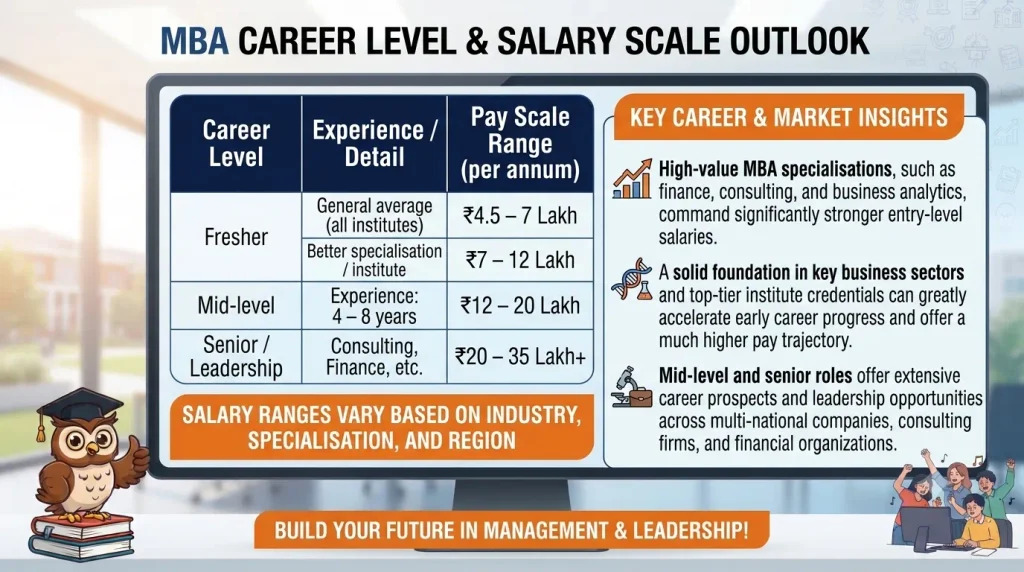
| Career Level | Pay scale range (per annum) |
| Fresher (general average across all institutes) | ₹4.5–7 lakh |
| Fresher (with better specialisation or institute) | ₹7–12 lakh |
| Mid-level (experience level: 4–8 years) | ₹12–20 lakh |
| Senior/leadership position (consulting, finance) | ₹20–35 lakh and above |
Highest-paying specialisations include management consulting, investment banking, corporate finance, and data science & AI management, with the latter being paid INR ₹18–40 LPA.
Placement reports regularly indicate a difference of several lakhs in the salary level of top-notch B-schools and medium regional colleges, something worth considering along with specialisation in your assessment of a programme.
The above data comes from a variety of placement and salary guides for 2026 and must be taken into account as market rates, not promises, as they differ depending on a particular institute, specialisation, and profile of a person.
In Which Sectors is There the Most Scope for MBAs?
The BFSI (banks, financial services and insurance) sector regularly turns out to be one of the largest employers of MBA graduates, offering various job positions in the areas of risk, strategy, and relationship management.
Management consulting is another growing segment with the steady demand for structured problem-solving and advice.
Technology and product management are still relatively young but rapidly developing fields, where business analysis and product jobs require MBA strategic thinking skills along with technical expertise.
FMCG and retail provide consistent opportunities for employment in brand management, sales strategy, and logistics jobs, whereas healthcare management is becoming an increasingly lucrative field since hospitals are professionalising their activities.
Start-ups and e-commerce fill out the last category where one can expect quick ownership and broader responsibilities earlier than in bigger companies.
Best MBA Specialisations for Great Career Prospects
The choice of specialisation has a significant impact on both employment opportunities and salary prospects.
The traditional high-demand specialisation that has proved reliable over time is finance in its different fields, such as banking, corporate and investment finance.
The other specialisation that provides numerous job openings is marketing, which encompasses brand management, digital marketing and sales strategy. Business analytics and data-driven management are one of the fastest-growing specialisations nowadays.
In the words of one recent industry placement commentary, for 2026, demand for MBA talent is business-driven, not trend-driven, a statement that holds true in the hiring numbers across industries consistently, rather than as sporadic surges.
The Key Skills That Make a Real-World MBA Candidate Successful
Apart from MBA degrees, there are certain sets of skills that are in high demand among employers who hire MBA graduates.
Leadership and team management remain the key: the ability to take responsibility and lead cross-functional teams rather than just follow directions.
Literacy with data becomes just as important; familiarity with dashboards and data-driven decision-making becomes a requirement even for those positions that are not analytics-orientated.
Of course, adaptability is another factor to consider, especially given how frequently graduates switch both their functions and industries according to business requirements. Good communication and stakeholder management also become increasingly important, particularly in the fields of consulting and sales.
The basic idea of how artificial intelligence and automation are transforming business practices is the final element to consider.
Combining all these skills with a specialisation is bound to help graduates achieve rapid salary growth and a sustainable career path no matter what sector they join.
Is an MBA Really Worth It in 2026?
Yes, but only if done correctly. An MBA from an institute which has good industry linkages, an updated curriculum and placement assistance will provide significantly greater value than any other random degree without research.
The potential of an MBA in India is definitely there, but it is those graduates who plan their specialisation carefully, develop practical skills along with theoretical knowledge and select the right sectors for their future employment who benefit from it the most.
Shaping Future Business Leaders at Takshashila University
The MBA course at Takshashila University is based on precisely this concept, that the true scope of MBA programme is in its ability to relate classroom study with industry expectations.
Its curriculum includes core fundamentals in management, including finance, marketing, operations and human resource management, together with new emerging areas of business such as business analytics and digital business strategies, keeping in view future hiring trends in BFSI, consulting, technology, healthcare management and other sectors.
Through industry interface, case studies and career placements, the MBA course at Takshashila University is developed in a manner that enables students to go past theoretical concepts of management and gain practical business skills.
For a degree where execution is key, it is through the right combination of basics and industry relevance that the graduates earn a competitive edge.
To wrap up
However, the scope of MBA in India in 2026 will be even greater and more varied, as it will cut across BFSI, consulting, tech, healthcare, and e-commerce sectors.
There are varying salaries based on the specialisation and institute, but all in all, the outlook is promising for those that use their MBAs wisely.
An MBA is not simply an insurance against future failure in business but a tool that can be used effectively only when it is used wisely.
Ready to Pursue Your MBA Career Path?
The scope of MBA in India pays off for those who specialise well and develop industry-orientated skills right away. Join the Takshashila digital community! Tap the link to follow @takshila university for student stories, achievements, and more.also check out Top 10 Advantages of MBA and New Age Commerce Careers
At Takshashila University, students can choose from a range of MBA courses designed to match different career interests and industry requirements. The university offers a general MBA programme along with specialised programmes such as MBA in Logistics and Supply Chain Management and MBA in Hospital Management. Students interested in financial technology can also explore the MBA Fintech Industry-Integrated Programme with Imarticus. These diverse options allow students to select an MBA specialisation that aligns with their academic background, professional interests, and future career goals.
Frequently Asked Questions for the Scope of MBA
Q1. What is the scope of MBA in India?
The areas of specialisation that come under MBA in India are BFSI, consulting, technology, FMCG, healthcare, and e-commerce, because of which there is an urgent need for corporate leaders in companies who not only possess strategic knowledge but also digital literacy.
Q2. What is the salary of an MBA graduate in India for freshers?
Average starting salaries range between ₹4.5 and ₹7 lakh per annum in most institutes, while in the case of graduates of specialisations that do better in placements, it ranges between ₹7 and ₹12 lakh.
Q3. Which MBA specialisation is best for a career?
Finances, marketing and business analytics are in great demand as far as hiring is concerned, while business analytics and data-driven management are the hottest MBA specialisations recently.
Q4. Is an MBA worth it in 2026?
Yes, if the institute in question has connections with the industry, a relevant and up-to-date curriculum and effective placement services, the success depends largely on the specialisation and skill set building.
Q5. What are the top recruiting industries of MBA professionals in India?
Apart from many more, BFSI and management consultancy are the major recruiters, alongside technologies, FMCG, healthcare management, and e-commerce.
Q6. What will be the earning capacity of a seasoned MBA professional in India?
Mid-career professionals having between 4 and 8 years of work experience generally earn around ₹12-20 lakh per year, while senior consultants or finance professionals earn over ₹30 lakh.
Q7. Is there any role of B-school in terms of MBA salary?
Definitely, placement records clearly reflect a noticeable salary difference between top institutes and inferior institutes, implying the institutes’ influence on salary.
Q8. What skills are required for career development in an MBA?
The main skills in this case include leadership, data skills, adaptability, communication skills, and digital skills.
Q9. Is it possible for MBA graduates to develop their careers in the technology and analytics sectors?
Yes, it is evident that product management and business analytics have become some of the most desirable MBA specialisation areas as tech companies increasingly emphasise the importance of sound decision-making.
Q10. What kind of preparation do prospective MBA students make for success in their MBAs at Takshashila University?
The MBAs offered at this institution integrate management principles with other new fields, including business analytics, among many others.