
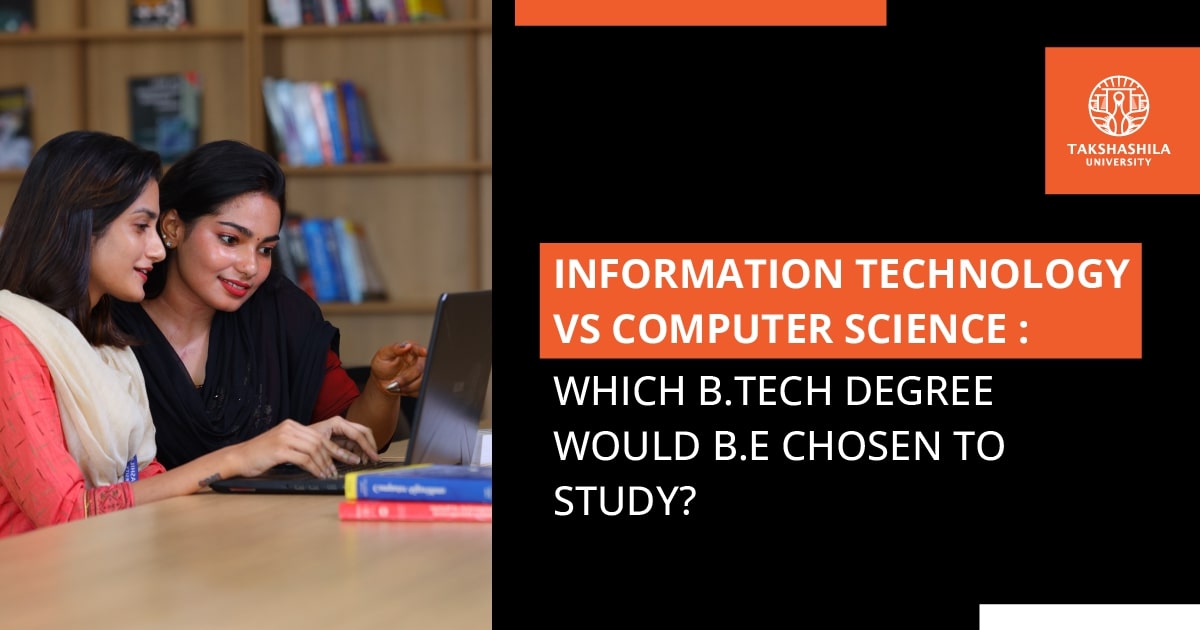
If you’re consider becoming a computer engineer, you might wonder if BTech CS or BTech IT is the right choice for you. This blog will answer all your questions about both courses, their career prospects, the pros and cons, and how they’ll work in the real world. Keep reading to find out!
BTech IT Or BTech CS?
If you want to enter into the ever-buzzing technology field, choosing the right degree, either BTech Computer Science or BTech Information Technology, is crucial. But making a pivotal decision between these two requires careful consideration.
In this blog, let’s learn about the intricacies of IT and CS degrees, their primary differences, advantages and disadvantages, scope, etc. By the end of the blog, you will be able to make an informed decision in the information technology Vs computer science debate.
Ensure you choose the path that aligns with your interests and career goals. Enrol in the BTech IT or BTech CS program at Takshashila University for a promising career in the IT industry.
Understanding Information Technology (IT)
Information Technology is a broad spectrum of knowledge and skills related to the management, utilisation and application of technology in different industries.

Core Areas Of Study In IT
- Networking and Communication
- Database Management
- Web Development
- Cybersecurity
- Systems Analysis
- Project Management
Career Prospects For IT Graduates
IT professionals are in demand across various fields. Here are some of the job roles and the respective salary prospects.
| Job Roles | Salary Prospects |
| Network Administrator | Entry level: INR 3 to 5 lakhs per annumMid-level: INR 5 to 10 lakhs per annumExperienced: INR 10 lakhs+ per annum |
| Database Administrator | Entry level: INR 4 to 6 lakhs per annumMid-level: INR 6 to 12 lakhs per annumExperienced: INR 12 lakhs+ per annum |
| Web Developer | Entry level: INR 2.5 to 5 lakhs per annumMid-level: INR 5 to 10 lakhs per annumExperienced: INR 10 lakhs+ per annum |
| IT Manager | Entry level: INR 5 to 10 lakhs per annumMid-level: INR 10 to 20 lakhs per annumExperienced: INR 20 lakhs+ per annum |
| Cybersecurity Analyst | Entry level: INR 4 to 8 lakhs per annumMid-level: INR 8 to 15 lakhs per annumExperienced: INR 15 lakhs+ per annum |
Real-world Applications of IT
- Design and maintain secure computer networks
- Develop user-friendly websites and mobile apps
- Ensure data integrity and protection
- Implement efficient information systems
- Manage IT projects for organisations
Exploring Computer Science (CS)
Computer Science is the study of algorithms, data structures, and the principles of computing systems.

Core Areas Of Study In CS
- Algorithms and Data Structures
- Programming Languages
- Artificial Intelligence
- Machine Learning
- Software Development
- Computer Graphics
Career Prospects For CS Graduates
| Job Roles | Salary Prospects |
| Software Developer | Entry level: INR 3 to 6 lakhs per annumMid-level: INR 6 to 15 lakhs per annumExperienced: INR 15 lakhs+ per annum |
| Data Scientist | Entry level: INR 6 to 10 lakhs per annumMid-level: INR 10 to 20 lakhs per annumExperienced: INR 20 lakhs+ per annum |
| AI/ML Engineering | Entry level: INR 5 to 10 lakhs per annumMid-level: INR 10 to 20 lakhs per annumExperienced: INR 20 lakhs+ per annum |
| Systems Architect | Entry level: INR 8 to 15 lakhs per annumMid-level: INR 15 to 25 lakhs per annumExperienced: INR 25 lakhs+ per annum |
| Game Developer | Entry level: INR 3 to 6 lakhs per annumMid-level: INR 6 to 12 lakhs per annumExperienced: INR 12 lakhs+ per annum |
Real-world Applications Of CS
- Develop cutting-edge software applications
- Create AI-powered solutions
- Design algorithms for efficient data processing
- Innovate in the field of machine learning and automation
- Advance computer graphics and virtual reality
Information Technology Vs Computer Science: Know The Differences
| Aspect | Information Technology (IT) | Computer Science (CS) |
| Core focus | Utilising and managing technology in various applications and industries | Algorithms, data structures and the fundamental principles of computation |
| Mathematical Component | Less focus on advanced mathematics | Requires a strong foundation in discrete mathematics |
| Programming | Requires practical programming skills, but not as deep as CS | Extensive programming knowledge and proficiency are required |
| Theoretical Vs Practical | Practical application-oriented learning | A mix of theory and practical application is essential |
| Innovative opportunities | Focus on implementing and managing existing technologies | Offer chances to innovate and create new technologies |
Pros And Cons Of IT
Let’s learn about the advantages and disadvantages of pursuing an Information Technology degree.
Pros:
- Diverse career opportunities: IT professionals are in demand across various industries.
- Practical application: Since IT emphasises practical skills, it can lead to immediate job opportunities.
- Job security: You can find stable career options in the IT industry.
- Competitive salaries: IT employees earn competitive salaries.
Cons:
- Limited innovation: IT roles focus more on implementing existing technologies rather than creating new ones.
- Rapid technological changes: Keeping up with ever-evolving trends is challenging.
- Skill specialisation: Limited opportunities for roles that require deep theoretical computer science knowledge.
Pros And Cons Of CS
Let’s learn about the advantages and disadvantages of pursuing a Computer Science degree.
Pros:
- High earning potential: CS professionals get higher salaries due to their specialised skills.
- Innovation opportunities: The Computer Science industry gives wonderful opportunities to create groundbreaking technologies.
- Broad career spectrum: Opting for CS opens doors to various tech-related roles.
- Problem-solving skills: CS professionals have solid analytical and problem-solving skills.
Cons:
- Demanding academics: The CS curriculum is intense since it focuses on complex mathematics and theory.
- Ongoing learning: Since the tech field evolves rapidly, the CS field requires continuous learning.
- Competitive field: The CS field is highly competitive, particularly for senior-most roles.
Factors To Consider When Choosing Between IT And CS
- Passion and interest: Evaluate which field excites you more.
a). Do you have a genuine passion for solving complex problems and indulging in the theoretical aspects of computer science?
(or)
b). Are you more inclined towards practical applications and technology management?
- Mathematical aptitude: Reflect on your ability in mathematics.
Computer science requires a deeper understanding of math, particularly discrete mathematics, the base for algorithms and data structures.
While information technology doesn’t require the knowledge of advanced mathematics.
- Programming efficiency: Evaluate your programming skills.
If you enjoy coding, CS might be your calling.
If you are not enthusiastic about programming, you can opt for information technology.
- Career goals: Analyse your career goals.
a). Do you aspire to work on groundbreaking innovations, artificial intelligence, and machine learning?
(or)
b). Do you want to manage IT systems and ensure their efficiency and security?
- Job market and demand: Research the job market in your region or where you want to work. Choose the field with a higher demand for professionals and better job prospects.
- Salary expectations: When it comes to salary, CS professionals comparatively earn more than IT professionals because of their specialised skills.
- Work-life balance: Reflect on your preferred working style.
Most IT roles have better work-life balance. While CS might involve demanding schedules.
It is crucial to keep in mind that both IT and CS are rewarding and promising careers!
Kickstart Your Career At Takshashila University!
If you’re looking for a top-notch Engineering university in India, Takshashila University is the place to go! It’s situated on a huge campus of 150 acres, with 64 different courses to choose from.
You’ll gain knowledge from experienced teachers and professionals to hone your skills and prepare you for the real work world. The university has teamed up with companies for easy campus placements so that you can get a job with big companies.
Sign up for BTech IT or BTech CS programmes today and start your journey to a successful career. Avail of your sports and academic scholarships to help with your finances.
Conclusion
We are in the ever-evolving world of technology, and the debate on information technology Vs computer science is a much-needed conversation. Both fields bestow individuals with unique opportunities and challenges, and there’s no one-size-fits-all answer for which is a better option.
One should note that continuous learning and adaptation are essential for whichever path you choose between BTech CS and BTech IT. Hence, enter the world of technology by making the right choice that aligns with your passion, strength and long-term career aspirations.
Frequently Asked Questions(FAQs)
1. Is IT and CS the same?
No, they are not the same. IT focuses on the practical application of technology in areas like network administration, cybersecurity, and database management, while CS dives into the theoretical foundations of computing, algorithms, and programming.
2. Is CSE harder than IT?
Compared to IT, computer science is considered to be more rigorous due to its theoretical curriculum and advanced mathematics. While IT emphasises more practical skills and applications and doesn’t require more mathematical background.
3. Is there coding in IT?
Though coding is required in IT, it may not be as demanding as in computer science programs. The IT professionals focus on scripting, automation, web development, system administration, etc.
4. Do you need math for information technology?
Though mathematical expertise is required, the level is generally less advanced than computer science programs. IT professionals should have basic maths skills for tasks such as calculating network subnetting, managing data in databases, troubleshooting hardware issues, etc.
5. Is information technology in high demand?
Information Technology (IT) is in high demand since it plays a crucial role in maintaining and advancing technology infrastructures across various industries.



2 Responses
Reading your article helped me a lot and I agree with you. But I still have some doubts, can you clarify for me? I’ll keep an eye out for your answers.
Reading your article helped me a lot and I agree with you. But I still have some doubts, can you clarify for me? I’ll keep an eye out for your answers.