Short Summary
The scope of anaesthesia and operation theatre technology is ever-broadening in India, fuelled by the increasing number of surgeries and constant demand for professionals in this sector.
There are opportunities in pursuing a Bachelor of Anaesthesia and OT Technology in Tamil Nadu to work as an OT technician, an anaesthesia technician, or a surgical assistant in hospitals, trauma centres, and even foreign countries’ health-care facilities.
The pay scale grows significantly along with specialisation and experience, while the profession is recession-proof, which makes this degree both appealing in terms of job security and career prospects.
Introduction: Why Anaesthesia and OT Technology Is Drawing More Students Into Healthcare Every Year
The scope of anaesthesia depends on the success of every surgical operation, which involves a group of people working behind the scenes.
The anaesthesia and operation theatre technologists who prepare the OT, handle the surgical equipment, and assist the anaesthesiologists in monitoring the patient throughout the surgical process.
With increasing surgical numbers year after year in India, anaesthesia and operation theatre technology has become one of the most dependable careers in allied healthcare, boasting a solid demand for entry-level professionals, clear avenues for specialisation, and an international scope which very few other paramedical courses can provide.
For students looking to have a career in healthcare without going for MBBS, there is no better option than a bachelor’s degree in anaesthesia and operation theatre (OT) technology. This blog discusses the job roles, salary prospects and growth trends in the field.
If a hands-on healthcare career without an MBBS interests you, here’s how the Anaesthesia & OT Technology course at Takshashila University can get you started.
A Field Growing in Step With India’s Surgical Boom
Healthcare facilities in India are growing rapidly, along with the number of surgeries performed every year in multispeciality hospitals, trauma centres, and standalone surgery units.
All these operations, ranging from simple appendectomies to complicated heart surgeries, require the services of OT and anaesthesia technologists to help with equipment setup and the administration of anaesthesia systems.
The workforce is expected to grow proportionally too. It is for this very reason that the profession is considered recession-proof in the allied healthcare field; as long as there are surgeries, there will be OTs.
The Many Roles Within a Single Degree
With a qualification in anaesthesia and OT technology, the career possibilities are really varied and linked to different stages of surgical operations:
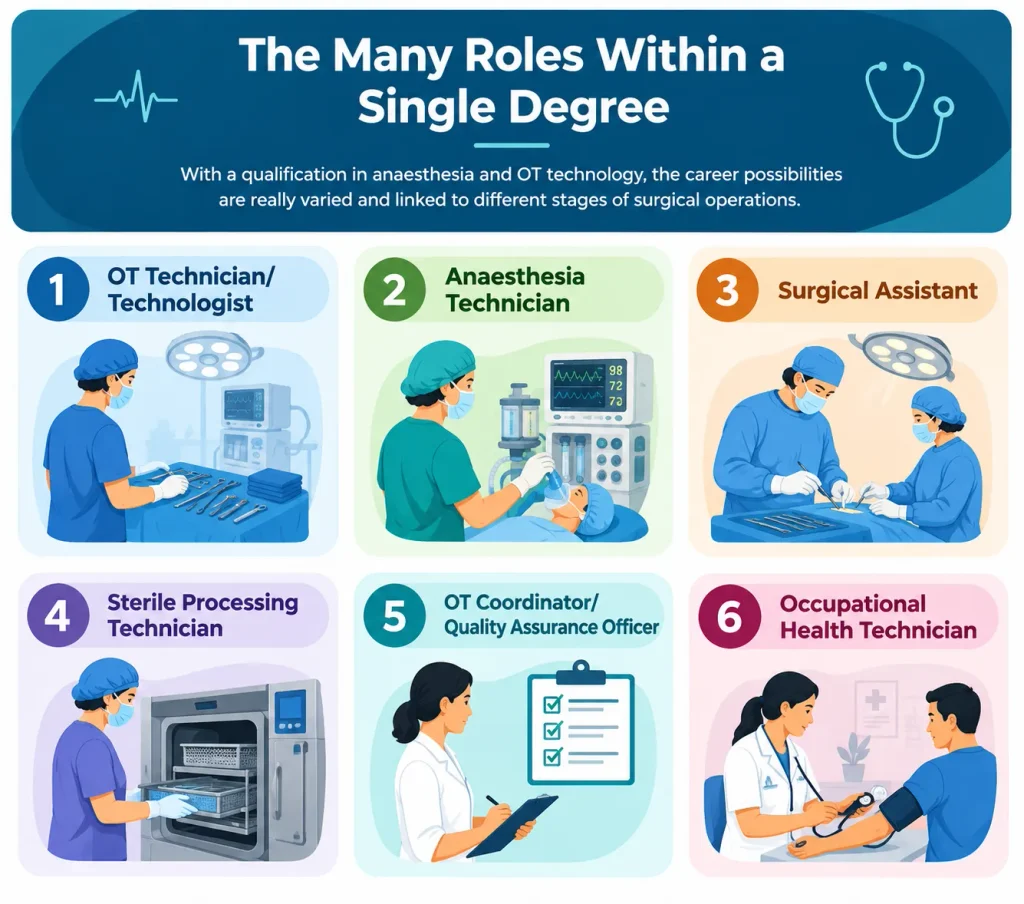
- OT Technician/Technologist
Helps prepare the operation theatre and set up surgical tools; works with the surgery team during the operation.
- Anaesthesia Technician
Works with anaesthesiologists in providing anaesthesia; manages the work of anaesthesia machines and observes patients’ vital signs during surgery.
- Surgical Assistant
Works together with the surgeon and nurses to provide the optimal OT process.
- Sterile Processing Technician
Deals with the cleaning, sterilisation, and arrangement of surgical tools after an operation, a position becoming more important because of increased requirements in terms of the control of infections.
- OT Coordinator/Quality Assurance Officer
Oversees compliance with healthcare standards and OT standards; it is the typical position of experienced technicians.
- Occupational Health Technician
Uses the knowledge of OT and anaesthesia in different occupational medicine areas.
Also, one may find employment in nursing care centres, diagnostics centres, rehabilitation centres, and even the healthcare IT area.
What the Salary Numbers Actually Show
When talking about the scope of anaesthesia, there is no set salary for this field, since salaries greatly vary depending on the position and level of experience.
Entry-level OT technologists are paid anywhere between ₹2.1 lakh and ₹3 lakh per year, while the monthly average salary of entry-level anaesthesia technologists is near ₹19,000, based on current job market trends.
In case of recruitment by the government, there is a somewhat different scenario: anaesthesia technicians of the Group C category are paid between ₹25,000 and ₹35,000 monthly, which increases to ₹35,000 to ₹50,000 per month after three to five years of experience and becomes ₹50,000 to ₹70,000 or even higher in positions of supervision.
In the private industry, the monthly salary for OT technologists and anaesthesia technology graduates varies between ₹16,000 and ₹45,000 but increases greatly with specialisation.
The yearly salary range of professionals with more than five years of experience in both government and private industries usually falls between ₹6 lakh and ₹20 lakh.
Why International Demand Makes This Degree Even More Valuable
One of the more interesting things about the scope of anaesthesia and OT technology lies in the fact that it is highly sought after internationally.
Healthcare countries that have reached advanced levels always tend to hire paramedical specialists, and Indian graduates are known to figure among these candidates.
As soon as one acquires the right credentials, one can practise his/her skills in hospitals and operating centres overseas, earning quite substantial sums of money compared to what one can earn domestically, where average salaries are much higher, reaching even a six-figure sum of USD 100,000 per year.
Specialisation and Further Study: Where the Real Growth Happens
Those who decide to go on to specialise gain more in terms of increased responsibility and financial reward than anyone else.
Some may choose to become supervisors and quality assurance officers after several years in practice, while others opt to do postgraduate studies or an MBA in healthcare management to gain entry into the field of hospital management, healthcare administration and resource planning.
With the growing sophistication of surgical technology, involving sophisticated anaesthetic delivery equipment and digital operating theatre monitoring, it is those who continuously upgrade their technical and managerial knowledge along with their professional education, who advance faster than anyone else in terms of career opportunities.
Training Surgical Support Staff for the OT: Takshashila University
The Anaesthesia and Operation Theatre Technology course offered by Takshashila University is based on one major idea, which is that one can gain true confidence in the OR only through true experience and not through simulations alone.
To see the OT labs and clinical training spaces up close, follow Takshashila University on Instagram or visit the Takshashila University homepage for full programme details.
To wrap up: A Career That Grows With India’s Surgical Landscape
The current scope of anaesthesia and operation theatre technology in India is wide-ranging and includes government hospitals, private multi-speciality chains, trauma centres and even international healthcare organisations, aided by a steady increase in the number of surgeries being conducted and a field which is mostly recession-proof.
This course provides students with a practical career in healthcare, which will see great demand for professionals upon graduation and well-defined specialisation options.
In addition to all of the above, graduates will also get to work internationally, something which not many other paramedical courses offer. also check the this blog Scope of Bachelor of Medical Radiology
Frequently Asked Questions for Scope of Anaesthesia
Q.1 What is the scope of anaesthesia and OT technology as a career option in India?
The scope of anaesthesia and OT technology is wide and extends from hospital settings to trauma centres, operating theatres, and even overseas healthcare systems, with constant demand owing to increasing numbers of surgeries performed in India.
Q2. What would be the average starting salary of an OT and anaesthesia technologist graduate?
Starting salaries are usually between ₹2 lakh and ₹4.5 lakh per year, depending on the position and location, while governmental jobs offer the set pay grade scale.
Q3. What kind of positions could the graduates hold after completing the programme?
One could become an OT technician, anaesthesia technician, surgical assistant, sterile processing technician, OT coordinator and so forth.
Q4. Do OT and anaesthesia technologists have job opportunities outside of India?
Indeed, many countries with developed healthcare systems seek qualified paramedical workers, and Indian graduates can practise abroad after acquiring a licence.
Q5. What is the salary growth pattern in this stream with experience?
The salary increases considerably with experience, and highly experienced individuals working in the public as well as the private sector earn a salary ranging from ₹6 lakh to ₹20 lakh per annum.
Q6. Can graduates take up jobs in government hospitals?
Yes, graduates in OT/anaesthesia technology will find jobs in government hospitals through the pay scale system, which offers them very good job security and increments.
Q7. Is this programme a better option than other MBBS-related healthcare programmes?
Yes, this programme provides job-oriented medical education without the need for an MBBS degree.
Q8. Which higher education options can graduates opt for?
Graduates can pursue an MBA in healthcare management and other specialisation courses.
Q9. Why is this area recession-proof?
As surgeries continue to be an absolute requirement in all health care setups, the need for skilled OT and anaesthetic personnel does not wane during economic downturns.
Q10. Why pursue this course from Takshashila University?
At Takshashila University, there is plenty of opportunity for clinical postings, state-of-the-art OT equipment, and expert faculty to make one confident as a member of a surgery team.