Short Summary
Engineer placements nowadays depend on the skills for engineering students and they have to pay heed not only to grades but also to the holistic development of engineering students as far as skills go; there is recruitment going on with an eye towards such skills as coding, data handling, communication, and teamwork, among others.
This blog discusses both types of skills and how their development can help in improving employability for engineering students from Takshashila University, the core engineering college in Tamil Nadu.
Introduction: Building a Foundation for a Successful Engineering Career
The education of engineers has never been restricted to books and exams. In the current highly competitive environment, companies no longer depend on academic records alone, and it is for this reason that the skills for engineering students have emerged as the key criteria for hiring through campus placements.
While the grade point average may qualify you for the interview, it is the skills of technical expertise, problem-solving, and job-readiness that ultimately lead to the offer letter.
With automation, AI, and digital transformation revolutionising conventional jobs, it becomes crucial for engineering graduates to be equipped with a variety of skills in order to remain relevant.
Here, in this blog post, we look at all those skills which an engineer should possess to increase his/her chances of getting placed in top firms. Ready to build placement-ready skills from day one? Explore engineering programmes at Takshashila University.
Why Skills Matter More Than Ever in Campus Placements

The findings of global employability surveys have repeatedly pointed out the presence of a disturbing mismatch between what is taught in engineering courses and what is required by industries.
According to the India Skills Report 2025, 71.5% of B.E./B.Tech graduates were judged employable based on the Global Employability Test. 83 per cent of engineers who graduated in 2024 are still unemployed, since it was already accurate and named.
This has resulted in institutions of higher learning and their students focusing on building holistic skills and not theoretical knowledge. Students are being assessed by placement panels through coding sessions, group discussions, case studies, and behaviours.
Technical Skills That Employers Look For
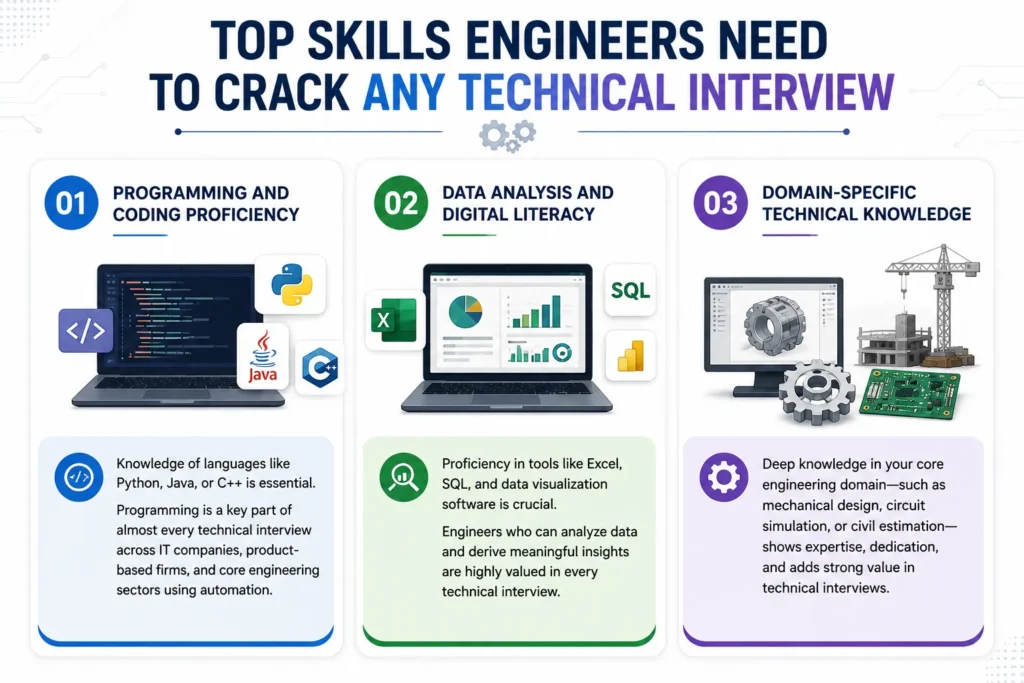
- Programming and Coding Proficiency
Regardless of specialisation, employers in different fields consider knowledge of at least one or two coding languages, such as Python, Java, or C++, among others, an essential requirement for engineers.
Programming is an important element of almost all technical interviews, especially those conducted by IT companies and product-based organisations, as well as engineering departments, which currently use automation software extensively.
- Data Analysis and Digital Literacy
Nowadays, when large amounts of data are being collected by companies, proficiency in using different analytical instruments, including Excel, SQL, and data visualisation software, becomes essential.
Engineers able to analyse data and draw appropriate conclusions are valuable participants of any technical interview, regardless of their speciality.
- Domain-Specific Technical Knowledge
Though basic skills may be general, recruiters also require depth in that particular student’s main area of study, something Takshashila’s engineering degree programme is built around, which could be mechanical design software, circuit simulation software, or civil engineering estimation. Good expertise in one’s area shows dedication and mastery.
Building Skills for Engineering Students Through Practical Exposure
Theoretical knowledge can be gained through classroom teaching, but the skills are acquired through practical experience in internships, projects in the industry, and research collaborations.
Students get an opportunity to practically implement their theoretical knowledge into the practical field, learn about work culture, and create a portfolio for themselves which carries much more weight than just a résumé.
Indeed, this desire for tangible experience has been echoed by the students themselves; the India Skills
Report 2025 found that 93% of students expressed strong interest in internships. Similarly, many recruiters now say they weigh internship and project experience as heavily as academic credentials when hiring freshers.
Joining technical clubs, coding competitions, and inter-college hackathons hones problem-solving skills along with giving the confidence of working under pressure.
As companies look for people who will be ready for the future, certifications reflect the part of the initiative taken by students towards future-readiness.
Leveraging Placement Cells and Industry Connect Programmes
An effective placement cell does much more than arrange interviews; it serves as a mediator between what students learn at college and what industries require.
The mock interview sessions, CV-making classes, aptitude-building programmes, and industrial talks conducted in a placement cell help students understand what is expected of them.
Engineering students who involve themselves actively in these programmes rather than considering them as supplementary activities enter the real-world interviews much more confident about themselves.
Where Skill Meets Ambition: The Takshashila University Advantage
It is Takshashila University’s aim to develop engineering graduates who will be not only competent in their academic fields but also equipped with the skills needed by the modern industrial market.
It is evident that the curriculum offered by the institution has been carefully crafted in order to ensure that the engineering students get a combination of technical training and industry-related learning activities.
This is meant to help all students become proficient in the skills expected of engineering students. The institution ensures that all its engineering students get all the necessary skills by offering them opportunities to learn through its dedicated placement cells, industry ties, laboratory sessions, and skill-enhancement workshops.
To wrap up: Preparing Engineering Students for a Future-Ready Career Beyond the Classroom
There are several factors that play a vital role in the transition of an engineering student from the classroom to career placements, training, and shape alone.
Proficiency, communication skills, adaptability, and problem-solving skills all affect the effectiveness of the placement process for a student.
As industries advance, the requirement for proficient engineering graduates will keep on increasing in number, and hence it becomes crucial for engineering students to allocate time and energy for these traits.
This is because it is not just academic excellence alone but proficiency in all other aspects that makes for a great engineer. student should need to know about Future of Data Science
Frequently Asked Questions about skills for engineering students
Q1. Which are the important skills for engineering students that they should emphasise for placement?
Programming skills, problem-solving skills, communication skills, and teamwork are the important skills that should be emphasised by engineering students for placements. A combination of these skills helps in improving the chances of placements.
Q2. How can engineering students develop their communication skills?
Communication skills can be improved by students through practice through discussions, presentations, and assignments. Engaging with college clubs and debate society activities can also provide them with opportunities to speak.
Q3. Is it necessary for engineering students to know how to code, even if they do not belong to the computer science engineering branch?
Yes, it is important for engineering students to have at least some knowledge about programming since many industries depend upon automation and data analysis these days.
Q4. What is the importance of internships in campus placements?
An internship provides practical exposure which is impossible to attain through classroom studies. It gives insight into the working environment and also provides practical experience. Internship candidates usually have an edge over other candidates.
Q5. How do the roles of soft skills and technical skills compare?
Often times it is the soft skills which determine how the technical knowledge of a candidate would be put to use. The recruiters look for both technical and soft skills in order to find well-rounded candidates.
Q6. How should students prepare themselves for technical interview rounds?
Regular coding, revisiting of basics of subjects taught in college and solving previous interview questions will go a long way in making a candidate prepared. Practice mock interviews conducted by placement cells are especially helpful in preparation for technical interviews.
Q7. How helpful are certifications of new technologies for placements?
Certification in areas such as artificial intelligence, cloud computing or even data science shows that the candidate keeps up with current technological changes. This can help in getting a job and also add to a resume.
Q8. How can engineering students improve problem-solving skills?
Hackathons, case studies and industrial projects can help to develop analysis skills.
Practice with actual problems increases one’s capability to perform in stressful situations. This quality is always checked in technical and HR interview rounds.
Q9. Why is team work an important skill for placements?
Almost all engineers need to work in team environments with people from different departments. Teamworking skills of students are tested in group discussions and situation-based questions. Good teamwork skills show preparedness for an actual workplace environment.
Q10. How does a university’s placement cell help in developing skills?
Placement cells conduct mock interviews, workshops on resumes and industry visits. The cells serve as the bridge between academia and industry requirements. Participation in such programmes is highly beneficial for placements.