Summary
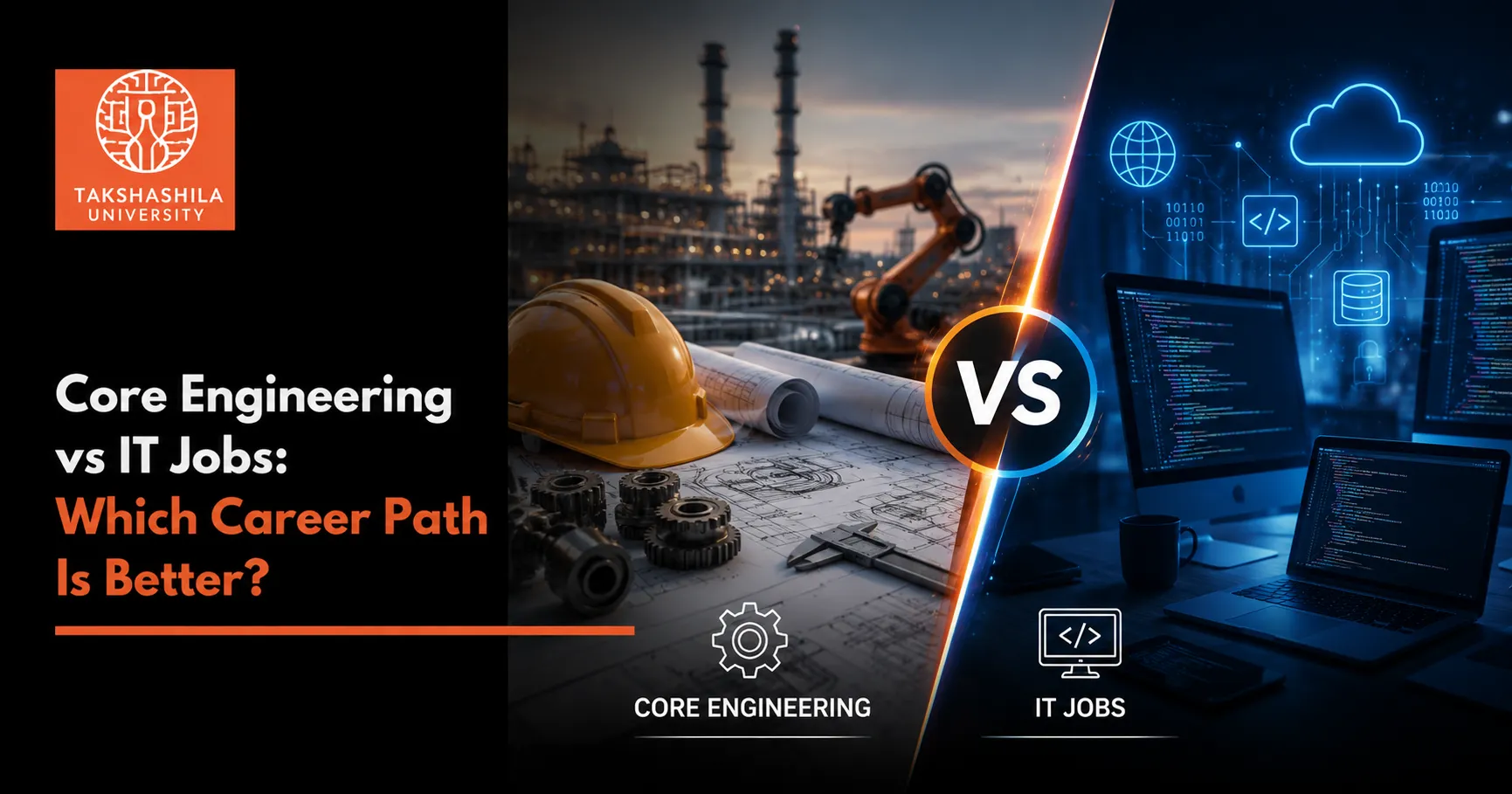
Choosing between Core Engineering vs IT Jobs is really a choice between two different lifestyles, not two different “good or bad” options. IT gives you faster money and remote flexibility. Core engineering gives you long-term stability and hands-on, real-world impact. The smartest move in 2026 is to mix both — core knowledge plus a little coding. Confused about which branch suits you? Talk to our admission team and get a clear, honest answer for your situation.
Introduction
If you are stuck between Core Engineering vs IT Jobs, here is the direct answer: neither one is better for everyone. IT usually pays more early and lets you work from anywhere. Core engineering rewards patience with strong job security and work you can actually see and touch. The right pick depends on your goals, your branch, and how you like to work.
Also read: Top Engineering Colleges in Tamil Nadu
Most students and parents worry about the same thing — “Will I earn well, and will my job be safe?” That single fear is why so many people rush into IT without thinking. This article will help you solve that confusion by comparing salary, job roles, skills, stability, and future scope side by side, so you can pick your path with confidence instead of pressure.
Core Engineering vs IT Jobs: Quick Comparison Table
Before we go deep, here is the full picture in one look. This is the fastest way to understand IT jobs vs core jobs at a glance.
| Factor | Core Engineering | IT / Software |
|---|---|---|
| Early salary | Slower start (₹3–5 LPA) | High start (₹4–8 LPA) |
| Long-term stability | Very high, especially PSUs | Medium, faster skill changes |
| Work location | Often on-site, factory, field | Remote / hybrid friendly |
| Work pressure | Steady, deadline-based | Fast-paced, project-driven |
| Skill shelf life | Long (fundamentals rarely change) | Short (tools update fast) |
| Real-world impact | High and visible | High but mostly digital |
| Best for | Builders, problem-solvers | Coders, quick learners |
Core Engineering Careers

Core engineering covers the traditional branches — mechanical, electrical, electronics, civil, and chemical. These are the fields that build the physical world around us: bridges, machines, power grids, factories, and vehicles.
Here is what makes core engineering careers attractive:
- Strong job security, especially in government jobs and PSUs like BHEL, NTPC, and ISRO.
- You work on tangible projects with visible, real-world impact.
- Specialised areas like VLSI, embedded systems, and EV design now pay salaries that rival top IT packages.
But there are honest downsides too:
- Salary growth is slower in the first few years compared to IT.
- Many roles need on-site or factory presence, so remote work is limited.
- There are fewer entry-level openings than in IT, so the competition is sharper.
There is good news for anyone worried about core engineering jobs in India — a talent shortage in specialised areas is quietly pushing skilled core salaries up every year.
IT Jobs

IT covers software development, data science, cybersecurity, cloud computing, and AI. It is the fastest-growing hiring sector in India, and it is why so many students dream of a software career.
Why IT stays so popular:
- High starting salaries and quick early growth.
- A huge volume of entry-level openings across the country.
- The freedom to work from home, from a café, or from another city.
The trade-offs people forget to mention:
- Lower long-term stability, with layoffs during slow market cycles.
- Skills go out of date fast, so you must keep learning forever.
- The field is crowded and highly competitive.
For students in Tamil Nadu, this matters a lot: giants like TCS, Infosys, Cognizant, and Accenture recruit heavily in Chennai, making IT roles easy to find right after graduation.
Did you know? India is now one of the top 10 markets for industrial robots in the world — meaning “core” skills like automation are becoming just as future-proof as coding. (Source: International Federation of Robotics)
Skills You Need for Each Path
The skills decide the salary. Here is what each side actually rewards.
For core engineering, focus on:
- Strong fundamentals in physics, mechanics, and circuits.
- Design and simulation tools like AutoCAD, SolidWorks, and ANSYS.
- Domain depth — VLSI, embedded systems, thermal, or structural design.
For IT, focus on:
- Programming — Python, Java, or JavaScript.
- Data and cloud basics — SQL, AWS, or Azure.
- Problem-solving through DSA (data structures and algorithms).
If you notice, one skill sits in both lists today —coding. That overlap is exactly where the highest-paying jobs are hiding, and we will get to that in the hybrid section below.
Not sure which skills match your branch? Get a free course-fit guide from our engineering colleges in Tamil Naduadmissions desk.
Career Opportunities and Job Roles
This is where engineering career options really open up. Both paths lead to strong roles — they just look different.
Popular core engineering roles:
- Design Engineer (mechanical, civil, electrical)
- Production and Maintenance Engineer
- VLSI / Embedded Systems Engineer
- Quality and Safety Engineer
- Government and PSU technical officer
Popular IT roles:
- Software Developer
- Data Analyst / Data Scientist
- Cybersecurity Analyst
- Cloud / DevOps Engineer
- AI / Machine Learning Engineer
A quick before vs after to make this real: before, a mechanical fresher might join a plant at ₹3.5 LPA doing manual design work. After learning simulation and a bit of Python, the same person moves into an automation role at nearly double the package within two years.
Salary Breakdown and Growth
Money is the number one question, so let’s be direct. Here is how salaries usually grow on both sides in India.
| Level | Core Engineering | IT / Software |
|---|---|---|
| Entry (0–2 yrs) | ₹3–6 LPA | ₹4–8 LPA |
| Mid (2–5 yrs) | ₹6–12 LPA | ₹8–18 LPA |
| Senior (5+ yrs) | ₹12–25+ LPA | ₹18–35+ LPA |
The pattern is clear. IT wins the early race. But core engineering closes the gap fast once you specialise — a VLSI or EV battery expert can out-earn many software roles by mid-career.
Another before vs after: before upskilling, a core electrical engineer earns ₹5 LPA in a general role. After moving into EV battery management, that same engineer commands ₹12–15 LPA because the skill is rare and in demand.
Courses to Consider
Your degree opens the first door. Here are the smartest choices for each direction:
- For core — B.E./B.Tech in Mechanical, Electrical, Civil, EEE, or ECE.
- For IT — B.E./B.Tech in Computer Science, IT, or AI & Data Science.
- For the best of both — any core branch plus certified coding and automation skills.
At a good campus, you get lab exposure, internships, and placement support that decide how ready you are on day one. That is where choosing the right university matters more than choosing “core or IT.”
The Hybrid Path: The Real Winner in 2026
Here is the secret most people miss. The highest-paying “sunrise” jobs are neither pure core nor pure IT — they are a mix. Career experts on forums like Quora keep calling hybrid roles the smartest path for 2026.
Look at how it works:
- Mechanical + Python = Robotics / Automation Engineer
- Electrical + Embedded C = EV Battery Management Specialist
- Civil + Data Analytics = Construction Project Data Manager
- Electronics + AI = Smart Device / IoT Engineer
So the real answer to Core Engineering vs IT Jobs may not be “choose one.” It may be “choose core, then add IT skills on top.” That combination is rare, and rare always pays more.
Myth vs Facts
Let’s clear the most common confusion that scares students and parents.
- Myth: Core engineering has no future. Fact: Automation, EV, and semiconductors are booming and desperate for core talent.
- Myth: IT is always safe. Fact: IT offers speed, but layoffs and constant reskilling are real.
- Myth: Core pays badly forever. Fact: Specialised core roles now match top tech salaries.
- Myth: You must pick one and stick to it for life. Fact: Hybrid skills let you move freely between both.
Pro Tips from Our Placement Mentors
A few honest tips we share with every student who feels stuck:
- Pick the branch you enjoy — passion beats trend-chasing over 40 years of work.
- Learn one coding language no matter your branch. It future-proofs you.
- Do at least one internship before final year to test the field.
- Don’t judge a career only by the first salary. Judge it by the 5-year growth.
- Talk to seniors and mentors, not just social media, before deciding.
According to a NASSCOM strategic review, India’s digital talent demand keeps outpacing supply, while core sectors under Make in India report similar skill shortages proof that skilled engineers on both sides stay in demand. You can explore the wider industry picture on the Make in India portal.
About Takshashila University
At Takshashila University, we don’t push students toward whatever is “trending.” We help you find the path that actually fits you, with hands-on labs, real internships, and mentors who have worked in the field. Follow our student journeys on Instagram @takshashilauniv , and if you missed it, do check our last blog (link to be added). Beyond engineering, we also run a well-known School of Business for MBA aspirants and one of the best arts and science colleges in Tamil Nadu so whatever your goal, there’s a home for you here.
Conclusion
So, Core Engineering vs IT Jobs which is better? Neither, and both. It depends on your goals, your branch, and how much you’re willing to keep learning. IT gives quick money and flexibility; core gives stability and deep impact; and hybrid skills give you the best of both worlds.
The one thing that never changes is this the right university makes any path work. At Takshashila University, we prepare you for both worlds with strong fundamentals, coding exposure, and placement support that recruiters trust. Explore everything we offer on our homepage, and when you’re ready to take the first step, book your seat now.
FAQ About Core Engineering vs IT Jobs
1 Does Takshashila University offer both core and IT-focused engineering branches?
Yes. Takshashila University offers core branches like mechanical, civil, and EEE along with IT-focused branches like CSE and AI & Data Science. This lets students build strong fundamentals while also gaining the coding and automation skills that today’s hybrid, high-paying engineering jobs demand across India.
2 Why choose Takshashila University for an engineering career in Tamil Nadu?
Because we focus on real skills, not just theory. Students get hands-on labs, industry internships, mentor guidance, and dedicated placement support. Whether you lean toward core engineering or IT, our approach helps you graduate job-ready and confident, which is exactly what recruiters in Chennai and across Tamil Nadu look for.
3 Will AI replace core engineering jobs or IT jobs first?
AI is more likely to change routine IT tasks faster, since coding tools are easier to automate. Core engineering, which needs physical design, testing, and on-site work, is harder to fully automate. In both fields, AI is becoming a tool that helps engineers, not a full replacement for skilled professionals.
4 Are IT jobs still safe in the age of AI?
IT jobs are still valuable, but the safest professionals are those who learn AI instead of fearing it. Roles in AI, data science, and cybersecurity are growing quickly. The key is continuous upskilling — engineers who keep learning new tools stay in demand, while those who stop learning face higher risk.
5 Which is better for freshers in core engineering vs IT jobs?
For quick early salary and easy job availability, IT often suits freshers better. For long-term stability and hands-on work, core engineering wins. The smartest freshers pick a core branch they enjoy and add coding skills, opening doors to high-paying hybrid roles that pure-IT freshers can’t easily reach.
6 Do core engineering jobs pay less than IT jobs in India?
In the early years, yes — IT usually starts higher. But this gap shrinks fast with specialisation. Skilled core engineers in VLSI, embedded systems, or EV design can match or beat top IT salaries by mid-career. So long-term earning depends far more on your skills than on core versus IT alone.
7 I got a core branch but want an IT job — is that even possible?
Absolutely, and it’s very common. Many core engineers move into IT by learning programming, data structures, and one cloud or data skill. Companies value the strong problem-solving that core branches build. Start with Python, build small projects, and you can comfortably shift into software or data roles after graduation
.
8 Is it worth choosing a core branch when everyone is shifting to IT?
Yes, if you enjoy it. The rush toward IT has actually created a talent shortage in core sectors like automation, EV, and semiconductors — which means less competition and rising salaries. A core branch plus basic coding gives you a rare, valuable profile that stands out in a crowded IT-heavy job market.
9 What is the main difference between core engineering and IT jobs?
Core engineering deals with the physical world — machines, structures, circuits, and factories — while IT deals with the digital world of software, data, and cloud systems. Core roles offer stability and tangible impact; IT roles offer speed, flexibility, and fast early growth. Both are strong careers with very different daily work.
10 How can I switch from a core engineering job to an IT career?
Start by learning one programming language, usually Python, then build a few real projects for your portfolio. Add a data or cloud certification and practise problem-solving through DSA. Many core engineers make this switch within a year. Your engineering logic gives you a real advantage over non-engineering IT beginners.