
Short Summary
Understanding the 4 levels of anaesthesia is crucial for medical students who are yet to practise in the surgical and clinical fields. These levels of anaesthesia, which are analgesia, excitement or delirium, surgical anaesthesia, and medullary paralysis, provide an overview of the effects of the drug on the body and the nervous system during the time of the medical procedures.
It helps the future doctors to understand the patient responses and the depth of the anaesthetic required during the time of the surgery. Also check out our lat blog BSc in Radiology Salary Structure
Introduction
Anaesthesia allows patients to go through medical procedures without pain while ensuring that doctors can perform surgeries safely and smoothly.
For graduate students who are studying medicine and health sciences, learning 4 levels of anaesthesia and how anaesthetic depth changes during procedures is an essential part of clinical training.
These 4 levels of anaesthesia will show how the body responds during the drugs’ effects and control the nervous system. This helps medical professionals to learn about the patient’s condition and when to use anaesthesia.
Through this blog we will discuss how with modern technology, learning anaesthesia and its levels is important, as it helps students to know the physiological changes that occur with this.
Breaking Down the 4 Levels of Anesthesia
The 4 levels of anaesthesia are different stages of anaesthesia that show the progressive changes in the patient’s body.
Because the anaesthetic agents act on the brain and nervous system. Each stage reflects increasing depression of the central nervous system and different physiological responses.
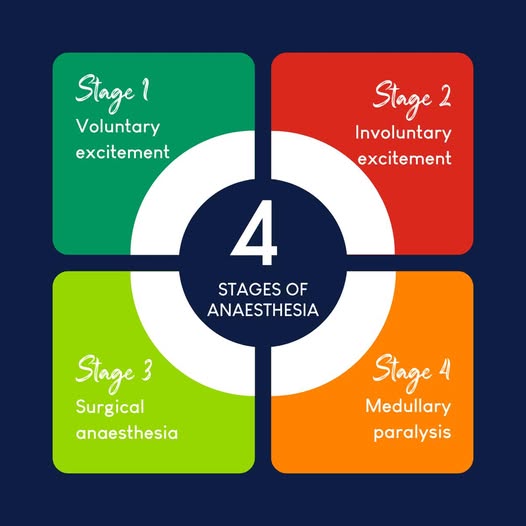
4 levels of anaesthesia:
- Analgesia (Induction Stage)
- Excitement or delirium
- Surgical anaesthesia
- Medullary paralysis (Overdose)
Each level has unique surgical features that help medical professionals figure out the patient’s level of sedation and maintain the safest depth of anaesthesia during surgery.
Level 1: Analgesia (Induction Stage)
The first level of anaesthesia is known as the analgesia stage. This stage starts when the drug is first given and lasts until the patient loses consciousness.
During this stage you will see the following:
- The patient remains conscious but begins to feel reduced pain sensation
- Sleepiness gradually develops
- Breathing and reflexes remain normal
- The patient can still respond to verbal commands
This stage is referred to as the induction phase, as it is the stage at which the transition from the awake state to the unconscious state takes place.
The agents act by interfering with the nervous system’s pain pathways.
From the point of view of education, the students should be aware that analgesia is not adequate for the purpose of surgical procedures. However, it is the first stage in the process of preparing the patient for the next level.
Level 2: Excitement or Delirium Stage
The second stage of the 4 levels of anaesthesia is the excitement or delirium stage. This stage occurs after the patient loses consciousness but before the patient reaches surgical anaesthesia.
Common signs that are present during this stage include the following:
- Irregular respiration
- Increased muscle tone
- Involuntary body movements
- Increased heart rate and blood pressure
- Possible presence of coughing, vomiting, or agitation
During this stage, the patient’s brain undergoes a relaxation response. This response can cause the patient to move randomly. This stage is therefore critical.
For this reason, the stage is passed as quickly as possible. This is done through the administration of fast-acting IV anaesthesia. This helps to minimise the occurrence of possible complications such as airway obstruction or laryngospasm.
For a medical student working in the operating room, understanding this level of anaesthesia will ensure that the patient’s airway is well managed.
Level 3: Surgical Anesthesia
The third stage is the most important level among all the other levels, as it represents the perfect depth needed for performing surgery.
At this level, the patient is fully unconscious and does not respond to pain. The body becomes relaxed to allow surgical intervention.
Signs of this level:
- Complete unconsciousness
- Loss of protective reflexes
- Relaxation of skeletal muscles
- Regular breathing pattern
- Absence of eye movements
This stage is then subdivided into four planes that represent different depths of anaesthesia during surgery. These planes assist anaesthesiologists in regulating the dosage of the drug and ensuring that the appropriate level of sedation is achieved during surgery.
Most surgeries occur during plane 2 or plane 3 of the stage.
This stage demands monitoring of the levels of oxygen, rate of breathing, heart rate, and blood pressure to ensure that the patient is in the right state of anaesthesia during surgery.
Level 4: Medullary Paralysis (Overdose)
The final stage of the 4 levels of anaesthesia is medullary paralysis, often referred to as the overdose stage. This stage occurs when excessive anaesthetic drugs suppress vital centres in the brainstem.
Key features of this level:
- Severe respiratory depression or cessation of breathing
- Extremely low blood pressure
- Dilated, non-reactive pupils
- Complete muscle paralysis
- Cardiovascular collapse if untreated
This stage is extremely dangerous, and the situation may become life-threatening if immediate action is not taken. The suppression of the respiratory and cardiovascular centres of the brain may lead to death if immediate action is not taken.
Therefore, a professional anaesthesiologist must avoid this stage if there is no emergency.
Why Medical Students Must Understand the 4 Levels of Anaesthesia
Learning about the 4 levels of anaesthesia is an important part of the medical curriculum. Despite the emergence of modern monitoring techniques, the detection of physiological signs is an important skill.
Key reasons for the importance of the knowledge are the following:
- Patient safety
The recognition of the level of anaesthesia helps to avoid complications like overdose or underdose.
- Surgical efficiency
Surgical procedures can be carried out smoothly without interruptions due to movements or pain.
- Clinical decision-making
Doctors need to adjust the dosage of anaesthesia according to the patient’s reactions during the surgical procedure.
- Emergency situation handling
Understanding these stages helps clinicians identify dangerous situations such as respiratory depression.
According to the health report, more than 300 million surgical procedures are performed worldwide every year. This shows the importance of safe anaesthesia practices and skilled professionals.
Students must learn about anaesthesia and all its levels for emergency, critical and surgical care.
Preparing Future Doctors at Takshashila University
For medical students, Takshashila University has various programmes that help students in knowing essential concepts like the 4 levels of anaesthesia. As medical education is not only about theory but also requires skills like patient care and emergency situation handling, we prepare our students accordingly.
Our programmes are designed to provide foundations in clinical sciences and anaesthesia principles, exposure to modern medical technologies and hands-on experience with clinical rotations. We have mentors for students who will teach you based on their experience in addition to modern techniques and technologies. Takshashila University Advancing Excellence in Healthcare Education.
To Sum up
It is very important for every medical student involved in the field of surgery to have a clear understanding of the 4 levels of anaesthesia. These four levels are a series of progressive effects of anaesthetic drugs on the central nervous system.Even though modern technology has greatly contributed to ensuring the safety of anaesthesia, it is still important to stay alert when providing anaesthesia to the patients.
To ensure patient safety during surgery with the new doctor, there must be an experienced doctor present so there is no chance of any mishap. For those who wish to become doctors in the future, it is very important to have a clear understanding of these four levels of anaesthesia with situation-handling skills.
FAQ about Levels of Anaesthesia
1 What are the 4 levels of anaesthesia?
The four levels of anaesthesia are analgesia, excitement or delirium, surgical anaesthesia, and medullary paralysis.
2 Who introduced the 4 stages of anaesthesia?
This classification of the four stages of anaesthesia was introduced by anaesthesiologist Arthur Guedel in the early twentieth century.
3 Which stage is ideal for surgery?
Stage 3, or surgical anaesthesia, is the ideal stage for carrying out surgical procedures.
4 Why is Stage 2 considered dangerous?
Stage 2 of anaesthesia is dangerous due to the irregular breathing pattern and involuntary movements.
5 What happens during the analgesia stage?
During Stage 1 of anaesthesia, the patient feels relief from pain but remains conscious.
6 What is medullary paralysis in anaesthesia?
It is the overdose stage where the respiratory and cardiovascular centres in the brain are severely depressed.
7 Are the four stages still relevant in modern medicine?
Yes, they are still relevant in modern medicine, although technology has improved significantly.
8 How do anaesthesiologists monitor anaesthesia depth today?
Anaesthesiologists today monitor the depth of anaesthesia using pulse oximeters, capnometers, blood pressure monitors, and EEG
machines.
9 Can patients skip some anaesthesia stages?
In modern balanced anaesthesia techniques, some stages may be skipped or may be hardly noticeable.
10 Why should medical students study anaesthesia stages?
Medical students should study the anaesthesia stages so that they can recognise the patient’s response to anaesthesia and thus improve patient care during surgery.