
Short Summary
Will AI replace radiologists? This question has gained attention as artificial intelligence rapidly advances in medical imaging.
Though there has been a lot of talk about AI replacing radiologists, studies indicate that AI assists and does not replace individuals. AI increases diagnostic precision and improves workflow efficiency. This means that radiologists are still a critical part of modern healthcare systems. Aslo see this blof this will be usefuly for you . Also have a look at Future of BSc Anaesthesia
Introduction
Every profession is being impacted by artificial intelligence, and medicine is no different. Among all medical fields, one thing that has been on everyone’s mind, especially in academic circles and discussions about potential careers, is this : will AI replace radiologists? This is because, at its core, radiology is an image-based diagnostic process, and AI is particularly well-suited to perform such a function.
However, it is not a situation where AI will completely replace radiology, as has been indicated by recent trends and developments.
Instead, AI is transforming and impacting radiology at a very fast rate, and it is upon individuals who wish to pursue a career as a radiologist to understand exactly how this is happening and how they can position themselves for success.
Understanding AI and Radiology
To answer the question, will AI replace radiologists? However, we have to consider how AI is actually being used in radiology today.
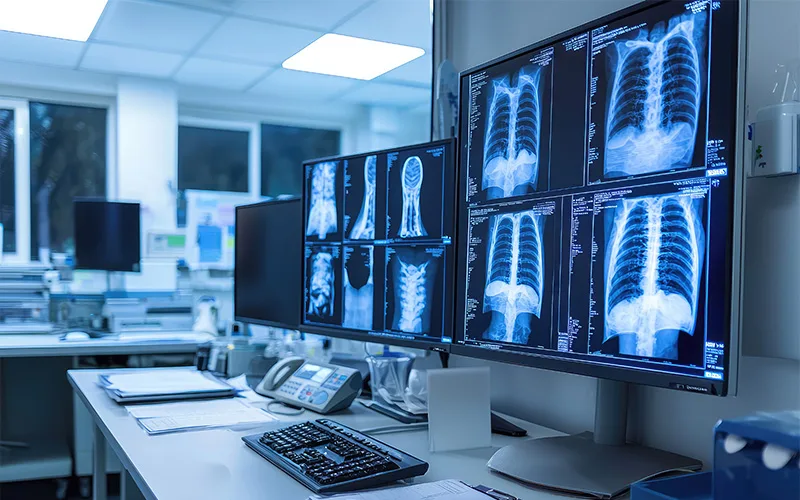
The use of artificial intelligence in radiology is to aid in analysing medical images such as X-rays, CT scans, and MRIs in detecting medical problems such as tumours, fractures, and strokes.
Recent studies have shown that artificial intelligence can perform tasks just as well as a human in recognising medical images. However, this is only in a controlled environment.
Additionally, artificial intelligence is not making clinical decisions on its own but is an aid to a trained radiologist.
Therefore, instead of showing that artificial intelligence is replacing radiologists in their jobs, current evidence suggests otherwise.
AI Taking Over Radiology: Reality or Myth
There has been no shortage of dramatic debate on AI replacing radiology completely.
This prediction by some scientists on AI that there would soon be no need for radiologists has been debated extensively.
But the truth has another face because AI algorithms are aiding image interpretation, which is created to assist the radiologist.
In a study conducted on medical students, only around 31% of people thought that AI would replace radiologists completely in their lifetimes, even though almost 45% of people thought that AI would reduce the number needed.
While radiology students worldwide seem to admit the value of AI, with around 73% agreeing that AI helps improve accuracy and decrease errors, only a small percentage seem to think that AI would replace human radiologists completely.
These studies showed that AI is indeed changing the perspective of a career in radiology, but the chances of radiologists being replaced by AI in the near future remain low.
Why Radiologists Aren’t Being Replaced
When thinking if AI will replace radiologists, the answer is no, and the reasons are here:
- Clinical judgement and complex interpretation
Radiologists are not just picture interpreters; they use a combination of clinical history, lab values, and patient symptoms to make predictions.
Many complex diagnostic decisions cannot be made by artificial intelligence. AI can point to a lesion that is suspicious for cancer, but only a trained Radiologist can understand its significance in relation to the entire medical picture.
- Patient interaction and communication
The interaction between a patient and a medical professional is essential for a medical team. Skills such as empathy and judgement that cannot be brought about by AI. So this becomes an important reason why AI cannot replace the radiologist.
- Ethical and legal responsibility
Currently, there is no legal framework that allows AI systems to be entirely responsible for medical decisions. Even if AI is used for medical diagnoses, the radiologist is ultimately legally responsible for interpreting the images.
- Continuous growth in imaging demand
The medical examination requirements continue to increase worldwide, especially due to the increasing age of the population and access to healthcare services.
Even if AI is used for medical imaging, the demand for radiologists is likely to continue increasing due to the complexity of medical requirements.
How AI Will Change Radiology Careers
Now, you get the answer of will AI replace radiologists, and that is no. So, now it’s time to understand how it will change the radiology career.
- By automating the routine task
AI can automate the routine tasks that involve repetition. It will help in tasks such as identifying clear normal cases or detecting obvious abnormal cases.
By using AI for these tasks, radiologists can focus on more complex cases or on tasks that add more value. This has now become an ongoing trend in many hospitals and clinics around the globe.
- AI has improve the radiology workflow efficiency
Use of AI can help radiologists to prioritise urgent cases, write preliminary reports, or integrate image information with electronic medical records.
In addition to this, AI can assist doctors in tasks such as the measurement of lesions, tracking changes over time, or creating reports that patients can understand.
- New specialisations and roles
Radiologists who understand AI can take on new hybrid roles. They can go for roles such as AI quality assurance, clinical workflow optimisation, or research in healthcare innovation.
This evolution parallels past shifts in professions where technology advanced but did not eliminate human expertise.
Preparing Future Radiologists for an AI-Driven World
If you are still wondering about AI taking over radiology, then you should know what the future of radiology holds.
- Embrace technology; don’t fear it
Radiologists who get aligned with AI will have an advantage over their colleagues. Knowing the basics of data science and AI will be part of radiology training in the near future.
- Focus on human-centred skills
Even in future clinical judgement, patient relations, and teamwork will be even more important. That AI cannot be replaced even in the upcoming days.
- Choose lifelong learning
Knowledge in medicine and AI will change fast. A radiology expert will be one who has updated his skills over time.
Takshashila University: Your Gateway to Future-Ready Careers
At Takshashila University, many students ask questions about whether will AI replace radiologists, and we have answers for them. As we know, the future of radiology careers is in the integration of human expertise and artificial intelligence.
That’s the reason we are committed to delivering curricula that combine traditional medical knowledge with modern AI skills to our students.
We guide students to lead in the continuously changing environment, innovate in diagnostic techniques, and work in a multidisciplinary environment. Our education model is designed so that students are not just equipped for the current situation but are ready to make their own future in medicine. Follow Takshashila University for healthcare innovation insights, student achievements, and campus updates: @takshashilauniv
To Wrap Up
For the question, will AI replace radiologists? The answer, based on the evidence to date, is a resounding no.
What AI will do, though, is change how radiologists work, make their lives less menial, and increase the importance of skilled professionals in patient care.
Far from being a threat to radiology jobs, AI represents an evolutionary catalyst for radiologists who learn to read pictures and algorithms alike.
Frequently Asked Questions About Will AI Replace Radiologists
1 Will AI completely replace radiologists?
No, it will not replace radiologists completely, according to the available evidence.
2 Is it possible for AI to interpret medical images as well as humans do?
Yes, it is possible for AI to interpret medical images as well as humans do, but it does not have the judgement required to do so.
3 Does AI reduce the workload of radiologists?
Yes, it does reduce the workload of radiologists by automating the work, thus potentially reducing the time spent on the task by radiologists.
4 Is it necessary for radiologists to learn AI programming?
Yes, it is necessary for radiologists to learn AI programming because it is a strong career asset, although it is not necessary for them to become programmers.
5 Will the demand for radiologists reduce as a result of AI?
No, it will not reduce the demand for radiologists because it will remain the same despite the presence of AI.
6 Are AI systems legally permitted to diagnose patients on their own?
No, AI systems are not legally permitted to diagnose patients on their own.
7 Can AI replace radiology training?
The answer to this question is no; AI may alter certain aspects but cannot replace the entire clinical training that a radiologist undergoes.
8 Do medical students have any fear about AI’s effect on radiology?
Yes; students have mixed perceptions about AI’s effect on radiology, with some students fearing its effect in the future.
9 Can AI deal with complex cases in radiology?
Currently, AI cannot deal with complex cases in radiology.
10 How should one become a radiologist in an AI world?
One should become a radiologist with knowledge of AI and develop humanistic clinical skills to deal with AI in the future.