
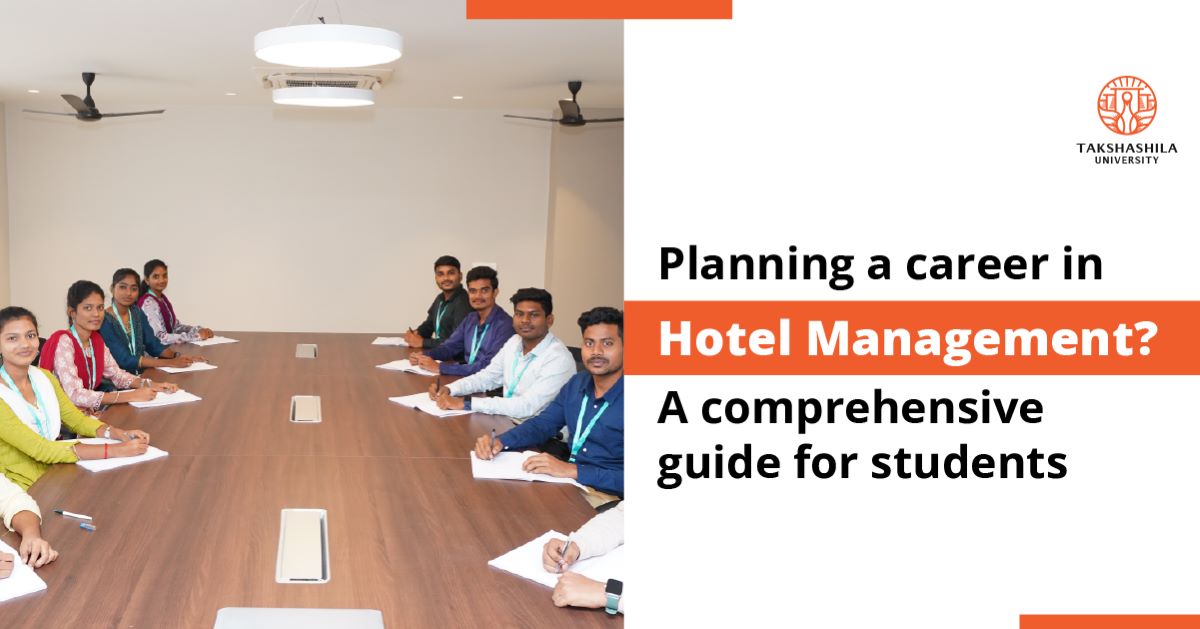
Just imagine you’re in a 5-star hotel. Are you more amazed by its extravaganza or the staff’s attention to make you feel at home? Their elegance, grace, warm greetings, and smiles stay with you forever. Do you want to be the mastermind behind this symphony of hospitality? Then, you should pursue a career in hotel management.
Thinking of hotel management, what comes to your mind? Hospitality, guest experience, etc.? Hotel management means supervising and coordinating the operations, services, and administration of hotels, resorts, motels, or lodges.
If you are a 12th-grade student aspiring to become a hotelier, enrol in the B.Sc. Hotel Management course at Takshashila University for a successful and fulfilling career.
A Comprehensive Guide To Starting A Career In Hotel Management
Let’s explore the step-by-step process that will help set you on the path to a prosperous career in hotel management after 12th grade.
1. Know The Eligibility Criteria

- The candidate should have completed 10+2 (or equivalent) in any stream from a recognised education board.
- A minimum percentage of 50% should be obtained. (It differs from one college to another and is based on the reservation)
- The candidate should appear for the entrance examination at the national, state, or institute levels.
Some national-level entrance exams are the All India Management Association Undergraduate Aptitude Test (AIMA UGAT), the International Institute of Hotel Management Electronic Common Hotel Admission Test (IIHM eCHAT), etc.
2. Explore The Courses

- You should explore the undergraduate degrees offering comprehensive curricula, including hotel operations, management principles and hospitality-related subjects.
- Before selecting the course, take the duration, accreditation, and the opportunities for practical training into consideration.
Here are the UG Hotel Management courses you can take,
- Bachelor of Hotel Management (BHM)
- BBA in Hospitality Management
- Bachelor of Science in Hospitality and Tourism Management
- Bachelor of Science in Hotel Management
3. Develop Essential Skills

- After enrolling in an undergraduate degree that suits your preferences and choice, ensure you develop the necessary skills to excel in the hospitality industry.
Here are’re some skills a hotel management professional should possess
- Communication skills
- Problem-solving skills
- Leadership skills
- Teamwork skills
- Organisational skills
- Flexibility
- Customer service skills
4. Gain Practical Experience

- While pursuing a college degree, opt for internships or part-time positions at hotels, resorts, or restaurants to gain hands-on experience.
- By having practical knowledge, you can get insights into hotel operations and customer service, and get a chance to apply classroom teachings in real-time work.
- The hands-on learning in hotel management complements your academic qualifications and will be an addition to your resume.
5. Stay Updated With The Latest Trends

- Since the hospitality industry is ever-evolving, you should stay updated about the latest advancements in technology, sustainable practices, guest preferences, industry innovations, etc.
- To meet up with the dynamic hospitality industry, you should dedicate yourself to continuous learning and adaptability.
6. Build A Professional Network

- To excel in the hotel management career, you should have contacts. Networking is the best way to build connections with industry professionals, mentors, and potential employers.
- You can open doors to career opportunities and valuable insights by attending hospitality events, industry conferences, and professional associations related to hotel management, etc.
7. Job Search And Career Opportunities

- You should begin your job search during your final year of college and look for entry-level positions in hotels or related establishments.
- You can opt for roles like front desk associates or food and beverage staff to gain a solid foundation in the hospitality industry and for career advancement. You can eventually take up supervisory and managerial positions.
8. Embody Professionalism

- In the hospitality industry, professionalism is one thing that helps you reach success. Whether during college or in the first job, start practising to demonstrate a positive attitude, attention to detail, and excellent customer service.
- When you display professionalism with your guests and colleagues, you move forward towards career progression, earning respect and trust from your peers and authorities.
9. Embrace Continuous Learning

- Once you have completed your B.Sc. Hotel Management degree, do not stop learning. You can do a master’s degree, advanced certificate courses, or attend workshops to continuously enhance your knowledge and skills.
Enrol in the 2-year master’s in hotel management course and enhance your chances of success in the hospitality field.
10. Seek International Exposure

- Try for international opportunities to broaden your horizons and gain deep insights into the diverse hospitality field.
- When you work in different countries or with different international hotel chains, you can broaden your global hospitality experience.
Planning a career in hotel management is easy with this step-by-step guide.
Do you know?
Is Hotel Management the same as Hospitality Management?
ANSWER: No. Though they are related fields, there differ in their emphasis.
Hotel management focuses on operating and administrating hotels, resorts, and other lodging establishments, including front desk operations, housekeeping, food and beverage management, and overall guest experience in a hotel setting.
Hospitality management is a broader discipline that covers various services and experiences beyond hotel operations, including tourism organisations, event planning, cruise lines, theme parks, and more.
Why Choose Takshashila University’s School of Hotel Management?
You should select Takshashila University as your top option for a B.Sc. in hotel management because it is a renowned university in India. Due to the wide variety of courses and excellent infrastructure, it is an ideal place to start your career.
Engineering, arts and sciences, allied health sciences, hotel management, physiotherapy, and agricultural sciences are among the university’s departments. It is spread across 150 acres of land and has 64 disciplines. The university’s academic and athletic scholarships allow students to follow their ambitions despite financial constraints.
The institution has collaborated with organisations to ensure that all graduates get placed. Hands-on learning equips students with transferable skills that allow them to shine in interviews and get recruited by potential employers.
Experienced faculty members teach students to deal with real-world situations by developing leadership and problem-solving skills.
Conclusion
If you are planning a career in hotel management, this blog will act as a go-to guide to establish yourself in the industry. From educational qualifications to getting placed, it covers everything you need to know to start from scratch. With your passion for service as a key check-in to your dream career for a rewarding and exciting future. From passion to profession, take the first step @TakshashilaCollege.
Frequently Asked Questions (FAQs) About a career in hotel management
1. Why should I choose hotel management as a career?
Hotel management is a promising career since it offers diverse opportunities, allows you to develop essential skills, such as communication, leadership, problem-solving, etc., and allows you international exposure.
2. Is there scope for hotel management?
There is a massive scope for hotel management since the hospitality industry is only ggrowing Since people are into more travelling and hotels play a vital role in accommodation, it leads to demand for hotel management professionals.
3. Which stream is best for hotel management in 12th?
Though students can pursue undergraduate hotel management courses irrespective of any stream, taking the commerce stream in 12th grade is usually recommended to understand Accounts and Economics.
4. Is hotel management difficult?
The difficulty level varies from one person to the other. Since hotel management involves subjects like customer service, finance, and operations management, it can be challenging, but students still find it manageable.
5. In what industries do hotel management graduates work?
Hotel management graduates work in diverse industries such as hospitality, tourism, event management, cruise lines, airline services, and conference centres. They get incredible opportunities to work in the entertainment industry.
6. What skills are required to succeed in the hospitality industry?
To succeed in the hospitality industry, strong communication, customer service, and problem-solving skills are essential. Professionals must handle guests politely and manage situations calmly. Leadership and teamwork skills are also important for managing operations smoothly. Time management and adaptability help in fast-paced environments. Developing these skills during your course improves employability and helps build a successful long-term career in hotel management.
7. What are the career options after completing hotel management?
After completing hotel management, students can explore roles such as hotel manager, front office executive, food and beverage manager, event planner, and housekeeping supervisor. Opportunities also exist in airlines, cruise lines, and luxury resorts. With experience, professionals can move into senior management roles. The field offers diverse career paths, allowing individuals to choose based on their interests and grow steadily.
8. What is the salary after hotel management courses in India?
The salary after hotel management depends on job role, company, and experience. Fresh graduates can earn around ₹15,000 to ₹30,000 per month. With a few years of experience, salaries can increase significantly, especially in reputed hotels or international chains. Senior professionals and managers earn much higher packages. The hospitality industry also offers additional perks like incentives, accommodation, and travel benefits.
9. Are internships important in hotel management courses?
Yes, internships are a crucial part of hotel management courses. They provide real-time exposure to hotel operations and help students understand industry standards. Internships improve practical skills, confidence, and communication abilities. They also help students build professional networks and increase job opportunities. Many companies prefer candidates with internship experience, making it an important step toward a successful career.
10. Can hotel management graduates work abroad?
Yes, hotel management graduates have excellent opportunities to work abroad. The hospitality industry is global, and skilled professionals are in demand worldwide. Many international hotel chains recruit trained candidates for roles in management, customer service, and operations. Working abroad offers better salaries, exposure to global standards, and career growth. Proper skills and experience can help secure international job placements.
11. What is the role of customer service in hotel management?
Customer service is the foundation of hotel management. Professionals must ensure guests have a comfortable and pleasant experience. This includes handling requests, resolving complaints, and maintaining high service standards. Good customer service builds brand reputation and customer loyalty. Strong interpersonal skills and a positive attitude are essential to deliver excellent service and succeed in this field.
12. Is hotel management a good career for the future?
Hotel management is a strong career choice due to the growing travel and tourism industry. As people continue to travel for leisure and business, the demand for hospitality professionals is increasing. The field offers job stability, global opportunities, and career growth. With the right skills and experience, individuals can build a rewarding and future-ready career in hotel management.
13. What are the top recruiters in the hospitality industry?
Top recruiters in the hospitality industry include luxury hotel chains, resorts, airlines, and event management companies. Well-known brands often hire skilled professionals for various roles. These companies offer structured career growth, training, and global exposure. Getting placed in a reputed organization can significantly boost career prospects and provide valuable industry experience.
14. Can hotel management graduates start their own business?
Yes, hotel management graduates can start their own business after gaining experience. They can open restaurants, cafes, catering services, or boutique hotels. The course provides knowledge of operations, finance, and customer service, which is helpful for entrepreneurship. With proper planning and market understanding, starting a business in the hospitality sector can be highly profitable.
15. What is the duration of hotel management courses after 12th?
Hotel management courses after 12th typically range from 3 to 4 years for undergraduate programs. Diploma and certificate courses may have shorter durations, usually between 1 to 2 years. The course includes both theoretical and practical training. Choosing the right program depends on career goals, but a full-time degree often provides better opportunities and long-term growth.
16. How to choose the best college for hotel management?
Choosing the best college depends on factors like accreditation, faculty, infrastructure, and placement opportunities. Look for institutions that offer strong industry exposure and internship programs. Reviews, rankings, and alumni success can also help in decision-making. A good college provides quality education and better career opportunities, making it an important step in building a successful career in hotel management.




2 Responses
Thanks for sharing. I read many of your blog posts, cool, your blog is very good.
Hi,
Thank you so much for your kind words! We’re thrilled to hear that you’re enjoying our blog posts. Your support means a lot and motivates us to keep sharing helpful and informative content.
Warm regards,
Team Takshashila University