
Blog Preview
Interested in knowing the scope of electronics and communication engineering in India? Whether you are looking for core VLSI and telecom profiles, crossover IT roles, or government positions, the current job prospects and ECE Engineering Career Scope in india in 2026 are outlined below.
Short Summary
The ECE scope in India is wide-ranging and can be generally categorised into four streams, which include core electronics, telecom and communication, IT and software engineering and also government sector ECE jobs, each offering different career outcomes.
Generally, the starting salaries of electronics communication engineering jobs are within the range of Rs 3-7 LPA; however, the salaries of VLSI jobs with companies such as Intel and Qualcomm start well above Rs 15-30 LPA.
The Indian semiconductor market will be valued at $63 billion by 2026, supported by government investments of Rs 76,000 crore in fabs and design centres, which are opening new hiring opportunities at core ECE companies.
Key Takeaways
- There are broadly four paths followed by ECE graduates in India: IT/software jobs, core ECE streams such as VLSI and embedded systems, government services, and higher education.
- Basic-level salaries in ECE in India lie in the range of Rs 3-7 LPA, but there is huge disparity, from Rs 3 LPA at mass IT recruitment firms to Rs 15-30+ LPA at core ECE firms focused on VLSI.
- India’s semiconductor drive includes Micron’s Gujarat fabrication facility and Tata Semiconductor’s upcoming Assam and Dholera fabs.
- Government services and PSUs still form a lucrative path for ECE engineers, with DRDO Scientist B and ISRO Scientist SC being the most lucrative jobs among freshers.
- Going in for higher education, especially an M.Tech in VLSI or a related specialisation, helps get into Tier 1 core ECE companies and design jobs.
Introduction: Cover Core Jobs, IT Opportunities, Salaries, and Higher Studies in One Complete Guide
The ECE scope in India is one of the most versatile streams in Indian engineering since there isn’t just one definite path that an electronics and communication engineer must follow.
The field includes core hardware and chip designing, telecom and 5G. infrastructure, a seamless shift to IT and software, and a solid government and PSU route via the GATE recruitment process.
This guide aims to highlight the actual scope of electronics and communication engineering in India, the top core positions which offer good salaries, the IT transition route, realistic salary levels across each of the paths, and instances when further studies make sense.
We will discuss the trends in the semiconductor and electronics industries that are impacting the scope of electronics and communication engineering in India. Watch a quick breakdown of ECE career paths.
What Does ECE Scope in India Actually Look Like in 2026?
While most ECE graduates in India do not go down one generic career route, they divide themselves among four different career paths, each having vastly different salary ceilings:
- IT/software (approximately 60%)
A majority of ECE graduates join the IT/software sector, which is more or less the same as the career path taken by CSE graduates due to the fact that the campus placement process heavily biases towards IT service recruiters.
- Core ECE fields (approximately 20%)
VLSI, embedded systems, telecom, and semiconductor jobs, where pay is much more determined by specialisation than the degree.
- Technical services in the government sector
DRDO, ISRO, Railways, and PSUs like BEL, HAL, and ECIL through means of GATE or specific entrance exams.
- Further education and other career options
M.Tech, MS from abroad, MBA, or any entirely different career field.
The main thing to note here is that the scope of ECE is not one number, but it is a decision point for the students who have to make the right choice instead of taking the default career route decided by their recruiter.
Electronics Communication Engineering Jobs: Core Roles Worth Knowing
There are certain domains in core electronics and communication engineering to which the jobs are confined, each having different qualifications and career trajectories.
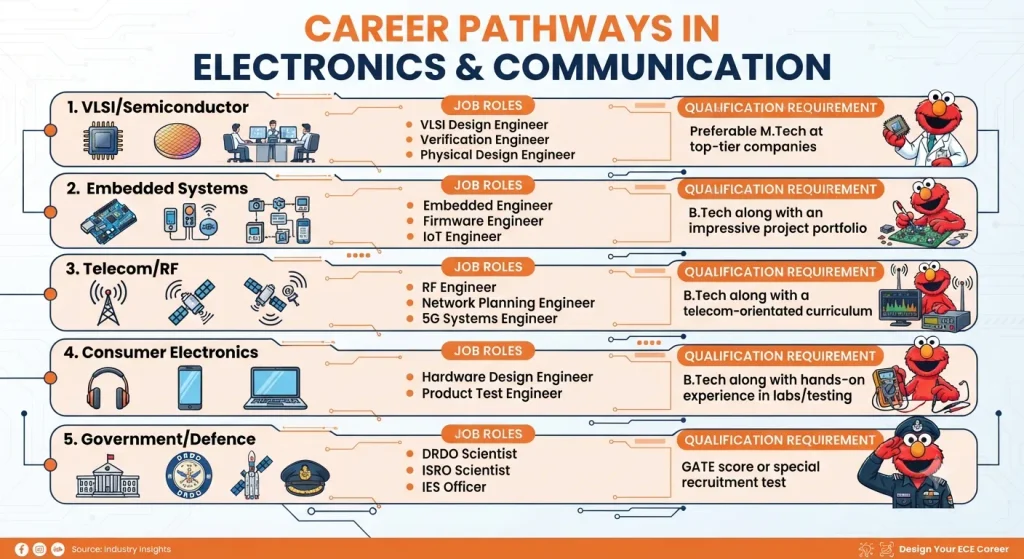
| Domain | Job Roles | Qualification requirement |
| VLSI/Semiconductor | VLSI Design Engineer, Verification Engineer, Physical Design Engineer | Preferable M.Tech at top-tier companies |
| Embedded Systems | Embedded Engineer, Firmware Engineer, IoT Engineer | B.Tech along with an impressive project portfolio |
| Telecom/RF | RF Engineer, Network Planning Engineer, 5G Systems Engineer | B.Tech along with a telecom-orientated curriculum |
| Consumer Electronics | Hardware Design Engineer, Product Test Engineer | B.Tech along with hands-on experience in labs/testing |
| Government/Defence | DRDO Scientist, ISRO Scientist, IES Officer | GATE score or special recruitment test |
Core ECE employers at the entry level, especially Tier 3 VLSI firms and small embedded firms, tend to pay almost the same amount as mass IT recruiters at roughly Rs 3-8 LPA.
However, the actual variation comes in at the upper end of the specialisation chain, especially for VLSI at Tier 1 firms.
ECE Salary in India: A Realistic Salary Analysis by Career Tracks
There is huge variation in ECE salary in India based on which of the four career paths an engineer takes, and it is the incorrect conflation between the various paths that leads to the myth that ECE salaries are lower.
- Mass IT/crossover roles pay Rs 3-6 LPA, drawing from the same recruiter pool as CSE graduates in IT firms.
- Core ECE entry-level roles pay Rs 3-8 LPA, similar to IT entry, with future growth tied to specialisation. Tier 1 VLSI firms paying Rs 15-30 LPA, however, typically prefer or even require an M.Tech.
The exact same ECE degree can fetch an offer ranging from Rs 3 LPA to Rs 30 LPA, and in both cases, what will make the difference is specialisation.
Semiconductor & Electronics Trends Influencing Future Scope in India
This is the segment that sees the highest change in ECE scope in India, and it deserves some understanding of how VLSI and semiconductor jobs are becoming the biggest growth opportunity in the field.
- The Indian semiconductor industry is expected to grow to a market size of USD 63 billion by 2026 due to supportive government policies and increasing domestic chip demand.
- Indian semiconductor investments have reached around Rs 76,000 crore, financing new fabrication facilities like Micron’s in Gujarat and Tata Semiconductor’s upcoming facilities in Assam and Dholera.
- Design centre expansion is in full swing: Intel, Qualcomm, AMD and Samsung have all increased their chip design capacity in India.
- Salary in the VLSI industry is rising by 15-20% every year, which is way above the overall IT sector salary rise, due mainly to the fact that there is an M.Tech-preferred barrier for entry into the field.
- Job openings expected by 2028: 50,000-100,000 positions related to VLSI, as fabrication plants and design centres shift from construction to operation and hire people.
- Investment in 5G technology crossed Rs 1.5 lakh crore, resulting in a continued requirement for RF and telecom-related ECE professionals well after the roll-out period.
Expert Advice: Career counsellors often tell ECE students to consider specialising in VLSI or embedded systems as a conscious choice to be made in the second year and not as a last-minute choice, considering the huge difference in salaries of core jobs vs. VLSI specialist jobs that have been increasing in India with their fab investments.
Building ECE Talent Ready for India’s Core and IT Job Markets
The programme at Takshashila University acknowledges the truth that the students graduating from the university would pursue different streams like core electronics, telecom, IT, and government instead of having similar aspirations from the course.
There are separate laboratories for VLSI, embedded systems, and communication engineering to provide practical experience to students much before placements.
Also, proper training and guidance are provided to students for preparing for the GATE examination in order to keep the M.Tech and PSU options truly open.
The placement cell has connections with different companies in the core ECE field, IT services, and the telecom industry, which enables the final-year students to decide their specialisation consciously through project experience.
To Wrap Up
The 2026 scope of ECE in India is truly vast, but it isn’t consistent, and that is where students are making a mistake in thinking of all paths as one and thus are losing out on some good pay packages.
The fastest growing are core VLSI and semiconductor positions driven by investments of fabs and design centres in India; telecoms, IT crossover and government paths have their own consistent and distinct trajectory.
It depends on the interest in hardware vs software, desire for M.Tech, and government recruitment through GATE, but all these are respectable ways to go forward for an ECE graduate.Energetic & Student-Friendly: Vibes, events, and everything Takshashila! Hit follow on @takshashila university to stay updated every day. are your think about How to Choose the Right Engineering Specialisation
Students interested in pursuing Electronics and Communication Engineering in Tamil Nadu can explore the B.Tech in Electronics and Communication Engineering (ECE) programme at Takshashila University. The programme offers an opportunity to build a foundation in electronics, communication systems, and related engineering technologies while preparing for careers in the evolving technology sector.
Frequently Asked Questions about ECE Engineering Career Scope
Q. 1. What is the ECE scope in India in 2026?
The scope of ECE in India includes four tracks: IT/software crossover, core electronics positions, government technical agencies, and advanced study, with varying levels of income and career prospects among these tracks.
Q. 2. What is the average ECE salary in India for freshers?
The starting salary of ECE ranges from Rs 3-7 LPA; however, the salary bracket is very wide, ranging from Rs 3 LPA for mass IT firms to Rs 15 to 30++ LPA for Tier 1 VLSI firms such as Intel/Qualcomm.
Q. 3. Which are the top core ECE companies in India?
Top core ECE companies are Intel, Qualcomm, AMD and Samsung for VLSI; BEL, HAL and ECIL for PSUs; and DRDO & ISRO for government agencies.
Q. 4. Are most of the ECE graduates employed in IT profiles?
Yes, about 60% of the ECE graduates are placed in IT/software profiles which pay and carry the same profile as that of CSE graduates due to the presence of many recruiters of IT services.
Q. 5. Should one opt for VLSI as a career path post ECE?
Yes, the salary increment in the VLSI domain is roughly 15%-20% per annum, which is more than the general IT domain salary growth, and the push towards the semiconductor industry in India is expected to create about 50,000 to 100,000 jobs in the VLSI domain till 2028.
Q. 6. Is an M.Tech course important for a core ECE career?
An M.Tech is preferred/required in most Tier 1 VLSI and chip designing firms. In case of embedded systems and telecom/IT crossover careers, an excellent project portfolio during B.Tech is usually enough.
Q. 7. What are the government job options for ECE graduates?
The government recruitment avenues open for ECE graduates are DRDO, ISRO, IES, Railways, and PSUs such as BEL, HAL, and ECIL and can be attained either via GATE score or through special examinations, with DRDO and ISRO having the highest fresher salary.
Q. 8. How would the impact of the semiconductor industry in India be reflected in the demand for ECE jobs?
There is a forecast of USD 63 billion growth in the semiconductor industry of India in 2026, where fabs at Micron and Tata Semiconductor and expansion in design centres will create a greater need for VLSI-skilled ECE engineers.
Q. 9. How do core ECE jobs differ from IT crossover jobs for ECE graduates?
Core ECE jobs entail electronics, embedded systems, VLSI and telecommunications work that are related to the ECE syllabus, while IT crossover jobs involve programming work in software development like CSE graduate jobs.
Q. 10. In case of doubt in core and IT options, should one go for ECE?
Definitely yes, because ECE keeps both ways open. Core electronics skills can be obtained through labs and projects of ECE, while programming skills can also be acquired before specialisation based on personal interest.