

Blog Preview
Doubts whether research opportunities university India will help you professionally in the future? Undergraduate research in publications or patents makes you exactly what admissions committees and recruiters want to see in you.
Short Summary
Research opportunities university India are not anymore some niche activity only for a few toppers but a true career differentiator in engineering, sciences and management.
According to Science and Engineering Indicators data, India awarded 40,813 doctorates in 2018–19, placing it third globally in S&E PhDs. India produced more than 300,000 research publications in 2022, ranking third globally.
The best private universities in Tamil Nadu get through projects and internships from professors, which makes it possible for students to be better prepared for postgraduate admissions, industries and innovation-based careers.
Key Takeaways
- India is positioned in third place in the world regarding the yearly number of PhDs awarded (40,813) as well as the publication rate (more than 3 lakh papers), which indicates a substantial research community.
- Research experience can strengthen postgraduate applications by demonstrating practical research skills, subject interest and the ability to work on open-ended problems.
- India’s R&D expenditure has remained below 1% of GDP, reaching an estimated 0.87% in 2024–25, according to the latest DST data.
- India recorded a 31.6% increase in patent applications in 2022, one of the strongest growth rates among major filing origins.
- An organised research internship, even for a semester, will provide practical exposure to research to the students much before they go for postgraduate studies or take up research careers.
Introduction: Explain the Importance of Research Projects, Publications, and Innovation From Day One
The process of research is becoming one of the major factors which help students stand out throughout their academic and professional life; however, most students perceive it as something exclusive only to their graduate years.
However, research opportunities university India , as well as project and publication experience, are the very skills sought after by employers and Ph.D. committees.
The research sphere in India has been growing and evolving rapidly over the years and currently is the third-largest producer of PhDs and research publications in the world. Want to gain research exposure while studying? Explore the research opportunities available at Takshashila University.
The programmes developed by the Indian government as part of the NEP 2020 agenda, as well as funding policies, actively encourage universities to promote research culture amongst undergraduates.
This blog is going to explain the importance of getting research experience while studying at the undergraduate level and the process of entering a Ph.D. programme, as well as where to get your research internship.
Why Research Opportunities Matter Long Before Postgraduate Study
There is no doubt that the experience gained from research has many other implications in addition to a single line on the resume.
Those students who have engaged themselves in research activities during their undergraduate degrees are likely to gain more analytical skills, more efficient problem-solving, and enhanced technical writing abilities compared to those who have no such research experience and only follow standard coursework.
In particular, research experience is definitely taken into account when considering applications to postgraduate studies, thus providing students with a competitive advantage over other applicants lacking this experience.
The practice is widely spread nowadays among colleges and universities in India, encouraging students to get involved in research groups and internships already in their freshman year.
Furthermore, research experience can also serve as evidence of the candidate’s ability to solve an open-ended problem that does not necessarily have a ready-made solution.
Undergraduate Research India: What the Numbers Actually Show
India’s R&D landscape has expanded by leaps and bounds, even while lagging behind countries leading in investment in research and development.
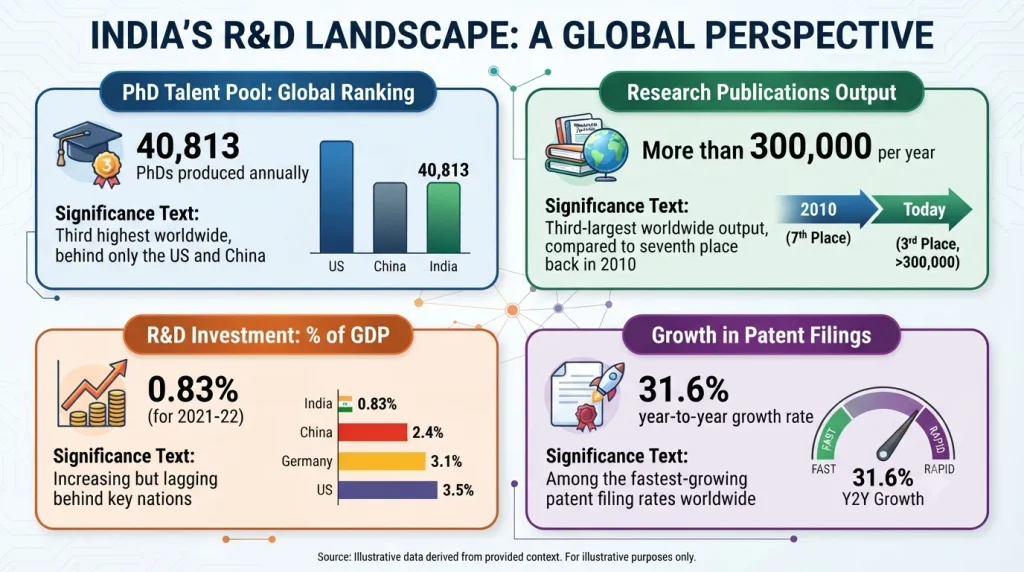
| Parameter | Value | Significance |
| Number of PhDs produced annually | 40,813/year | Third highest worldwide, behind only the US and China |
| Number of research publications | More than 300,000 per year | the third-largest worldwide output, compared to seventh place back in 2010 |
| R&D Expenditure as % of GDP | 0.83% (for 2021-22) | Increasing but lagging behind China (2.4%), Germany (3.1%), and the US (3.5%) |
| Growth rate of patent applications filed | 31.6% year-to-year | Among the fastest-growing patent filing rates worldwide |
How Government Initiatives Are Expanding Undergraduate Research Access
Now there are several initiatives of the government itself that provide opportunities to undertake undergraduate research in India.
- The Anusandhan National Research Foundation has been instituted to promote research funding and industry-academia interactions among Indian institutions, thus providing opportunities for research beyond a few prestigious institutions.
- A Rs 1 lakh crore Research, Development and Innovation (RDI) scheme has been initiated from November 2025, which focuses explicitly on incentivising innovations in the private sector and filling in the gap between early-stage academic research and market products.
- AISHE surveys and RUSA (Rashtriya Uchchatar Shiksha Abhiyan) offer financial support that assists in implementing a research-based programme for undergraduate students.
Understanding the PhD Pathway
Students who wish to pursue research as a career will follow a series of steps in their journey to become a PhD, which is strongly influenced by the research experience they get during their undergraduate studies.
- Undergraduate research projects/internships develop basic research skills and give the students a sense of real research interests.
- Research internships for college graduates give practical experience and offer some form of stipend and certificate programmes.
- Postgraduate studies become more competitive for candidates having an undergraduate research experience, preferably a publication or good recommendation from their research supervisors.
Research Internships and Industry Applications
The research internship is not merely a stepping stone towards academics; it is increasingly being used as a direct means towards innovation within the industry sector. Research internships can be taken up through research institutions, universities, industry labs, NGOs or think tanks to get students a glimpse of research in practice, i.e., in the form of products, policies, and systems, as opposed to publication.
This industry interface is more relevant today than ever before. The research landscape in India has traditionally excelled in early-stage research but failed to translate this into commercialisation (TRL 7-9).
Internship exposure to such industry-orientated research issues is extremely important for students irrespective of their intention of pursuing either a PhD pathway or research within the industry.
How Early Research Exposure Shapes Real Outcomes
Take two such examples where undergraduate research experience actually manifests in action. The engineering student who takes part in an embedded systems project led by the faculty during their second year usually experiences first-hand the benefits of debugging and documenting that help them in their interview process.
With companies now asking students to present a complete project as opposed to working out theoretical problems.
In a similar vein, the student who participates in the research internship for a semester, taking part in data collection and analysis and even co-authoring a paper or making a poster presentation, is bound to have an edge over others who have only grades from their courses.
Expert Advice: The common experience shared by all faculty researchers is that students with research experience from early on, including a minor second-year project, are able to take up much more demanding research internships and PhD applications in their final year.
Building a Research Culture That Prepares Students for What Comes Next
In contrast to many other universities, research opportunities university India are not something postgraduate students at Takshashila do; rather, they are an integral part of their learning process.
The undergraduate research opportunities at Takshashila University give the chance to engage in live research along with the faculty members. Students can use modern laboratories and courses that incorporate the latest fields such as AI, IoT, and data analytics.
Events like the Tech Bootcamp and the XE Conclave conducted at the university provide an opportunity for students to learn about real-world challenges along with research. Moreover, faculty mentoring helps the students discover their interests in research early on.
To wrap up
Research opportunities university India are altering the way students establish their academic and professional profiles even before they pursue postgraduate programmes.
Now, with India becoming the third-highest country in the world for research with respect to its number of PhDs and publications, as well as government programmes that are making it possible for undergraduates to access research funds and infrastructures, now is the time to get involved with research from undergraduate years.
This will not only help in gaining valuable skills through research experience but also make one’s academic profile stand out.Energetic & Student-Friendly: Vibes, events, and everything Takshashila! Hit follow on @takshashila university to stay updated every day. also if your inresyed check out A Day in the Life at Campus so we can grow together
Frequently Asked Questions about How Research Opportunities in University
Q. 1. What is the significance of research opportunities university India?
Undergrad research enhances one’s analytical skills, problem-solving skills and technical writing skills, which would not be acquired through coursework, and even makes one’s application for postgraduate study more attractive besides providing a specific project to the recruiters to judge.
Q. 2. How does undergraduate research assist PhD admissions?
Research experience is viewed as a major asset for postgraduate study because admissions committees prefer candidates who possess a proven track record in handling problems and, most preferably, a publication or a good recommendation from professors to coursework performance alone.
Q. 3. What is India’s position in global research production?
India occupies the third place globally in terms of annual PhD production, which amounts to over 40,813 PhDs per year, and the number of publications, amounting to over 3 lakh publications in a year.
Q. 4. How can a first-year or second-year student get into a research internship?
Students can start by going through the faculty publication list, attending seminars of departments, and then talking to those professors who share their interest area, as most Indian institutions have started encouraging research from the beginning.
Q. 5. What is the difference between a research internship and an internship?
A research internship is related to participating in some kind of research, whereas a normal internship has to do with some other activities performed under a professional environment.
Q. 6. Does India have adequate investments in research and development?
R&D investments in India stand at around 0.83 per cent of GDP, as compared to America (3.5 per cent) and China (2.4 per cent); hence, there is active involvement of government in the form of schemes like the RDI scheme.
Q. 7. Which government schemes help with undergraduate research in India?
Some of the significant schemes are the Anusandhan National Research Foundation, the Rs 1 lakh crore Research, Development and Innovation Scheme, RUSA funding and the UGC rules related to the credit system for research internships completed by undergraduate students.
Q. 8. Can research experience be beneficial outside of academia as well?
Yes. Research experience is valuable because it builds transferable skills that recruiters seek out, including problem-solving under ambiguity and presentation of results in an understandable manner – both having applications in fields other than academia.
Q. 9. What is the innovation valley of death in India, and what does it mean for students?
The term applies to the fact that although India is good at basic research, it lacks the capability to commercialise its research work. The practical and industry-orientated research experience gained by the students helps in bridging this gap.
Q. 10. Is undergraduate research just important for PhD aspirants?
No. Though it increases chances of getting admitted to PhD programmes, it also develops the problem-solving and project management skills which are highly valued in industries and thus relevant for both students who want to pursue academics and those on an industry career path.