
Short Summary
NMC is India’s highest body that regulates medical education and determines whether or not an educational institution is qualified to take admissions. In this blog, we shall discuss what is NMC, how it works, and the actual benefits of getting it for students. We’ve also added a checklist to verify a checklist for the verification of NMC status of a college before admission.
Key Takeaways
- The National Medical Commission (NMC) is the statutory regulatory body for medical education in India, which replaced the Medical Council of India (MCI) in September 2020 under NMC Act, 2019.
- NMC approval, which comes in the form of a Letter of Permission (LoP), is necessary for any college before admitting MBBS students.
- There are four autonomous boards under NMC, and they are UGMEB, PGMEB, the Medical Assessment and Rating Board, and the Ethics and Medical Registration Board.
- Degrees from non-approved colleges are not valid for registration, government job and further studies; hence, verification is a must before admission.
- Simple document-based checklist to verify the NMC status of a college before admission.
Why Regulatory Approval Should Be Your First Checkpoint, Not an Afterthought
Selecting the appropriate medical college for studies is one of the most critical decision-making procedures a student goes through, which is no different from the care that a student takes to select an accredited course, be it an allied health science course in Tamil Nadu .
Medicine, however, carries an extra layer of scrutiny, because practising as a doctor in India requires a degree from an institution formally approved by the correct regulatory authority.
This is where the National Medical Commission (NMC) comes into play. Every year, thousands of proposals for establishing new medical colleges as well as increasing the seat capacity of existing colleges are examined, approved, or rejected by the NMC. This process is crucial for families to know about, and this blog explains all that in detail.
What is NMC?
The National Medical Commission is a regulatory body for medical education and practice in India. It was formed under the National Medical Commission Act, 2019, which was approved by the president on 8 August 2019 and officially came into existence on 25 September 2020 after replacing the Medical Council of India, which was in existence for decades.
History of the Change from MCI to NMC
The Medical Council of India, formed under the Indian Medical Council Act of 1956, was constantly criticised regarding lack of transparency in its approval process.
It was dissolved by the government in 2018 and placed under a temporary Board of Governors until the parliament enacted the NMC Act for a better and accountable regulator.
Unlike the members of MCI, who were elected from among practitioners, the 33 or so members of the NMC include nominated public health and academic experts along with the medical professionals.
The Four Autonomous Boards Under NMC
NMC does not work in isolation. The provisions made under section 16 of the Act provide for the division of regulatory functions among four independent boards with specific tasks assigned to each board:
Board Core Function
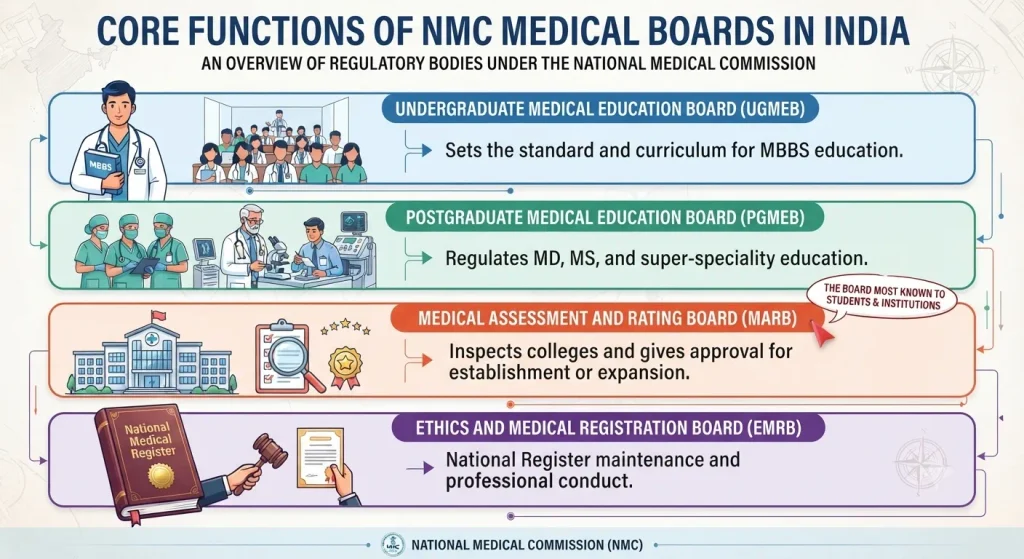
- The Undergraduate Medical Education Board (UGMEB) sets the standard and curriculum for MBBS education.
- The Postgraduate Medical Education Board (PGMEB) regulates MD, MS, and super-speciality education.
- The Medical Assessment and Rating Board (MARB) inspects colleges and gives approval for establishment or expansion.
- Ethics and Medical Registration Board National Register maintenance and professional conduct
It is the Medical Assessment and Rating Board, which is the most known to the students, because it conducts an inspection of the infrastructure of the college, faculty size and clinical exposure.
How the National Medical Commission Approves a New Medical College
Getting approval from the NMC is not a one-time activity; it is a formal process involving paperwork that every college, government or privately owned, has to go through before a single candidate gets admission.
The Application and Inspection Process
Every year, the MARB makes an appeal through its website for establishing new medical colleges, introducing postgraduate courses, or adding more seats, in accordance with Sections 28 and 29 of the NMC Act and Establishment of Medical Institutions, Assessment and Rating Regulations, 2023.
Following that, the college goes through inspection to verify the faculty-to-student ratio, the number of beds available in the hospital, laboratory facilities, and other teaching amenities.
Letter of Permission and Renewal
In case the MARB is satisfied with the response, the authority gives an authorisation letter (LoP) to the college allowing it to admit a certain number of MBBS or PG students in a particular academic year.
The same is not permanent since the college needs to approach again for approval in case the intake increases. The NMC has also said that any LoP granted by the college with the help of fake documents can be withdrawn at any point in time, even if the admission process is completed.
MBBS College Approval: A Checklist to Verify Before Admission
Because the consequences of enrolling in an unapproved college are so severe, it is worth building a simple checklist to verify NMC approval before admission. Families should:
- The name of the college should be found on the official website of NMC under approved colleges for that particular academic year.
- The college should be asked to provide a copy of the LoP and cross-check the number of seats mentioned in it.
- The academic year validity should be considered, because an LoP for one particular session does not guarantee approval for all future sessions.
- Affiliating university should be checked, since each NMC-approved medical college has to have affiliation to a recognised state or deemed university.
- NEET-based admission only should be considered. If the college offers MBBS seats through other means than NEET and counselling, then it should raise some red flags.
- Confirm from the state Directorate of Medical Education as well, as it normally releases its own list along with the NMC’s.
Just a few minutes spent going through the checklist could save years of wasted time, since an MBBS degree from any unapproved college cannot be registered with any state medical council or even for government services.
Medical Council India: Why Accreditation Is Important Now
Parents generally stick to using the old name, Medical Council India, because this used to be the registration process followed by the MCI. But this has not become obsolete; it has just changed.
The state medical councils continue to register doctors, provided that the MBBS degree of that doctor comes from an NMC-approved college. The Ethics and Medical Registration Board now holds the National Register of Doctors, on which the state medical councils base themselves.
Accreditation Is Not the Same as Approval
Two concepts need to be separated for a better understanding of this topic. The NMC approval is the formal authorisation required to conduct the MBBS or PG course and enrol students.
The second concept is accreditation, a quality assessment independent of NMC approval. The lack of a high-quality assessment does not prevent a college from NMC approval; that is precisely the reason students should consider both the LoP and the quality assessment.
Student Benefits of Choosing an NMC-Approved Medical College
Picking an approved college is not just a legal necessity; it directly shapes a student’s future:
- Recognised degree
Students who attend only those colleges recognised by NMC are allowed to register at a state medical council and practise legally in India.
- Eligibility for NExT
The future national exit test, which will function as a licentiate examination for graduates in MBBS, is based on the curriculum recognised by NMC, hence making it easier for them to comply with this criterion.
- Quality assurance infrastructure
MARB inspections ensure that recognised colleges fulfil the criteria in relation to faculty strength, bed capacity, and clinical exposure.
- Postgraduate opportunities
Recognition of a college is necessary for admission into NEET-PG and government hospitals, along with various fellowships.
- Safety from frauds
Official recognition saves families from being scammed by those colleges that charge fees without any valid LoP. This has happened with some applicants who have been victims in states where the approval was later proven to be fake.
| Did You Know?In the current 2024-25 cycle alone, the NMC cleared approximately 50 new medical colleges in just one notification, adding more than 8,000 MBBS seats and bringing the number of MBBS seats in the entire country well beyond 1,07,000 seats and 700-plus medical colleges – which is proof of just how active the regulator continues to be in the expansion and evaluation of medical education facilities in India. |
Why Takshashila University Promotes Verified & Approved Education
Takshashila University believes that regulatory clarity should not be an afterthought for any student making a decision regarding his or her studies, whether it is engineering, agricultural, managerial or allied health sciences courses in Tamil Nadu.
Our courses are designed and delivered according to the approval and affiliations needed by the regulating authorities, and we encourage students to verify all of their credentials prior to joining any institution, ours included.
In fact, we know that just like the MBBS degrees discussed above, health and allied health sciences degrees depend on the credibility of infrastructure, faculty, and paperwork. This blog from Takshashila University is aimed at helping you make such decisions.
Conclusion
Knowing how National Medical Commission approvals work is the sole most critical factor in distinguishing between a safe college and a questionable one.
This affects all matters ranging from the number of MBBS seats that a college has to offer to whether the certificate issued would ever qualify the graduate to practise medicine.
Now that the regulatory body has split into four separate boards and the inspection system has undergone a reformation, complete with documentation, there is no dearth of ways for families to verify the credentials of a college before investing years and lakhs of rupees on it.
Refer to the checklist, double-check using the NMC directories, but above all, do not believe anything said about the college without verifying. For more updates on medical education and university admissions, check out @Takshashila University. hence your read this blog hopfuly you like to read this to UGC-Approved Universities in Tamil Nadu
Frequently Asked Questions about What is NMC Approval
Q. 1. What is NMC, and what led to its formation?
The National Medical Commission (NMC) is India’s regulatory authority for medical education and the medical profession, established through the enactment of the NMC Act, 2019. NMC succeeded the existing Medical Council of India (MCI) on 25 September 2020 amid persistent complaints regarding the transparency and governance of MCI.
Q. 2. How does NMC differ from the previous Medical Council of India (MCI)?
MCI regulated all areas, like educational standards, approval of colleges, ethics, and registrations, through one organisation whose members were mostly elected by the practitioners themselves. In comparison, NMC has nominated members, which include public health specialists and academicians in addition to doctors.
Q. 3. What is the Letter of Permission (LoP)?
A letter of permission is the official letter provided by the Medical Assessment and Rating Board after clearance of the respective college in terms of both inspection and documentation. It provides permission to the college to admit a certain number of MBBS or postgraduate students for a particular academic year and needs to be renewed if there are changes in intake of students or new courses are offered.
Q. 4. Is a medical degree from a non-NMC approved college eligible to practice medicine in India?
No. A medical degree awarded by an unauthorised or non-NMC-approved college will not allow its graduate to register himself or herself with any of the state medical councils, which is the necessary first step before practising medicine in India. These graduates cannot take up post-graduate entrance exams or get recruited into most government services or hospitals.
Q. 5. How can I be sure that a particular college is an NMC-approved institution?
For this purpose, you should begin your search from the NMC website to find out the list of approved institutions for the corresponding year because this list gets updated every now and then.
Q. 6. Does approval from the NMC ensure high standards of teaching?
This shows that the concerned college has fulfilled certain criteria set in respect of its infrastructure, faculty, and clinical experience after a thorough physical inspection of the college by the Medical Assessment and Rating Board. But the quality of teaching, research work, and campus culture in an NMC-approved college may vary greatly.
Q. 7. What are the four autonomous boards within the NMC?
The Undergraduate Medical Education Board that sets up standards of the MBBS curriculum; the Postgraduate Medical Education Board that is responsible for MD, MS, and super-speciality education; the Medical Assessment and Rating Board that inspects colleges and gives permission; and the Ethics and Medical Registration Board that manages the National Register of physicians
Q. 8. Is the NEET mandatory even for approved private colleges of NMC?
Yes, all the NMC-approved colleges, whether government or private or deemed universities, must admit MBBS students on the basis of NEET and the counselling system. The approved colleges must allocate certain numbers of seats under the All India Quota, which is controlled by the Medical Counselling Committee of India.
Q. 9. What will happen if a college uses fraudulent documents for approval?
The NMC has clearly said that if a Letter of Permission is acquired using false statements or fake documents, it can be cancelled and revoked anytime, even in an unannounced inspection. This cancellation may take place even after enrolment of the student in the course, making the future of the student academically insecure.
Q. 10. How frequently does a college require renewal of its NMC approval?
It becomes necessary to renew NMC approval when there is an attempt made by a college to increase the admission in the MBBS course or introduce a postgraduate course or if the college wants to run for more than the period stated in the Letter of Permission.