
Short Summary:
UGC-approved universities Tamil Nadu are the sole criterion for a real degree programme from India. This blog highlights the importance of UGC recognition of institutions, classification of central, state, deemed and state-private universities in Tamil Nadu, and describes the process of verifying an educational institution before admission.we will also see the List of UGC-Approved Universities in Tamil Nadu
Key Takeaways
- Recognition of an institute under Sections 22 and 23 of the UGC Act, 1956 is the only legal means to obtain an academic degree in India.
- Tamil Nadu has the largest number of deemed universities compared to other states of India: 28 in total.
- There are 4 types of educational institutions; central universities, state government universities, deemed universities, and state-private universities.
- The University Grants Commission periodically makes a publicly available list of fake universities that have no right to give degrees according to any law.
- Verification requires only a few minutes on ugc.ac.in.
Introduction: Choosing Among the Best Private Universities
Tamil Nadu houses hundreds of colleges and scores of universities in fields such as engineering, medicine, arts, commerce and research. With hundreds of institutes and new private universities added each year, one question matters most to students and parents: is this university legally recognised?
The importance of this issue is unprecedented; of the private universities in Tamil Nadu, only a very few have complete UGC recognition along with other recognitions such as AICTE, NAAC or NBA, wherever relevant.
A degree from an unrecognised institute is simply money wasted; it may even make a degree legally invalid for government recruitment processes, higher education and even employment outside India.
This blog will explain how the recognition of UGC works and the best private universities in Tamil Nadu and many more things.
UGC-Approved Universities Tamil Nadu: What Recognition Actually Means
The University Grants Commission (UGC) is a statutory body that acts in coordination with respect to the standard of university education in India.
In the light of Section 22 of the UGC Act, 1956, only the following institutions can award degrees: a university created by a Central or State Act, the institution that is declared to be a deemed university in accordance with Section 3 of the Act and the institution granted the authority by an Act of Parliament.
In addition, Section 23 of the Act prohibits any other institution from even using the term university in its name.
This is why the UGC-approved universities Tamil Nadu is the first legal check to make before applying. It has nothing to do with the rankings or quality of an institution, but rather it is a legal requirement.
An institution without it is not authorised to give you a degree, no matter how nice its buildings are or how many affiliations and degrees are advertised. Apart from the above requirements, there are other statuses for universities which are needed for getting grants and doing research, such as Section 2(f) and 12(B) of the UGC Act.
These are more relevant for the institutions rather than individual students but can be used as a secondary indicator of their legitimacy when comparing two similarly named private universities.
Difference Between UGC Recognised Colleges & Deemed Universities
Confusion about UGC recognised colleges, deemed universities and autonomous colleges is the most frequent error applicants tend to make. Here’s how they differ from each other:
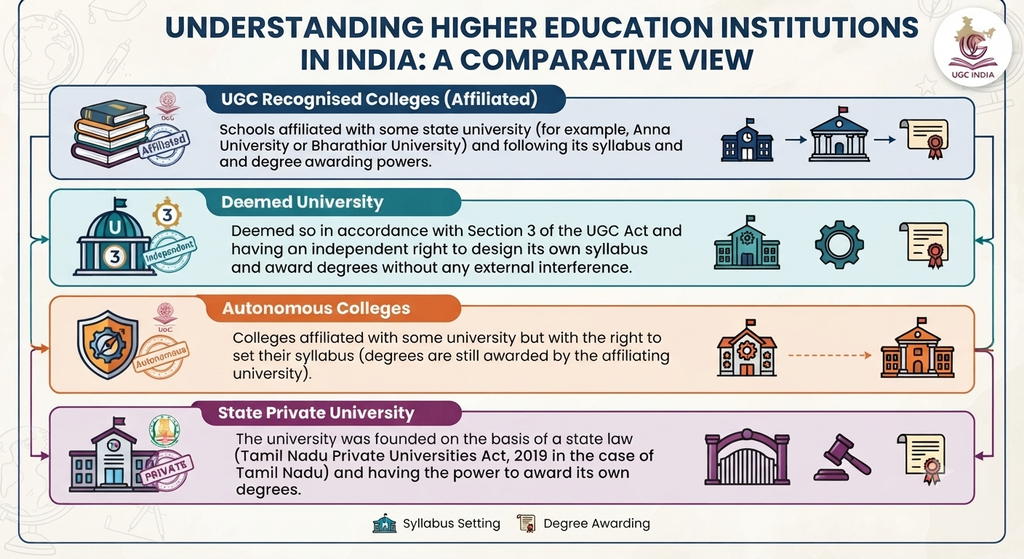
| Type | Description |
| UGC recognised colleges | Schools affiliated with some state university (for example, Anna University or Bharathiar University) and following its syllabus and degree-awarding powers |
| Deemed university | Deemed so in accordance with Section 3 of the UGC Act and having an independent right to design its own syllabus and award degrees without any external interference |
| Autonomous colleges | Colleges affiliated with some university but with the right to set their syllabus (degrees are still awarded by the affiliating university) |
| State private university | The university was founded on the basis of a state law (Tamil Nadu Private Universities Act, 2019 in the case of Tamil Nadu) and having the power to award its own degrees. |
UGC-recognised college(https://aishe.gov.in/) cannot award degrees independently, and a degree certificate will always indicate the affiliating university.
Deemed/university, on the other hand, grants degrees in its name, for which reason it is essential that the approvals of the UGC and state governments are verified directly and not indirectly through the affiliating institution.
Deemed University Tamil Nadu: The State With the Highest Number of Deemed Universities
What makes Tamil Nadu a unique case in India is the fact that there is no other Indian state that has 28 deemed universities in Tamil Nadu, which boasts of 28 deemed-to-be-universities.
This fact can be attributed to the fact that the state has been investing a lot in terms of infrastructure in the areas of engineering, medicine, and research. There are some of the most reputed institutions of India in these sectors located in the state of Tamil Nadu.
In light of the fact that deemed universities receive approval on an individual basis from the Ministry of Education on the recommendation of the UGC, it is also important to note that not all private colleges that use the term university in a marketing context actually are recognised as such; precisely why independent verification is more important than reputation and glossy admissions pamphlets.
List of UGC-Approved Universities in Tamil Nadu
There are more than 60 UGC-approved universities in Tamil Nadu that includes:
Central University
- Central University of Tamil Nadu, Thiruvarur
State Government Universities
- Anna University, Chennai
- University of Madras
- Bharathiar University, Coimbatore
- Bharathidasan University, Tiruchirappalli
- Madurai Kamaraj University
- Manonmaniam Sundaranar University, Tirunelveli
- Alagappa University, Karaikudi
- Periyar University, Salem
- Tamil Nadu Agricultural University, Coimbatore
- Tamil Nadu Dr MGR Medical University
- Tamil Nadu Open University
- Tamil Nadu Teachers Education University
- Tamil Nadu Dr J. Jayalalithaa Fisheries University
Deemed to be Universities (selected)
- Amrita Vishwa Vidyapeetham, Coimbatore
- VIT, Vellore
- SRM Institute of Science and Technology
- Sathyabama Institute of Science and Technology
- B.S. Abdur Rahman Institute of Science and Technology
- Avinashilingam Institute for Home Science and Higher Education for Women
- Karunya Institute of Technology and Sciences
- Hindustan Institute of Technology and Science
- Sri Ramachandra Institute of Higher Education and Research
State Private Universities
- Takshashila University, Ongur, Tindivanam
Several others are established under the Tamil Nadu Private Universities Act, 2019.
This list is indicative, not exhaustive. New state private universities are notified almost every academic year, so the current, authoritative version should always be cross-checked on the UGC portal before it’s treated as final.
Fake University List: How to Add Verification Steps and Avoid Being Misled
UGC issues a public notification from time to time about self-styled, unrecognised institutions operating against the provisions of UGC Act and which don’t have the right to grant degrees.
Such notifications in the past have included institutions operating in states such as Delhi, Uttar Pradesh, West Bengal and Orissa, and mostly use grand or generic names like Open University and world universities or spiritual/vocational ones to sound legitimate. Follow these simple checks before enrolling at any such institute:
- Go to the official UGC website, ugc.ac.in, and verify your university under deemed, State Private, State Public and Central tabs (never just take admission on third-party sites only).
- Verify the fake/self-styled university notification issued by UGC from time to time to find out whether your prospective institute isn’t mentioned there.
- Verify the enabling act or gazette notification, because every legitimate private/deemed university is constituted through a legal document.
- Check separately for AICTE, NAAC, NBA and NCTE approval for the particular programme because UGC approval alone may not cover all professional programmes.
- Verify your institute information via the AISHE portal (All India Survey on Higher Education), which correlates the data provided with the database maintained by UGC.
- Avoid institutes with extremely vague-sounding names such as Commercial University, Vocational University; legitimate universities always have a specific identity, linked to either a founding trust or the state/city they belong to.
- Call the UGC helpdesk or write to the regional office in case of any doubts post online verification; this process is absolutely free and takes just a few days.
Takshashila University: Built for Verified, Future-Ready Learning
Established under the Tamil Nadu Private Universities Act, 2019, and recognised by UGC under Section 2(f), with AICTE approval for its technical programmes, Takshashila University is situated at a sprawling 150-acre campus in Ongur, Tindivanam.
It is one of the UGC-approved universities Tamil Nadu that offers quality education. It combines decades of academic excellence and transforms it into an approved state private university, where students can enrol into undergraduate, postgraduate and doctorate programs of engineering, arts, science, commerce, management, and health sciences.
Admission takes place via the Takshashila Eligibility cum Entrance Test (TEET), and the university is equipped with specialist laboratories, hostels, and a placement cell, which helps students to connect with recruiters.
For those choosing recognised private universities in Tamil Nadu, Takshashila University provides a reliable option with all its legal aspects and transparency from the very beginning. For more updates on university admissions and higher education, check out @Takshashila University. also have a look at Top Future Career Options and Opportunities
Conclusion
Selecting a university is perhaps the most critical decision a student ever makes, and finding the UGC-approved universities Tamil Nadu is the most crucial task for them.
While Tamil Nadu has a truly impressive educational system backed by the country’s highest concentration of deemed universities, along with increasing numbers of well-regulated private universities, this makes thorough research a necessity.
Frequently Asked Questions for UGC-Approved Universities Tamil Nadu
Q. 1. How do I find out the list of UGC-approved universities in Tamil Nadu?
Log onto ugc.ac.in and see the state-wise consolidated lists available under the tabs for Central, State, Deemed and Private universities. The website updates this list as and when more institutions are notified, o check the page directly rather than relying on third-party lists.
Q. 2. What is the difference between UGC recognised colleges and universities?
An institution is referred to as recognised if it is affiliated with a university and does not award any degree – the degree awarded in its name is in the name of the university.
Q. 3. How many deemed universities are there in Tamil Nadu?
Tamil Nadu has 28 deemed universities, the maximum of any state in India in engineering, medicine, research fields, and more.
Q. 4. Is Takshashila University approved by the UGC?
Yes, Takshashila University is a private state university which is approved by UGC, AICTE, and the Government of Tamil Nadu under the Tamil Nadu Private Universities Act, 2019, for various courses of engineering, arts, science, and management.
Q. 5. What is meant by the UGC fake university list?
The periodic list prepared by UGC mentions self-proclaimed universities which have no legal existence and power to award degrees under the UGC Act.
Q. 6. Can a degree from a non-UGC university be used for government jobs?
Absolutely not. Degrees from unrecognised universities are not considered valid for any job, admissions in higher education institutions, licensing of professions in India or overseas countries.
Q. 7. What is a state private university as per Tamil Nadu?
It is a university created as per the Tamil Nadu Private Universities Act 2019, authorised to grant its own degrees independently and different from an affiliated private college which confers degrees in the name of a parent university.
Q. 8. Can the NAAC/NIRF ranking substitute UGC recognition?
No. Both NAAC/NIRF rank institutions’ performances/quality, whereas UGC approval is a requirement for the legal basis of issuing a degree by a college/university.
Q. 9. To whom should I complain about a fake university?
Complaints may be filed either with the regional office or headquarters of UGC or even via the UGC Grievance Redressal Portal that looks into complaints regarding self-styled/unauthorised institutions.
Q. 10. Is every private university in Tamil Nadu approved by UGC?
No. Each private university has to be individually set up as per state laws and also listed by UGC. Hence, it is necessary to check each institution.