
Short Summary
The Pharmacy Council of India (PCI) authorises those institutions which can offer the D.Pharm, B.Pharm, M.Pharm and Pharm.D courses.
Only those students who have graduated from authorised colleges can enrol as pharmacists in a State Pharmacy Council. There are more than 100 authorised PCI affiliated colleges in Tamil Nadu, including JSS College of Pharmacy, Ooty, and the School of Pharmacy at Takshashila University.
The authorisation details are available on the PCI site. Fees can be compared, and the application can be made through counselling.
Key Takeaways
- PCI is a statutory body created by the Pharmacy Act, 1948, and it regulates pharmacy education in India.
- B.Pharm is an eight-semester, four-year course. The authorisation should be valid in the year of admission.
- Qualification from an authorised institution is required for the registration as a pharmacist.
- Look into the PCI list, the university letter of affiliation, and the sanctioned intake before making any payment.
- B.Pharm fees in Tamil Nadu range greatly from less than ₹1 lakh to above ₹6 lakh for the whole course.
Introduction: Why Checking Approval Matters Before You Pick One of the Best Pharmacy Colleges
Selecting from the best pharmacy colleges in Tamil Nadu will be more of an informed choice than a ranking exercise. However, before comparing campuses, labs or placements offered, there is one question that trumps all others.
Is the college approved by the Pharmacy Council of India? If not, then a B.Pharm qualification will not help you become a registered pharmacist in India.
One of India’s most bustling centres for pharmacy education, Tamil Nadu houses a wide range of institutions, such as government colleges, private colleges and private universities.
While this is good news, families have to differentiate between courses that are actually recognised and those that only claim affiliation.
This blog will discuss PCI approval, how it helps students and how one can check the approval status of a college independently. You will know about the admission to B.Pharm in Tamil Nadu, tuition fees and some colleges you need to know about, like Takshashila University.
What Are PCI-Affiliated Colleges in Tamil Nadu?
The Pharmacy Council of India is a statutory body established by the Pharmacy Act, 1948, to regulate pharmacy education and profession throughout India.
Technically, PCI sanctions the colleges, and it is the university that affirms them. PCI affiliated colleges is thus common parlance for the colleges that have received approval from PCI and are associated with a recognised university.
In Tamil Nadu, most of the pharmacy colleges are affiliated with the Tamil Nadu Dr M.G.R. Medical University, Chennai. Some of the private universities, like Takshashila, offer their degrees under the private universities act of the state.
The PCI sanction applies to the following programmes:
- D.Pharm: Two-year programme
- B.Pharm: Four-year programme (eight semesters)
- M.Pharm: Postgraduate specialisation
- Pharm.D: Six-year programme (includes internship)
One college publication mentions 146 PCI sanctioned colleges in Tamil Nadu. These numbers tend to change every year; hence, it would be best to consider the number as indicative.
Pharmacy Council of India Recognition: How Approval Works
Approval from PCI as per Section 12 of the Pharmacy Act depends on the infrastructural setup, laboratories, library, faculty and intake of the institution.
This approval is not perpetual. According to records at PCI, this approval was granted or renewed for the specified academic year and also the number of seats, which include 60 and 100 for B.Pharm, respectively.
Apart from this, PCI also includes certain conditions. In the case of B.Pharm, PCI mandates submission of the consent of affiliation from the examining body and a no objection certificate from the state government prior to admission of students.
In case there is no submission of consent of affiliation, PCI says that approval is automatically withdrawn and the responsibility lies with the institute.
To the applicant, this means that three things will matter:
- That the approval is valid.
- It must be for the specific course.
- Only sanctioned intake of the institution should be considered for admission.
Advantages of studying in PCI-approved institutes
By studying in such institutions, both your degree and career are secured.
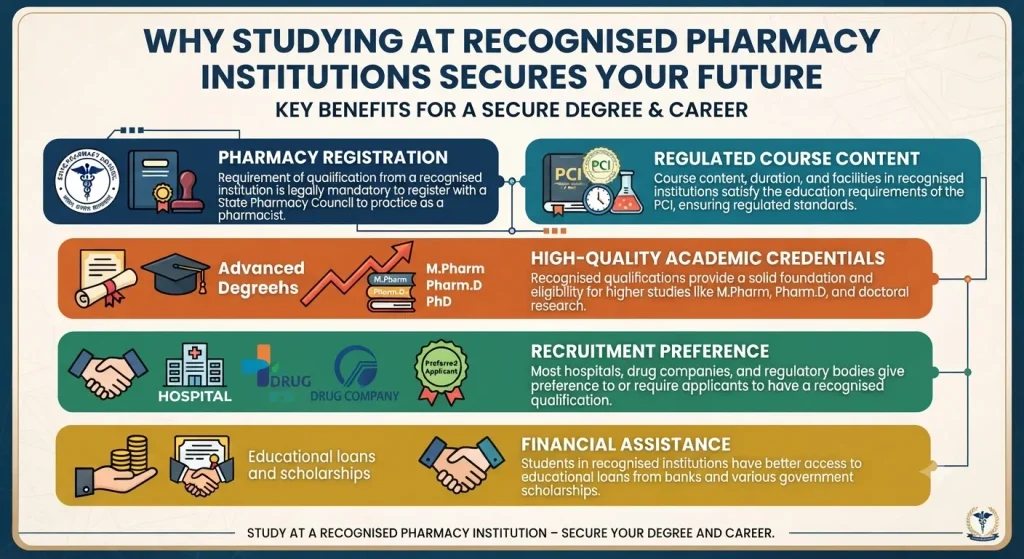
- Pharmacy registration
The requirement of having obtained a qualification from a recognised institution is the way to register with a State Pharmacy Council, which is legally mandatory for practice as a pharmacist.
- Regulated course content
The course content, duration and facilities in recognised institutions satisfy the education requirements of the PCI, hence being regulated.
- High-quality academic credentials
Recognised qualifications help one to further their studies in M.Pharm, Pharm.D and doctoral research.
- Recruitment preference
Most hospitals, drug companies, and regulatory bodies normally require applicants to have a recognised qualification.
- Financial assistance
Educational loans and scholarship programs often ask for the institution to be recognised before granting financial support.
How to Verify Pharmacy Council of India Recognition Before You Apply
Don’t believe brochures or advertisements. Verify the college is approved in six simple steps:
- Look up the approved list of colleges on the PCI website (pci.nic.in), listing the course, year of study and intake.
- Ask for the PCI letter for the current year and make sure your course is mentioned in it.
- Find out about the affiliation from the university. In the case of M.G.R. Medical University colleges, verify the affiliation.
- Verify the state government approval because PCI requires NOC for new B.Pharm programmes.
- Check the college approvals page. The good institutions, including Takshashila University, always display the letters from the UGC and PCI on their websites.
If you see one of the red flags (approval arriving soon, immediate need for a payment of deposit or refusal to give the necessary documents), don’t trust this college.
B.Pharm Admission TN: Eligibility and Counselling
- Eligibility
The eligibility is usually 10+2 with Physics, Chemistry and Biology/Mathematics, with 50 per cent aggregate marks (45 per cent for reserved categories). Lateral entry into the second year is possible for D.Pharm graduates based on the minimum aggregate in the prospectus.
- Counselling
In the case of government quota seats, the counselling process is conducted by the Selection Committee of the Directorate of Medical Education.
This is done online using tnmedicalselection.org. Private universities like Takshashila conduct their own admissions process. Dates and criteria can be obtained from the university website. Rules for admission vary every year. Therefore, check all details against the present prospectus.
Pharmacy College Fees and Recognised Colleges to Shortlist
The fee structure for pharmacy colleges in Tamil Nadu greatly depends on the category of institutions.
Listed fees range from about ₹64,000 to over ₹6 lakh in four years for a B. Pharm degree depending on whether it is a government college like Madras Medical College or a private college, respectively.
| Colleges | Location | Reasons for shortlisting it |
| Takshila University | Chennai | Takshila University for its industry-oriented programmes, modern infrastructure, experienced faculty, research opportunities, and career-focused learning. With UGC recognition and PCI-approved B.Pharm programmes, the university offers diverse academic opportunities and a supportive campus environment. |
| JSS College of Pharmacy | Ooty | Well-established pharmacy college; ranked in NIRF |
| Madras Medical College (College of Pharmacy) | Chennai | Well-known government college with affordable fees |
| PSG College of Pharmacy | Coimbatore | Well-known private college at affordable prices |
| Sri Ramachandra Institute of Higher Education and Research | Chennai | Deemed university and hospital exposure |
| Annamalai University | Annamalai Nagar | Public university with a long history in pharmacy education |
| JKKN College of Pharmacy | Kumarapalayam | PCI approved, NAAC A grade, founded in 1985 |
The above table shows an indicative list. Please check the current status of PCI approvals for all colleges.
| Did you know? Education in India for pharmacy is statutory rather than under the university policy. For PCI approval under the Pharmacy Act, 1948, the institutions require the PCI approval. PCI-approved qualifications lead the way in registration as pharmacists with a state pharmacy council; therefore, a brochure is never a substitute for this approval. Therefore, one should always request the documentation before any payment. |
Where the pharmacy learning meets practice: Takshashila University School of Pharmacy
Takshashila University, which was founded in 2022 in Ongur, Tindivanam Taluk, Villupuram District, is a recognised state private university in Tamil Nadu. The School of Pharmacy offers a four-year course of B. Pharm., which ensures a strong foundation in pharmacology, medicinal chemistry, pharmaceutics and clinical pharmacy.
The university displays their UGC and PCI approvals publicly, thus making the verification process in this guide very simple. The pharmacy learners get trained on a university campus that hosts programmes such as medicine, nursing, allied health sciences and physiotherapy.
For the prospective students looking for the best pharmacy colleges in Tamil Nadu, Takshashila provides the students with a regulated programme, transparent documentation and career prospects in hospitals, industries and research. For more updates on pharmacy education and admissions, check out @Takshashila University. hence your read this blog hopfuly you like to read this to TANCET Exam 2026
Choose a Pharmacy College You Can Verify, Then Build Your Career With Confidence
Pharmacy education is for four years, and the worth of it depends upon the sanctioning. Whether PCI recognition will give you a chance to become a registered pharmacist and take up your post-graduation studies is dependent on the sanctioning of the course by PCI.
Look into the PCI affiliated colleges, get the affiliation and approval letter from them, verify the sanctioned intake, and compare the fee structure before spending a penny. Make a list of a few good institutions and go on a visit to their campus and raise your doubts.
Frequently Asked Questions for PCI-affiliated Colleges
Q 1. What are the PCI-affiliated colleges in Tamil Nadu?
These are the pharmacy colleges recognised by the Pharmacy Council of India and affiliated to a recognised university. While PCI recognises the institution, the university affiliates it. Only such colleges award you the degrees to get registered as a pharmacist.
Q. 2. Is PCI recognition mandatory for B.Pharm colleges?
Yes, it is mandatory for an institute to have PCI recognition to conduct a B.Pharm programme legally. In case it does not, you will find it difficult to get registered with a State Pharmacy Council. Make sure you ask for the latest letter of PCI recognition before you pay any money.
Q. 3. How do I know if a pharmacy college is PCI recognised?
Check the list of recognised institutions from pci.nic.in website along with the programme, year, and intake. Then ask the college for their recognition and affiliation letters and match them with the figures quoted to you.
Q. 4. What are the eligibility criteria for the B.Pharm programme in Tamil Nadu?
The candidate should have passed +2 with physics, chemistry, and biology/mathematics with a minimum of 50 per cent marks (45 per cent for reserved category candidates). D.Pharm holders can join from the second-year level.
Q. 5. For how many years is the D.Pharm and B.Pharm programme?
The D.Pharm programme spans two years, whereas the B.Pharm programme spans four years or eight semesters. The Pharm.D course is a six-year-long programme, including an internship period.
Q. 6. What are the usual college fees for pharmacy colleges in Tamil Nadu?
The total fee for the B.Pharm course spanning four years ranges between less than ₹1 lakh in government colleges and more than ₹6 lakh in certain private colleges.
Q. 7. Is it possible to get registered as a pharmacist after completing a programme from a PCI-approval free college?
A person usually gets himself registered through a qualification obtained from PCI-approved institutions. Thus, registration becomes difficult after obtaining a qualification from such colleges.
Q. 8. Is the B.Pharm programme at Takshashila University PCI approved?
The PCI-approved status of the School of Pharmacy is mentioned on the website of Takshashila University. Like any other college, the prospective candidate must ask the admission office about the latest approval letter that matches the PCI list.
Q. 9. Is there direct lateral entry from D.Pharm into B.Pharm in the second year?
Yes, lateral entry is possible from D.Pharm into the second year of B.Pharm provided minimum marks and registration criteria are fulfilled. The date and conditions for counselling may vary, so read the latest prospectus.
Q. 10. What can I do after a B.Pharm degree?
One can register as a pharmacist, work as a pharmacist in hospitals/pharma companies/QA/regulatory departments, etc., and do M.Pharm and research. Most of the B.Pharm candidates try GPAT to get admission into M.Pharm courses.