There is huge scope for optometry in India. Graduates can establish their careers in hospitals, retail chains, government health services, and corporate R&D if they graduated from the best BSc optometry colleges in Tamil Nadu, with salaries increasing as they gain experience and specialisation.
With over 100 million Indians needing corrective glasses and rising screen-related eye strain, this field offers strong entry-level demand alongside genuine long-term career growth.
Introduction: Optometry Is One of India’s Most Underrated Healthcare Careers

The scope for optometry in the Indian healthcare scenario is a promising one, as there is a genuine lack of skilled healthcare providers and a continuously increasing number of Indians getting exposed to screens each year, resulting in eye problems and straining of eyes on a regular basis.
Asking students to suggest any career in health care, not many opt for optometry. However, there is hardly anything to feel shy about when it comes to opting for the B.Sc. Optometry Technology programme as a healthcare career, given the immense scope of optometry in India. This is because nearly 400 million Indians need corrective glasses today.
Optometry provides one thing in healthcare which is rare now: access to patient care without the need for NEET and MBBS, and that too in a growing market rather than a stagnant one. Students interested in this career can explore the B.Sc. Optometry Technology programme at Takshashila University.
This blog talks about the growing demand in this field, how much optometrists make, and why optometry seems to be a very promising profession for years to come.
The Shortage That’s Quietly Driving This Career Forward
The Indian eye care industry is suffering from a shortage, but one that works positively for those looking into joining the industry.
Despite the eye care industry experiencing growth at a compounded annual growth rate of about 7.85%. When considering the number of people within India that need vision care, the hospitals, clinics, and optical retail stores are all after the same scarce talent.
Where Optometry Graduates Actually Work
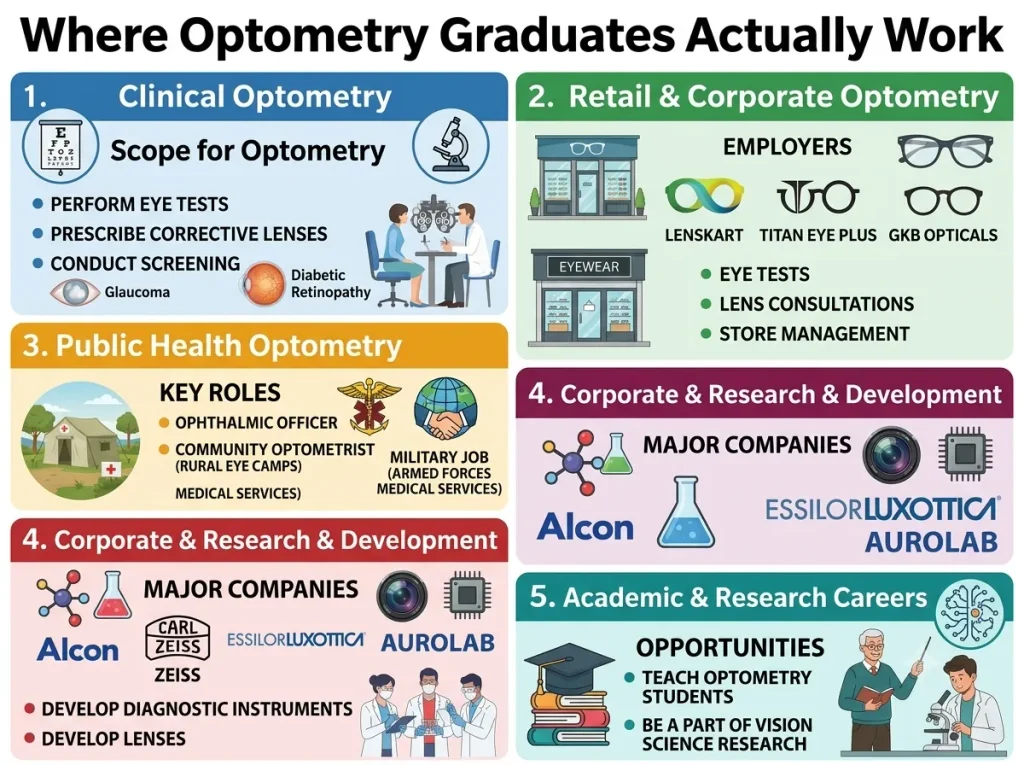
If you are wondering about the scope for optometry, here you will get the answer. We have mentioned the places where the optometry career provides for a truly diverse range of career environments.
- Clinical optometry
Here optometrists work in hospitals and eye clinics, perform eye tests, prescribe corrective lenses, and conduct screening for various diseases like glaucoma and diabetic retinopathy.
- Retail & corporate optometry
Here big names like Lenskart, Titan Eye Plus and GKB Opticals hire optometry graduates for jobs ranging from eye tests and lens consultations to store management.
- Public Health Optometry
This includes the position of an ophthalmic officer, a community optometrist working in rural eye camps, and a military job in the armed forces medical services.
- Corporate & Research & Development
Companies like Alcon, Carl Zeiss, EssilorLuxottica and even Indian manufacturers like Aurolab recruit optometry graduates to develop diagnostic instruments and lenses.
- Academic & Research Careers
The expanding optometry postgraduate opportunities can lead one to teach optometry students and be a part of vision science research.
What Optometrists in India Actually Earn
Salary in optometry follows an established pattern for most healthcare jobs: low for beginners but with good scope as experience accumulates and specialisation takes place.
Fresh graduates with a BSc optometry degree can expect to earn about ₹2.6 LPA, with a monthly pay ranging from ₹19,000 to ₹38,000 in the private sector. In government service, the salary range is broader: ₹2 LPA to ₹5 LPA.
With experience beyond three years, pay goes up significantly: individuals cross ₹6 LPA, while specialised job positions like that of a low vision specialist command a pay scale of ₹5 LPA to ₹8 LPA. With a master’s degree, salary goes even higher: graduates with an MSc Optometry degree can expect to earn ₹4 LPA to ₹10 LPA.
According to projections, annual growth in the optometry industry worldwide will be 4.3% per year between 2019 and 2027.
Why the Coming Years Look Especially Promising
The shift towards the digital lifestyle, considering that there are already more than 500 million smartphone users in India and the number of hours spent watching screens continues to grow among all age groups.
Ageing population and increasing cases of diabetes, which leads to higher demands for eye screening and diabetic retinopathy check-ups.
Also, the spectacles market size in India is expected to be worth US$ 4.1 billion in 2024 and is predicted to reach US$ 7.6 billion by 2030, growing at a CAGR of 11.4%.
With the introduction of emerging trends, such as tele-optometry and artificial intelligence in diagnostics, optometry will continue to move forward on multiple fronts at once.
Where Successful Optometry Careers Begin, at Takshashila University
When students are confused about the scope of optometry, we at Takshashila University provide them with the help they need.
Optometry courses offered here will help students graduate ready to work in the field and not just know the theory but be ready to practise from the very beginning. The university trains students using state-of-the-art refractive and diagnostic tools, providing supervised clinical rotations in hospitals and clinics, and teaching them through faculty members who have practical experience in eye care.
The curriculum at the institution has been devised in such a way that it aligns with the future direction of the field, be it digital eyestrain or new technology. Students can also follow Takshashila University on Instagram for campus updates, student achievements and academic updates.
To wrap up: A Career That Sees Further Than Most Students Realise
In India today, the ambit of optometry encompasses hospitals, retail chains, government health services, and corporate research and development as well as academia, and this all comes backed by an adequately recorded scarcity of professionals along with a populace that is increasingly in need of eye care.
In fact, for aspiring students who want to forge ahead in a secure medical career without NEET or MBBS, optometry provides great prospects, especially if one plans to specialise in the field and hone his skills in the process.
Frequently Asked Questions for Scope of Optometry
Q1. Scope of optometry profession in India?
The scope of optometry includes hospitals, optometry clinics, retail chain stores, government health organisations, and the research and development sector as well as academics, fuelled by the shortage of eye specialists across the nation.
Q2. Salary of a new optometry graduate?
New entrants in BSc Optometry get their salaries starting at around ₹2.6 LPA, whereas the salaries in the private sector are from ₹19,000 to ₹38,000 per month.
Q3. How much salary do you get after having some experience in the optometry profession?
Usually, salaries go up to beyond ₹6 LPA when there are more than three years of experience in the profession; particularly specialists such as low vision specialists earn ₹5 LPA to ₹8 LPA.
Q4. Is there a lack of optometrists in India?
Yes, there is a shortage of nearly 60,000 optometrists that need to be hired to meet the international standards of eye care, thus keeping the demand for optometrists higher than the supply.
Q5. Which companies hire optometry graduates?
The optometry graduates are recruited by companies such as Lenskart and Titan Eye Plus and also the corporate companies such as Alcon, Carl Zeiss, and EssilorLuxottica.
Q6. Do optometry graduates get employed in the government sector?
Yes, the graduates in optometry are recruited as ophthalmic officers, community optometrists, and medical services of the armed forces in the government hospitals, and the salary scale of the government would be between ₹2LPA and ₹5LPA.
Q7. Is optometry an alternate career path for MBBS careers?
Yes, optometry is a practical healthcare profession depending upon the practice of patient care without needing NEET or an MBBS.
Q8. What kind of options are there for an optometry graduate for further education?
An optometry graduate can pursue an MSc in Optometry that provides a salary range between ₹4 LPA and ₹10 LPA.
Q9. Why is there an increased demand for optometrists?
There are several reasons for the increasing demand for optometrists; some of them include the increasing use of screen time, diabetes-related complications in eyes, and age groups’ populations.
Q10. Why should one opt for optometry from Takshashila University?
If one goes for optometry at Takshashila University, he/she will get practical knowledge and experience through hospital postings and sophisticated diagnostic tools.