
B.Tech in Electronics & Communications Engineering
Join the Best Colleges for Electronics and Communication Engineering in Tamil Nadu
- Hands-on Training
- Faculty with International Experience
- Advanced Curriculum
- Upto 100% Scholarship based on merit

About the Course
The B.Tech in Electronics & Communication Engineering at Takshashila University is designed to provide students with comprehensive knowledge in electronics, telecommunications, embedded systems, and signal processing. Recognised among the best colleges for Electronics and Communication Engineering in Tamil Nadu, the programme combines academic excellence with practical learning to prepare students for careers in the rapidly evolving electronics and communication industry. As one of the leading Electronics and Communication Engineering colleges in Tamil Nadu, Takshashila University equips students with the skills to design, develop, and maintain advanced communication systems for real-world applications.
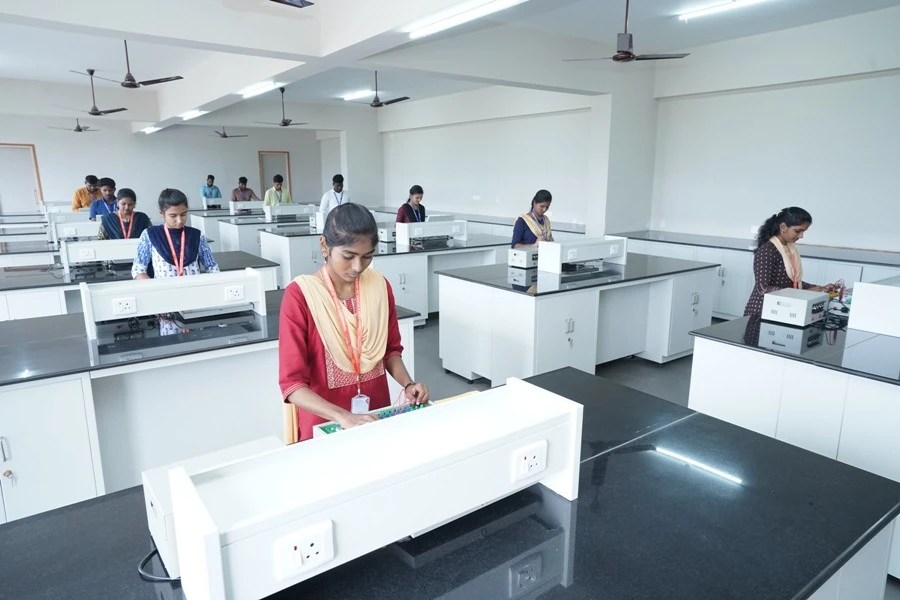
The curriculum focuses on emerging technologies, including mobile communication, satellite communication, embedded systems, VLSI, IoT, and digital communication. Through hands-on laboratory sessions, industry internships, and live projects, students gain practical experience and exposure to modern communication technologies, enabling them to confidently solve real-world engineering challenges and build successful careers in the global technology sector.
Students looking for B Tech ECE in Tamil Nadu will benefit from Takshashila University’s industry-focused learning approach, experienced faculty, and advanced laboratory facilities. Recognised among the best engineering colleges for Electronics and Communication Engineering in Tamil Nadu, the programme encourages innovation, research, and practical problem-solving to prepare graduates for successful careers in the electronics and communication sector. With its strong academic foundation and industry exposure, Takshashila University is also regarded as one of the Top B Tech ECE Colleges in Tamil Nadu for aspiring engineers.
Why Choose B.Tech in Electronics & Communication Engineering?
Electronics and Communication Engineering is one of the fastest-growing engineering disciplines, powering innovations in telecommunications, embedded systems, semiconductor technology, IoT, automation, and wireless communication. Choosing the right programme is essential to building a successful engineering career. Takshashila University is recognised among the best Electronics and Communication Engineering colleges in Tamil Nadu, offering an industry-focused curriculum that combines academic excellence with practical learning.
As one of the top colleges for Electronics and Communication Engineering in Tamil Nadu, the programme equips students with expertise in digital electronics, embedded systems, VLSI design, communication networks, signal processing, and IoT through advanced laboratories, industry projects, and internships. Students graduate with the technical knowledge and practical skills needed to meet the evolving demands of the electronics and communication industry.
With experienced faculty, modern infrastructure, and strong industry collaborations, Takshashila University also provides excellent B Tech ECE Placement in Tamil Nadu, helping graduates secure rewarding careers in electronics, telecommunications, semiconductor manufacturing, automation, and emerging technologies.
Industry Recognition
Learn through an industry-aligned curriculum covering embedded systems, VLSI, communication engineering, IoT, semiconductor technology, and digital signal processing. As one of the leading B Tech ECE colleges in Tamil Nadu, Takshashila University prepares students with the skills required by today's technology-driven industries.
Hands-On Learning & Innovation
Build practical expertise through advanced laboratories, live industry projects, internships, technical workshops, and research opportunities that prepare you to solve real-world engineering challenges.
Excellent Placement Support
Benefit from dedicated placement assistance, industry partnerships, and internship opportunities that contribute to excellent B Tech ECE Placement in Tamil Nadu, connecting students with leading technology companies.
Global Career Opportunities
Recognised among the Best Electronics and Communication Engineering Universities in Tamil Nadu, Takshashila University prepares graduates for successful careers in electronics, communication systems, embedded technologies, semiconductor industries, automation, and research.
Course Curriculum

Year 1 (Foundation Stage)
The first year introduces fundamental engineering concepts, including mathematics, physics, and computer science, alongside basic electronics and electrical engineering principles. The learners will also develop programming skills and understand the basics of electronics and communication systems.
Key Subjects: Mathematics, Physics, Electrical Circuits, Engineering Graphics, Programming in Python and C, Electronic Devices.
Year 2 (Core Electronics & Circuits)
In the second year, the learners build a strong foundation in core electronics and circuit design. They will learn how electronic components work, analyze circuits and understand signals and systems that form the backbone of communication engineering.
Key Subjects: Analog Electronics, Electronic Circuits, Signals and Systems, Network Theory, Electromagnetic Fields, Object-Oriented Programming, Probability and Random Processes, Digital Electronics
Year 3 (Communication & Advanced Systems)
study how information is transmitted over various media and explore concepts related to digital systems, control systems and embedded technologies. Practical exposure through mini-projects becomes important at this stage.
Key Subjects: Analog Communication, Digital Communication, Microprocessors and Microcontrollers, Control Systems, VLSI Design, Embedded Systems, Data Communication and Networking
Year 4 (Specialization & Industry Readiness)
In the final year, the learners specialize in advanced topics and work on major projects. The focus is on applying their knowledge to real-world problems, research and industry-oriented skills. They may also choose electives based on your interests.
Key Subjects: Wireless Communication, Optical Communication, Satellite Communication, Internet of Things (IoT), Artificial Intelligence, 5G Communication, Project Work / Internship
Career Scope
Graduates of the B.Tech in Electronics & Communication Engineering at Takshashila University are well-equipped to pursue rewarding careers across the electronics, telecommunications, semiconductor, automation, and embedded systems industries. As one of the best colleges for Electronics and Communication Engineering in Tamil Nadu, the programme prepares students with the technical knowledge and practical skills required by leading employers. Career opportunities include:
Electronics Engineer
- Role: Design, develop, and optimise electronic circuits and devices.
- Salary: ₹4,50,000 to ₹8,00,000 per annum.
Communication Engineer
- Role: Develop and maintain communication systems such as wireless networks, satellite systems, and signal transmission technologies.
- Salary: ₹4,00,000 to ₹9,00,000 per annum
Embedded Systems Engineer
- Role: Design and program embedded systems used in devices like automobiles, appliances, and IoT products.
- Salary: ₹5,00,000 to ₹12,00,000 per annum
VLSI Design Engineer
- Role: Develop software applications, systems, and programs across various platforms.
- Salary: ₹4,00,000 to ₹7,00,000 per annum.
Network Engineer
- Role: Design and develop semiconductor chips and integrated circuits.
- Salary: ₹3,50,000 to ₹8,00,000 per annum
RF Engineer
- Role: Work on radio frequency systems used in wireless communication like mobile networks and radar systems.
- Salary: ₹5,00,000 to ₹12,00,000 per annum
Software Developer
- Role: Manage and optimise network systems, ensuring data transfer and communication efficiency.
- Salary: ₹4,00,000 to ₹12,00,000 per annum
Data Analyst
- Role: Analyze data, generate insights, and support decision-making using statistical tools.
- Salary:₹4,00,000 to ₹10,00,000 per annum.
Why TAKSHASHILA?

Industry-Relevant Curriculum
The B.Tech programme is crafted to meet the latest industry requirements, ensuring students gain up-to-date knowledge and skills in electronics and communication engineering. As one of the leading B Tech ECE colleges in Tamil Nadu, Takshashila University prepares students for the evolving demands of the industry.
Hands-On Experience
You will work with modern tools and technologies in state-of-the-art laboratories, gaining practical experience that directly applies to industry demands.
Expert Faculty
Learn from distinguished faculty members with years of academic and industry experience.
Global Career Opportunities
Takshashila University’s global network of partners and industry contacts will help you access career opportunities worldwide.

- Applicants must have completed their 10+2 or equivalent in Science with a minimum of 50% marks, including subjects like Physics, Chemistry, and Mathematics.
- Entrance exams or personal interviews may be required as part of the selection process.

For All Programmes except MBA, MCA, M.Tech, and Integrated Programmes offered by Sunstone, FacePrep, Kalvium and NxtWave
|
S.No |
% of Marks |
Scholarship Amount in Tuition Fees per year |
|
1 |
60% – 75% |
10% |
|
2 |
Above 75 % – 90 % |
25 % |
|
3 |
Above 90 % |
50 % |
Calculation of percentage of Marks (+2 of HSC / 2nd Year of APBIM or +2 of CBSE or Equivalent)
- Engineering – Average marks in Mathematics, Physics, Chemistry/Computer Science
- Lateral Entry – Average marks in Diploma Programme.
- Agriculture – Average marks in Physics, Chemistry, Biology / Botany &Zoology
- AHS / BPT / Pharmacy – Average marks in Physics, Chemistry, Biology / Botany &Zoology/Bio Tech
- UG – Arts & Science / Hotel Management – Overall +2 marks – (+2 of HSC / 2nd Year of APBIM or +2 of CBSE or Equivalent)
- PG – Overall % in UG
- Diploma – Average mark in 10th /Equivalent
MBA, MCA, M. Tech, and Integrated Programmes offered by Sunstone, FacePrep, Kalvium and NxtWave – No Academic Scholarship applicable.
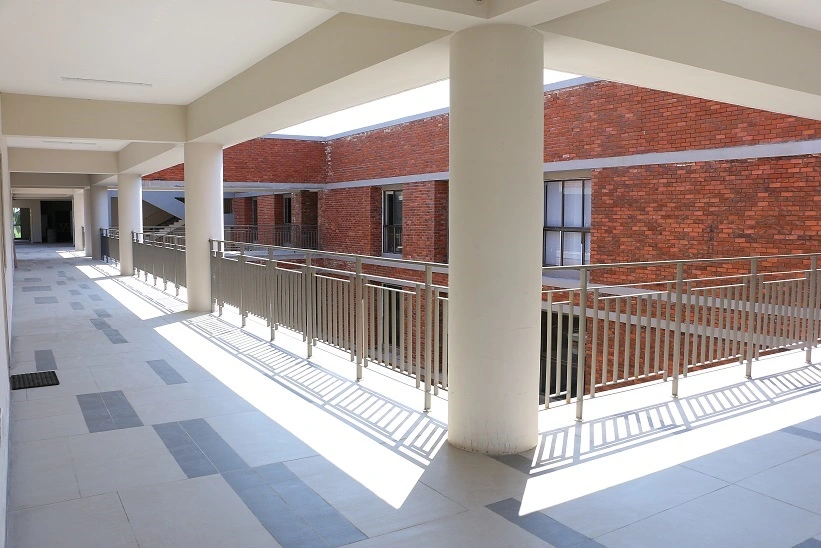
Spread over 150 acres
At Takshashila University, you will have ample opportunities to hone your skills in real-world healthcare settings, utilising state-of-the-art medical facilities and simulation labs on our 150-acre campus.







Join One of the Best Colleges for Electronics and Communication Engineering in Tamil Nadu
Frequently Asked Questions (FAQs)
1. Which Is the Best College for B.Tech Electronics and Communication Engineering in Tamil Nadu?
Choosing the best B.Tech Electronics and Communication Engineering college in Tamil Nadu depends on academic quality, laboratories, faculty, placements, and industry exposure. Takshashila University offers an industry-focused ECE programme with modern labs, experienced faculty, internships, and placement support, helping students develop the skills required for careers in electronics, communication, and embedded technologies.
2. What Is B.Tech Electronics and Communication Engineering?
B.Tech Electronics and Communication Engineering is a four-year undergraduate programme that focuses on electronic circuits, communication systems, embedded systems, VLSI, IoT, signal processing, and wireless technologies. At Takshashila University, students gain practical knowledge through laboratory sessions, projects, internships, and industry-oriented learning.
3. Why Should You Choose B.Tech Electronics and Communication Engineering at Takshashila University?
Takshashila University offers an industry-aligned B.Tech Electronics and Communication Engineering programme with experienced faculty, advanced laboratories, project-based learning, internships, and placement assistance. The curriculum prepares students for careers in electronics, telecommunications, semiconductor technologies, embedded systems, automation, and emerging communication technologies.
4. How Can I Get B.Tech ECE Admission in Tamil Nadu?
B.Tech ECE admission in Tamil Nadu generally requires candidates to complete Class 12 with Physics, Chemistry, and Mathematics from a recognised board. At Takshashila University, eligible students can apply through a simple admission process by submitting their application, verifying documents, and meeting the prescribed admission requirements.
5. Who Is Eligible for B.Tech Electronics and Communication Engineering?
Students who have completed Higher Secondary education with Physics, Chemistry, and Mathematics from a recognised board are generally eligible for B.Tech Electronics and Communication Engineering. The B.Tech ECE eligibility criteria in Tamil Nadu may vary by institution, and Takshashila University provides clear admission guidelines for applicants.
6. What Is the Duration of B.Tech Electronics and Communication Engineering?
B.Tech Electronics and Communication Engineering is a four-year undergraduate programme consisting of eight semesters. Students learn through classroom sessions, laboratory experiments, industrial visits, internships, and practical projects covering electronics, communication systems, embedded technologies, and semiconductor applications.
7. What Subjects Are Covered in B.Tech Electronics and Communication Engineering?
The curriculum includes digital electronics, analog circuits, communication systems, embedded systems, VLSI design, signal processing, microprocessors, wireless communication, IoT, and semiconductor technologies. Takshashila University combines theory with practical learning to prepare students for modern engineering careers.
8. What Is the B.Tech ECE Fee Structure in Tamil Nadu?
The B.Tech ECE fee structure in Tamil Nadu varies depending on the university and facilities provided. Students should review tuition fees, hostel charges, laboratory fees, and other academic expenses before admission. Takshashila University offers transparent fee details for students and parents.
9. Does Takshashila University Offer Scholarships for B.Tech ECE Students?
Yes. Takshashila University offers scholarships for eligible B.Tech Electronics and Communication Engineering students according to the university’s scholarship policy. Students can contact the admission team to learn about scholarship eligibility, required documents, and the application process.
10. Do B.Tech Electronics and Communication Engineering Students Get Internship Opportunities?
Yes. Internship opportunities are an important part of the B.Tech Electronics and Communication Engineering programme at Takshashila University. Students gain practical industry exposure through internships, live projects, laboratory training, and industrial visits that strengthen their technical and professional skills.
11. What Career Opportunities Are Available After B.Tech Electronics and Communication Engineering?
Graduates can pursue careers as Electronics Engineers, Communication Engineers, Embedded Systems Engineers, VLSI Engineers, IoT Developers, Network Engineers, Automation Engineers, and Design Engineers across various technology and manufacturing industries.
12. Can B.Tech Electronics and Communication Engineering Graduates Get Government Jobs?
Yes. B.Tech Electronics and Communication Engineering graduates can apply for government jobs in ISRO, DRDO, BSNL, BEL, Railways, Defence, Public Sector Enterprises, and other government organisations through competitive recruitment processes.
13. How Are the Placement Opportunities for ECE Students at Takshashila University?
Takshashila University provides placement training, technical workshops, internships, career guidance, and industry interaction to prepare students for recruitment. The university focuses on developing industry-ready graduates with strong technical knowledge and practical engineering skills.
14. Which Companies Recruit B.Tech Electronics and Communication Engineering Graduates?
ECE graduates are recruited by semiconductor companies, electronics manufacturers, telecommunications firms, automation companies, IT organisations, embedded systems companies, and multinational technology enterprises seeking skilled engineering professionals.
15. What Salary Can You Expect After Completing B.Tech Electronics and Communication Engineering?
The salary after B.Tech Electronics and Communication Engineering depends on technical skills, internship experience, certifications, employer, and job role. Graduates with practical knowledge and industry exposure generally receive competitive salary packages in the electronics and communication sector.
16. What Is the Future Scope of Electronics and Communication Engineering?
Electronics and Communication Engineering offers excellent career opportunities in semiconductor manufacturing, embedded systems, 5G communication, IoT, robotics, defence technologies, automation, and smart electronics. The growing demand for advanced technologies continues to create opportunities for skilled ECE graduates.
17. Can I Study Abroad After Completing B.Tech Electronics and Communication Engineering?
Yes. B.Tech Electronics and Communication Engineering graduates can pursue higher education abroad in Electronics, Communication Systems, Embedded Systems, Robotics, VLSI, Microelectronics, Wireless Communication, and related engineering disciplines.
18. How Can I Become an Electronics and Communication Engineering Professional?
To become an Electronics and Communication Engineering professional, students should complete a recognised B.Tech ECE programme, strengthen technical knowledge, participate in projects and internships, develop practical skills, and stay updated with emerging electronics technologies.
19. What Are the Latest Trends in Electronics and Communication Engineering?
Current trends in Electronics and Communication Engineering include 5G technology, Internet of Things, Embedded Systems, Artificial Intelligence in Electronics, Semiconductor Design, Robotics, Electric Vehicles, Smart Devices, and Wireless Communication technologies.
20. How Do You Choose the Right Electronics and Communication Engineering College in Tamil Nadu?
When selecting an Electronics and Communication Engineering college in Tamil Nadu, consider accreditation, experienced faculty, laboratories, industry collaborations, internships, placements, curriculum, and research opportunities. Takshashila University offers an industry-oriented B.Tech ECE programme that prepares students for successful engineering careers.