
B.A. Economics
Want to Build a Career in Economics? Explore the Best B.A. Economics Colleges in Tamil Nadu
- Hands-on Training
- Faculty with International Experience
- Advanced Curriculum
- Upto 100% Scholarship based on merit

About the Course
B A Economics Colleges in Tamil Nadu is a specialized undergraduate program for aspiring economists, financial analysts, and economics professionals. Offered by leading Tamil Nadu colleges, this degree combines economic theory with practical financial analysis and policy expertise. Students master microeconomics, macroeconomics, econometrics, financial economics, and policy analysis. The curriculum emphasizes analytical learning through case studies, research projects, internships, and mentorship from experienced economists. Graduates gain economics expertise and analytical skills, enabling them to launch careers as economists, financial analysts, and policy professionals across Tamil Nadu’s finance, government, and corporate sectors.
To develop analytically sharp, socially conscious economists who can link theory with policy, business decisions, and everyday economic realities.
WHY CHOOSE B A ECONOMICS
Choosing B A Economics Colleges in Tamil Nadu offers strategic advantages for aspiring economists and finance professionals. First, Tamil Nadu colleges provide rigorous curriculum designed with economics faculty, finance experts, and government economists ensuring theoretical excellence and practical relevance. Second, colleges feature research centers, economics labs, and analytical facilities matching national standards. Third, the program guarantees strong placement for economists with average packages of ₹5-11 lakhs. Fourth, graduates enjoy exceptional career growth in India’s expanding finance, policy, and economics sectors experiencing 14-18% annual growth. Finally, the scope of B A Economics Colleges in Tamil Nadu remains exceptionally high with continuous demand for skilled economists across Tamil Nadu’s finance and government sectors.
Choosing one of the top colleges for M.Com in Tamil Nadu enables students to gain specialised knowledge in financial management, corporate accounting, business analytics, and taxation. Graduates are well prepared for careers in banking, financial services, consulting, auditing, education, and research while also building a strong foundation for doctoral studies and professional certifications.
Advanced Commerce Curriculum
Rigorous B A Economics Colleges curriculum ensures economists master microeconomics, macroeconomics, and financial analysis directly aligned with finance sector demands.
Research & Practical Learning
Strong placement for economists and financial analysts with 78-88% success rate and average salaries of ₹5-11 lakhs annually.
Expert Faculty & Mentorship
Access to research centers, economics labs, and mentorship from experienced economists ensuring analytical expertise throughout the program.
Future-Ready Learning
Exceptional career scope for economists, financial analysts, and policy professionals with career growth potential and finance opportunities.
Course Curriculum

Year 1
The first year of the B.A. Economics programme introduces students to the basic principles of economics, both micro and macroeconomic theories. The foundation of economic theory is laid, including the study of market dynamics, production processes, and consumer behavior. Additionally, you will begin learning the basics of mathematical methods for economics and statistical techniques that support economic analysis.
Key Subjects:
- Introduction to Economics
- Principles of Microeconomics
- Indian Economy: Issues and Policies
- Mathematical Methods for Economics
- Basic Statistical Techniques for Economists
Year 2
Building upon the first-year fundamentals, the second year explores deeper into topics such as macroeconomics, economic systems, and the Indian economy post-independence. Students will also engage in more advanced mathematical concepts that enhance their ability to analyze economic data and model economic behavior. The year also introduces international trade theory and policy, helping students understand the global economic system.
Key Subjects:
- Advanced Microeconomics
- Macroeconomics: Theory and Policy
- International Trade
- Development Economics
- Economic Systems
- Indian Economy Post-Independence
Year 3
In the final year, the focus shifts to more specialized areas such as agricultural economics, economic growth, globalization, and natural resource management. Students will also study advanced topics in financial systems, economic growth processes, and the role of computers in economics, preparing them for both practical applications and further academic pursuits.
Key Subjects:
- Agricultural Economics
- Advanced International Economics
- Economics of Natural Resources
- Economic Growth and Globalization
- Public Finance and Policy
- Economics with Computer Applications
SCOPE OF THE PROGRAMME
The scope of B A Economics Colleges in Tamil Nadu is exceptionally broad for aspiring economists, financial analysts, and economics professionals. This specialized undergraduate program positions graduates to pursue diverse career paths across economics, finance, policy, and business sectors experiencing continuous advancement. The primary scope encompasses economic analysis and research where research institutions, universities, and think tanks seek economists to analyze economic trends, conduct economic research, and provide policy recommendations. Financial analysis and investment represent critical scope for economists analyzing financial markets, stocks, bonds, and investment strategies. Macroeconomic policy and government economics create emerging scope for economists working on national economic policy and fiscal strategy. Development economics and poverty analysis offer specialized scope for professionals studying economic development, poverty reduction, and sustainable growth. International economics and trade represent emerging scope for economists analyzing global trade, exchange rates, and international commerce. Corporate finance and business economics create scope for economists analyzing business performance and corporate strategy. Banking and financial services provide emerging scope for professionals in banking sector economics and credit analysis. Insurance and risk management offer specialized scope for economists analyzing insurance economics and risk assessment. Labour economics and human resources represent emerging scope for economists studying employment, wages, and labour markets. Public finance and taxation create scope for economists analyzing government spending, tax policy, and fiscal management. Environmental economics and sustainability offer specialized scope for economists addressing environmental issues and sustainable development. Urban economics and regional development provide scope for economists studying city development and regional economics. Agricultural economics and rural development represent emerging scope for economists addressing agricultural sector and rural issues. Health economics and medical finance create scope for economists analyzing healthcare costs and medical economics. Education economics and human capital offer specialized scope for economists studying education sector and skill development. Behavioural economics and experimental economics represent emerging scope for economists studying consumer behaviour and decision-making. Quantitative economics and econometrics create scope for economists using advanced statistical methods and data analysis. Teaching and academic careers significant scope for economists pursuing faculty positions and economic research. Government economics and policy advisory create scope for economists contributing to government policy formulation. International organizations and development agencies offer scope for economists working on global economic issues. Banking and financial institutions provide career scope for economists in financial advisory roles. Consulting firms and research organizations create opportunities for economists providing economic consulting. Entrepreneurship and business analytics pathways exist for economists launching economic analysis businesses. The scope of B A Economics Colleges extends across government agencies, financial institutions, research organizations, universities, international organizations, consulting firms, and corporations, positioning Tamil Nadu economists as critical contributors to economic policy and financial analysis.
Career Scope
Graduates of B A Economics Colleges from Tamil Nadu colleges enjoy diverse and lucrative career opportunities as economists, financial analysts, and economics professionals. Placement statistics demonstrate 78-88% success rates with average packages ranging from ₹5-11 lakhs, with top performers earning ₹12-22 lakhs annually as senior economists and finance leaders. The program’s rigorous curriculum ensures economists possess critical skills in economic analysis, financial modeling, and policy knowledge—precisely what financial institutions and government agencies demand. Direct partnerships with financial institutions, government agencies, think tanks, and corporations provide direct recruitment pathways for Tamil Nadu B A Economics Colleges graduates. Economists seamlessly transition into financial analysis, policy, and research roles across organizations nationally. The career trajectory spans junior analyst positions to senior economist, financial manager, and policy advisor roles within 8-12 years. Government advancement and career progression opportunities abound as government values economics expertise. International opportunities exist through development organizations and global finance institutions. The scope of career advancement for economists is strong with steady demand across finance and policy sectors.
- Junior Economist
- Policy Intern
- Bank Trainee
- Data Analyst (economic and social research)
- Junior Economist
- Think-Tank Analyst
- Financial Assistant
- Development Officer / NGO Programme Assistant
Why TAKSHASHILA?

At Takshashila University, we are committed to providing a high-quality education in economics that prepares you for a successful career in a dynamic and evolving global economy. Here’s what we offer:
Industry-Relevant Curriculum
Our curriculum is designed to align with current industry needs and equip you with the skills required to thrive in the modern world of economics.
Personalized Learning Experience
With small class sizes and individual attention from faculty, you will have the support you need to excel academically and professionally.
Global Perspective
We provide opportunities for students to gain international exposure and understand the nuances of global economic systems, preparing them for global careers.
Practical Learning Opportunities
Students will engage in live projects and internships, developing real-world problem-solving skills and gaining valuable industry experience.

To apply for the B.A. Economics Honors programme, candidates must meet the following criteria:
- Academic Qualification: You should have completed your 10+2 or equivalent with science subjects (preferably Biology, Chemistry, and Physics).
- Minimum Marks: You need to have at least 50% marks in your qualifying exam.
- Entrance Exam/Interview: Some cases may require an entrance exam or interview to check your suitability for the program.
- Course Fees: ₹25,000 per semester.

For All Programmes except MBA, MCA, M.Tech, and Integrated Programmes offered by Sunstone, FacePrep, Kalvium and NxtWave
S.No | % of Marks | Scholarship Amount in Tuition Fees per year |
1 | 60% – 75% | 10% |
2 | Above 75 % – 90 % | 25 % |
3 | Above 90 % | 50 % |
Calculation of percentage of Marks (+2 of HSC / 2nd Year of APBIM or +2 of CBSE or Equivalent)
- Engineering – Average marks in Mathematics, Physics, Chemistry/Computer Science
- Lateral Entry – Average marks in Diploma Programme.
- Agriculture – Average marks in Physics, Chemistry, Biology / Botany &Zoology
- AHS / BPT / Pharmacy – Average marks in Physics, Chemistry, Biology / Botany &Zoology/Bio Tech
- UG – Arts & Science / Hotel Management – Overall +2 marks – (+2 of HSC / 2nd Year of APBIM or +2 of CBSE or Equivalent)
- PG – Overall % in UG
- Diploma – Average mark in 10th /Equivalent
MBA, MCA, M. Tech, and Integrated Programmes offered by Sunstone, FacePrep, Kalvium and NxtWave – No Academic Scholarship applicable.
Experience Beyond the Classroom at Takshashila University
At Takshashila University, life extends beyond academics. Students engage in a range of extracurricular activities, networking events, and internships that help develop leadership skills, teamwork, and personal growth.
Spread over 150 acres
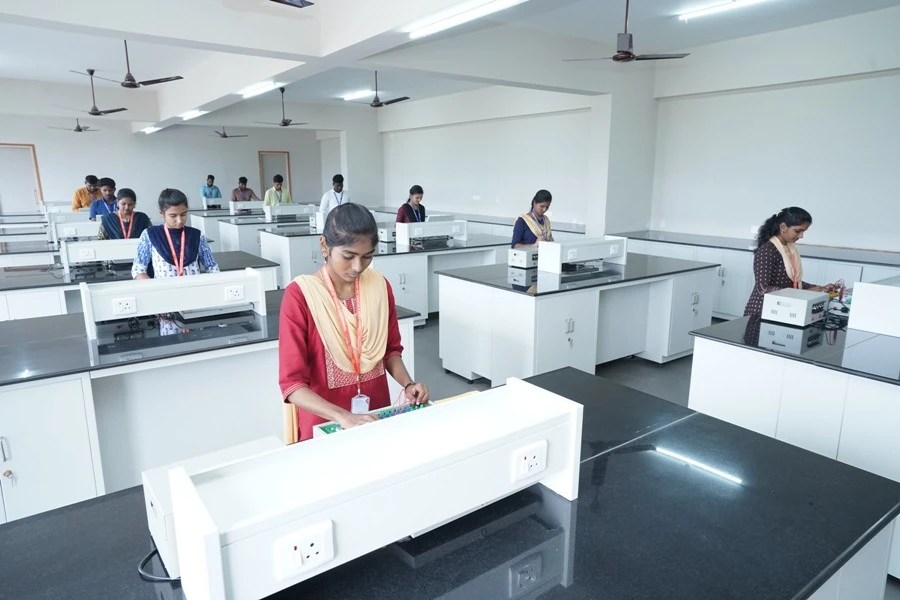
At Takshashila University, you will have ample opportunities to hone your skills in real-world healthcare settings, utilising state-of-the-art medical facilities and simulation labs on our 150-acre campus.








Become an Economist, Financial Analyst, or Economics Professional Join B A Economics Colleges in Tamil Nadu Today
Frequently Asked Questions (FAQs)
- What is B A Economics Admission process in Tamil Nadu?
B A Economics Admission requires 12th pass with any stream, merit-based selection through entrance exams or 12th marks. Colleges conduct merit-based counseling for B A Economics Admission in Tamil Nadu. - What is the B A Economics Fees structure in Tamil Nadu?
B A Economics Fees: Government colleges ₹15,000-₹35,000/year; Private colleges ₹1,00,000-₹3,50,000/year. Total 3-year B A Economics Fees: ₹45,000-₹1.05 lakhs (government) to ₹3-10.5 lakhs (private). - What is B A Economics Eligibility Criteria in Tamil Nadu?
B A Economics Eligibility Criteria: 12th standard pass. Minimum 45-50% aggregate marks. Merit-based selection for B A Economics Eligibility Criteria. - Are B A Economics Scholarships available in Tamil Nadu?
Yes. B A Economics Scholarships include government merit scholarships, SC/ST/OBC category scholarships, and education loans with 8-10% interest. - What is B A Economics Fee Structure payment options?
B A Economics Fee Structure offers annual payment, semester payment options. Education loans available for B A Economics Fee Structure covering full cost with 8-10% interest rates. - Which colleges have best Top B A Economics Colleges with Placement in Tamil Nadu?
Top B A Economics Colleges with Placement: Loyola College Chennai (85%+ placement), Madras Christian College (82% placement), Christ University (88% placement), Presidency College offer excellent economics placement. - What economist and financial analyst roles can I pursue after B A Economics Colleges?
After B A Economics Colleges, pursue Economist, Financial Analyst, Policy Analyst, Business Analyst, Credit Analyst, or Research Economist roles. - What is the average salary for economists after B A Economics Colleges graduation?
B A Economics Colleges graduates earn ₹5-11 lakhs starting salary as economists. With 5-7 years experience: ₹12-22 lakhs. Senior economists: ₹22-35+ lakhs annually. - Are internship opportunities available for B A Economics Colleges students during the program?
Yes. B A Economics Colleges internships with financial institutions, government agencies, research organizations, and corporations. Internship stipends: ₹4,000-₹8,000/month. - Can I pursue M A or postgraduate degrees after B A Economics Colleges?
Yes. B A Economics Colleges graduates eligible to pursue M A Economics, MBA Finance, and specialized postgraduate degrees for advanced economics careers. - What entrance exams are required for B A Economics Admission in Tamil Nadu?
B A Economics typically requires merit-based selection. Some colleges conduct entrance tests. Direct admission based on 12th marks for B A Economics Admission. - How does B A Economics Colleges benefit aspiring economists?
B A Economics Colleges provides economic theory training, financial analysis expertise, policy knowledge—essential for economists in finance and government roles. - What is the duration of B A Economics Colleges undergraduate program?
B A Economics Colleges spans 3 years (6 semesters) with classroom learning, case studies, research projects, analytical work, and mentorship integrated throughout. - Can I pursue international economics opportunities after B A Economics Colleges?
Yes. B A Economics Colleges graduates secure positions with international finance organizations, development banks, and global economic institutions. - What economics and financial skills develop in B A Economics Colleges?
B A Economics Colleges develops: economic theory, financial analysis, econometrics, policy understanding, research methodology—core economics professional skills. - Are government economics positions available after B A Economics Colleges in Tamil Nadu?
Yes. Government positions available for B A Economics Colleges graduates in economics departments, finance ministry, policy research, and government agencies. - What is the future scope of B A Economics Colleges in Tamil Nadu?
Future scope for economists: steady with expanding finance sector, growing policy needs, and economic research demand. - How to pick the best B A Economics Colleges college in Tamil Nadu?
Pick best B A Economics Colleges college: check placement rates (78-88%), average salary (₹5-11 lakhs), research center quality, faculty expertise, alumni success. - What are current industry trends in B A Economics Colleges for Tamil Nadu?
Industry Trends: fintech economics focus, sustainability economics emphasis, behavioural economics integration, data-driven analysis advancement, policy research growth. - Why choose B A Economics Colleges over other degree programs in Tamil Nadu?
Choose B A Economics Colleges: specialized economics training, government job opportunities (78-88%), finance career path, economics expertise, policy contribution, postgraduate advancement options.